
Inside Ottoman Coffeehouses: Work, Conversation, and Everyday Life
Coffee connected Ottoman shops and households to growers, craftspeople, performers, and officials trying to regulate urban gatherings.
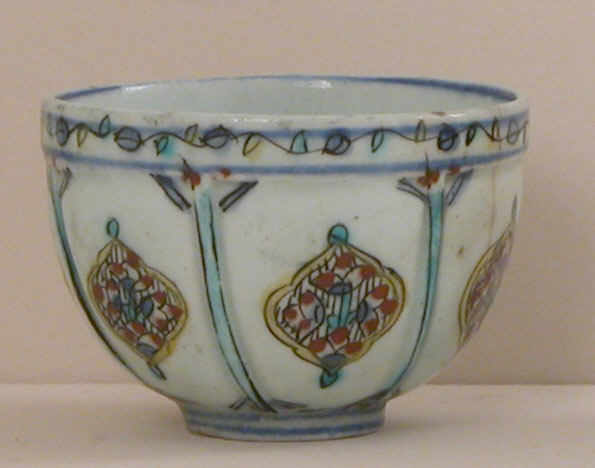
An eighteenth-century coffee cup from Kütahya, now in the British Museum, stands just over five centimeters high. Its painted pomegranates and leaves show that a daily drink could sustain careful decorative work. The cup survives; the conversation once conducted around it does not. That imbalance is characteristic of coffeehouse history. Objects, regulations, paintings, and accounts preserve parts of an ordinary social experience, each through a different filter. The Kütahya cup, G.325
In Ottoman Istanbul, coffeehouses became places where men met, heard news, played, and made contacts outside the household. Coffee also circulated through streets, palaces, and domestic gatherings that included women. Following the drink across those settings reveals a more varied urban life than either an idyllic room of equals or a permanent headquarters of rebellion.
The uncertain date of a familiar institution
Accounts place Istanbul’s first coffeehouses in the 1550s, but do not agree on a single year. The chronicler İbrahim Peçevi associated their arrival with sellers from Aleppo and Damascus in 1554–55; other Ottoman authors gave an earlier date. Peçevi wrote after the event. His story is valuable evidence of how the institution’s beginning was remembered, rather than a surviving license proving the first cup sold in the city. Çaykent and Gürses Tarbuck on coffeehouse origins
That caution need not obscure the larger development. By the later sixteenth century, the coffeehouse had become sufficiently visible to attract both customers and hostile official attention. A new commercial setting was taking shape in the capital, connected to habits that had already developed elsewhere. Its history should begin with those connections, rather than with a legend about a single ingenious founder.
Before Istanbul, a beverage crossed the Red Sea
Coffee’s botanical origin and the history of preparing it as a drink are related but distinct questions. Museum histories place the early growth of the hot beverage in fifteenth-century Yemen and connect its spread with Sufi devotional practice. Staying awake could have a religious purpose before coffee became associated with prolonged sociability in a commercial shop. Detroit Institute of Arts on coffee culture
Michel Tuchscherer’s study describes the emergence of an intensive coffee economy in the later sixteenth century. Farmers cultivated mountain terraces in Yemen, while commercial networks connected ports to Jiddah and Cairo. Those connections supplied distant consumers and made coffee part of exchange between the Indian Ocean and Mediterranean. Coffee in the Red Sea area The everyday availability of the beverage in an Ottoman city rested on cultivation, transport, and merchants who were largely invisible to the person lifting a cup.
From harvest to the shop
The Danish expedition to Arabia provides a closer view of that work in the eighteenth century. A modern study of Peter Forsskål’s observations from 1762–63 follows coffee down to Beit al-Fakih and onward to ports including Mocha and Lohaja. His notes distinguish beans from the surrounding fruit material and shells, describe cleaning for sale, and record customs charges. They show a commodity being sorted, measured, and taxed at successive stages. The Danish expedition’s coffee observations
Such records also discourage treating every preparation called coffee as identical. Different parts of the fruit could support different drinks. The coffeehouse cup was the endpoint of choices about what was grown, cleaned, transported, purchased, and prepared. A familiar urban habit depended on rural labor and commercial standards as well as the skill of the person serving it.

A furnished room with familiar features
Selma Akyazıcı Özkoçak draws attention to similarities between coffeehouse interiors and male reception areas in houses: hearths, raised platforms, and continuous benches along walls. Those arrangements made sitting together possible without reproducing the obligations of being a guest in someone’s household. The room could feel socially familiar while operating as a commercial establishment. Özkoçak on coffeehouse space
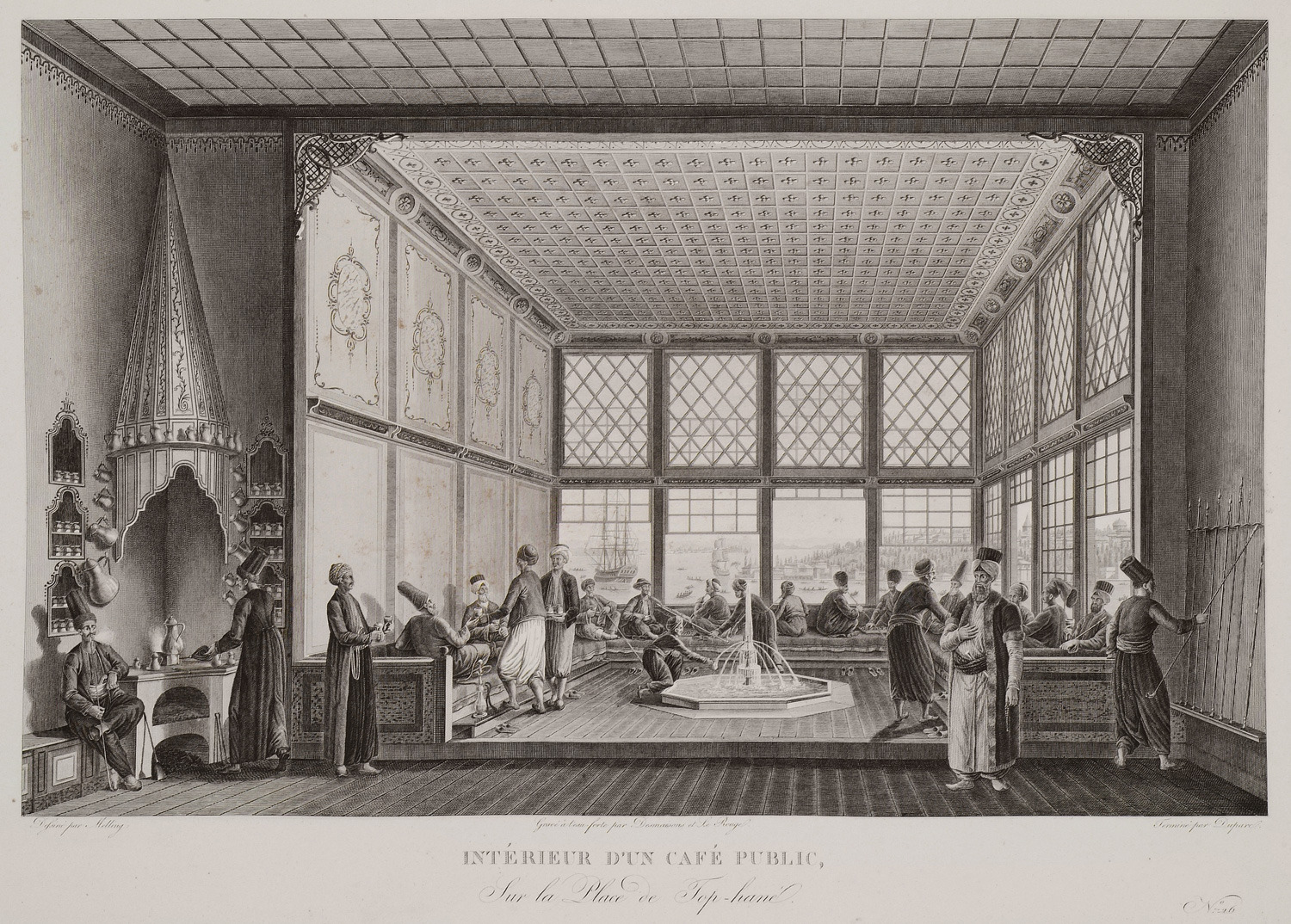
The surviving images must be dated as carefully as the buildings. Antoine Ignace Melling’s large Tophane interior was published in 1819. Its elaborate architecture and furnished seating are later Ottoman evidence, not a view of the first shops in the 1550s. Melling’s Tophane engraving It can help a reader examine how an artist organized people and space, but it cannot establish that all coffeehouses looked alike, or that their interiors remained unchanged for three centuries.
Leisure required performers and work
Studies of early coffeehouse culture identify books, poetry, musical instruments, games, trays, grinders, and cups among its material equipment. Storytellers, musicians, servers, and coffee makers helped produce the experience patrons purchased. Chess and backgammon could attract participants and spectators; poetry could be recited and assessed in company. Karababa and Ger on coffeehouse activities
These activities divided the room into people doing different kinds of work and play. The listener enjoying a performance depended on somebody capable of holding an audience, while the server continued moving through a gathering whose members might remain seated. A history of sociability needs to keep that labor visible alongside the pleasure of the customer.
Meeting people could mean finding a livelihood
Cengiz Kırlı’s long-term study emphasizes that coffeehouses supported commercial and occupational activity as well as recreation. They could be places to arrange business, hire labor, and make connections useful to newcomers in the city. Migration networks sometimes provided shelter through such establishments. These functions developed across a long history and should not all be projected back onto every sixteenth-century shop. Kırlı on leisure and sociability
The importance of a particular establishment depended partly on who already used it. Knowing where workers, employers, or people from a familiar place gathered could make entry into a large city more manageable. That practical function complicates the official description of coffeehouse time as mere idleness. To an observer outside the network, sitting and talking might look unproductive; to a newcomer, the same activity could create access to information or work.
News did not wait for a newspaper
Conversation and collective reading connected coffeehouses to a wider urban culture. Serkan Şavk notes that reading aloud occurred in houses, mosques, village rooms, and coffeehouses. A written text could therefore acquire an audience larger than the number of people capable of reading it privately. Information moved through voices and meetings as well as through books. Şavk on public and private space
Historians debate whether these practices created a “public sphere,” a term often associated with European political history. The useful question is less whether Istanbul fits a predetermined European sequence than how people actually encountered one another. A house could host a gathering with public significance; a commercial room could contain tightly bounded groups. Neither a doorway nor the sale of coffee automatically erased differences of status, occupation, religious affiliation, or familiarity.
Why officials objected
Hostile documents often explain more about official anxieties than about the conduct of every customer. A 1578 order to Bursa, discussed by Karababa and Ger, associated coffeehouses with neglected work, games, intoxicants, and rumor. Its accusations should be read as part of an effort to regulate gathering. They are not a statistical description of what normally occurred in every shop. The Bursa decree and its interpretation
Closures also responded to particular crises. Özkoçak discusses Murad IV’s prohibitions after Istanbul’s great fire of 1633, while noting that the fire began in a caulker’s shop. Blaming or restricting coffeehouse activity was therefore not equivalent to demonstrating that a coffeehouse had caused the disaster. The 1633 prohibitions Regulation could concern public order, political criticism, and the use of urban space as well as objections to the beverage itself.
The recurrence of prohibitions is evidence of continuing conflict over the institution. It should not be converted into a timeless picture of either complete state control or uninterrupted popular freedom. Enforcement, tolerated practice, and the circumstances behind a particular order all mattered.
Women drank coffee beyond the public shop
The predominantly male character of the coffeehouse did not make coffee an exclusively male drink. Jean Baptiste Vanmour’s painting of a maternity visit, dated by the Rijksmuseum to about 1720–37, shows coffee being prepared on a brazier within a wealthy household. Refreshment belongs to a visit involving women, with service work embedded in the composition. The museum identifies an enslaved woman preparing sorbet at the left. Lying-in Room of a Distinguished Turkish Woman
The image is a representation produced by an artist, not a transcript of a universally typical visit. Even so, it directs attention to a social setting absent from histories restricted to male coffeehouses. Domestic hospitality required vessels, fuel, preparation, and labor. For the wealthy, it might involve enslaved workers. Gender and status shaped who received refreshments, who served them, and which gatherings became visible to later observers.

The cup was also a manufactured commodity
Kütahya became an important center of coffee-related ceramics in the eighteenth century. LACMA’s account describes tableware sold within the empire and exported to Europe, with decorative tastes connected to wider exchanges. Coffee sets might include cups, saucers, and pots; elite hospitality could add trays, cloths, incense, and rosewater equipment. LACMA, Culture in a Cup
These objects offer evidence of differentiation. An ornate service reveals what some households acquired, not what every customer in a neighborhood shop possessed. The Met attributes the illustrated eighteenth-century cup-and-saucer set to Kütahya and connects such vessels with reception rooms in upper-class Ottoman Syrian homes. Its stonepaste body was decorated in several colours beneath transparent glaze. Those details establish material and classification; they do not recover each occasion on which this particular cup was filled. Keeping the museum’s attribution visible prevents a surviving luxury object from becoming a universal portrait of Ottoman drinking. The Met’s cup-and-saucer record
Images carried the habit abroad
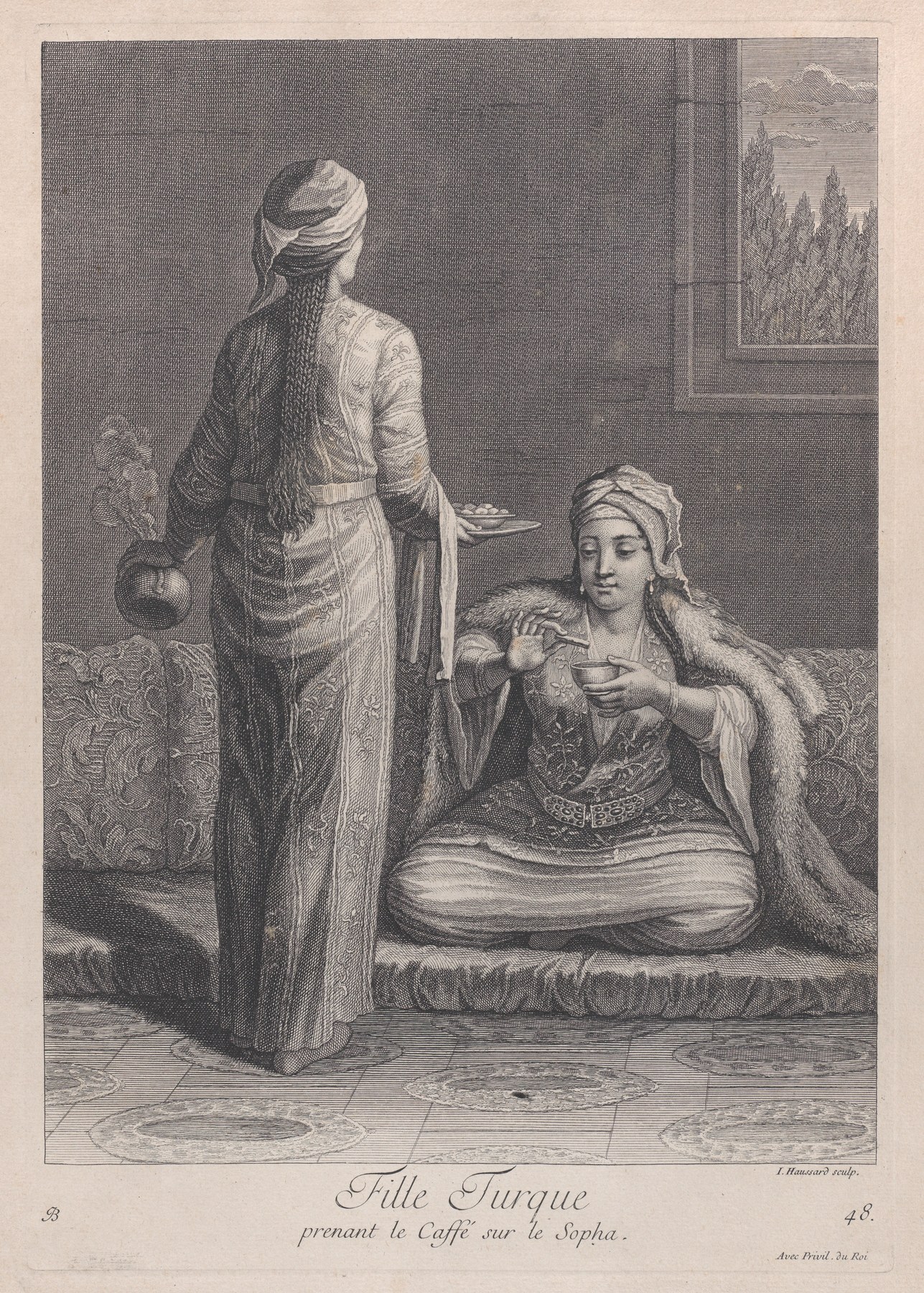
An engraving in the Metropolitan Museum, made in 1714–15 after Vanmour and executed by Jean-Baptiste Haussard, depicts a Turkish woman taking coffee on a sofa. Its place in a published series about peoples of the Levant matters. The image reached viewers through selection, translation into print, and commercial publication. Clothing, vessels, and gestures became elements of a European presentation of Ottoman life. The Met’s print record
Knowledge traveled through texts too. Duygu Yıldırım’s study of Luigi Ferdinando Marsigli’s Bevanda asiatica, published in 1685, shows his reliance on the Ottoman scholar Hezarfen Hüseyin’s account of coffee. Marsigli also drew on experience in Ottoman lands, including work as an enslaved cook. Bevanda asiatica and scholarly exchange The transfer of coffee knowledge was therefore shaped by learned cooperation and unequal personal circumstances, as well as commerce.
A shared drink, different social arrangements
At a V&A scholarly discussion, coffee appears as an example of Ottoman practices that European consumers sometimes valued precisely because of their Ottoman associations. V&A, Where was Europe? Yet adoption produced new objects and settings. The Met’s eighteenth-century French coffeepot illustrates a technical response to finely ground coffee: a high spout helped leave settled grounds behind when the drink was poured. Charles Donze’s coffeepot The vessel joined a transferred preparation method to a particular tradition of European metalwork.
Ottoman coffeehouses belong in that connected history without being reduced to a prelude to London or Paris. Their own story includes Yemeni growers, port merchants, shopkeepers, performers, workers seeking contacts, officials attempting regulation, and households arranging hospitality. The small decorated cup is an entry into these relationships. Understanding them requires placing the surviving object beside records of supply, labor, gathering, and dispute, rather than filling its silences with an invented conversation.
Sources and further reading
- British Museum, eighteenth-century Kütahya coffee cup, G.325
- Özlem Çaykent and Derya Gürses Tarbuck, Coffeehouse Sociability: Themes, Problems and Directions, Journal of Ottoman Studies 49(2017),203–229
- Detroit Institute of Arts, Celebrating Coffee Culture and Islamic Art
- Michel Tuchscherer, Coffee in the Red Sea Area from the Sixteenth to the Nineteenth Century, in The Global Coffee Economy(2003)
- Ib Friis, Coffee and qat on the Royal Danish expedition to Arabia: observations in Yemen 1762–1763, Archives of Natural History 42(2015)
- Selma Akyazıcı Özkoçak, Coffeehouses: Rethinking the Public and Private in Early Modern Istanbul, Journal of Urban History 33(2007),965–986
- Eminegül Karababa and Güliz Ger, Early Modern Ottoman Coffeehouse Culture and the Formation of the Consumer Subject, Journal of Consumer Research 37(2011),737–760
- Cengiz Kırlı, Coffeehouses: leisure and sociability in Ottoman Istanbul
- Serkan Şavk, Doors, privacy and the public sphere: a conceptual discussion on the spatial structure of early modern Istanbul, Urban History(2022)
- Rijksmuseum, Jean Baptiste Vanmour, Lying-in Room of a Distinguished Turkish Woman, SK-A-2003
- LACMA, Culture in a Cup(2024)
- Metropolitan Museum of Art, Haussard after Vanmour, Fille Turque prenant le Caffé sur le Sopha, 2019.282.57
- Duygu Yıldırım, Bevanda asiatica: Scholarly Exchange between the Ottomans and Europeans on Coffee, Journal of Ottoman Studies 56(2020)
- Victoria and Albert Museum, Transcript: Salon I, Where was Europe?
- Metropolitan Museum of Art, Charles Donze, Coffeepot,1768–69
- Wikimedia Commons, Melling, Intérieur d’un café public sur la place de Top-hané,1819
- Metropolitan Museum of Art, Cup and Saucer, eighteenth century, 06.338a, b