
WORLD WAR II · EASTERN FRONT
Kursk: The Campaign Beyond the Tank Battle
From the minefields around Kursk to the return to Kharkov, the summer campaign of 1943 was decided by far more than the tanks at Prokhorovka.
Before dawn on 5 July 1943, German troops prepared to attack the Soviet lines around Kursk. Ahead of them lay minefields, trenches and guns placed to cover the likely approaches. Behind those positions waited more troops and tanks. The Germans had spent months assembling their striking force. The Red Army had spent the same months preparing to meet it.
The fighting would produce the celebrated tank battle at Prokhorovka. But Kursk’s outcome took shape over a much larger area, from the stubborn defense of Ponyri in the north to the Soviet return to Kharkov in August.
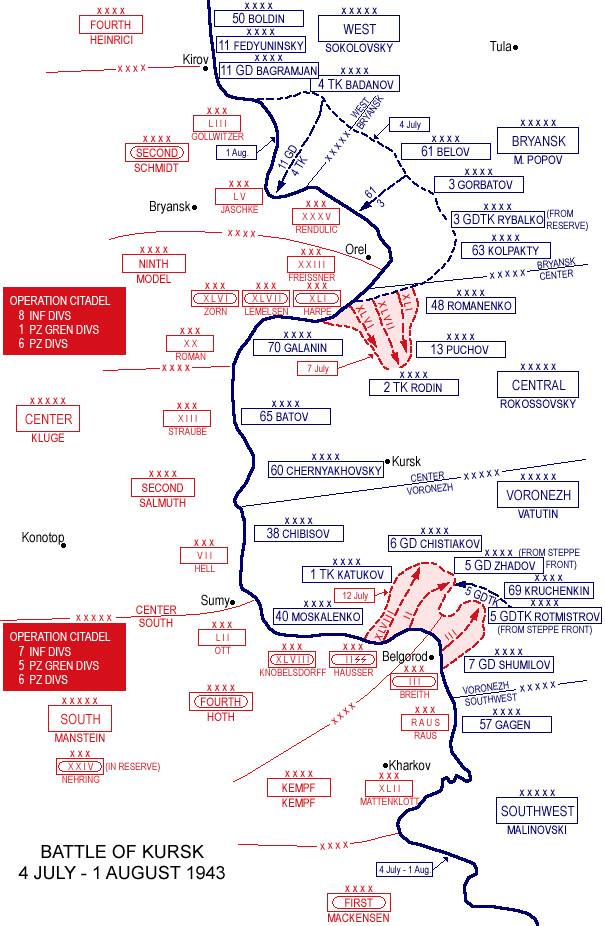
A bulge on the map
The front had acquired its awkward shape during the winter after Stalingrad. Soviet advances carried the Red Army west, but a German counterattack recaptured Kharkov in March 1943. When the spring thaw slowed operations, Soviet troops still held a broad bulge around Kursk. Soldiers called such a projection into enemy-held territory a salient.
German forces stood on both shoulders of the bulge: near Orel to the north and Belgorod to the south. Operation Citadel aimed to slice it off. Walter Model’s Ninth Army would drive south; Hermann Hoth’s Fourth Panzer Army would push north, with Army Detachment Kempf guarding its eastern side. If the two attacks met, the Soviet armies inside would be surrounded.
That plan offered Hitler a chance to recover from the winter’s defeats and regain control of the campaign. It also presented Soviet commanders with a fairly obvious target to defend. Success depended on the Germans breaking through quickly enough to stop the defenders moving reserves into their path.
The months before the attack
The attack was repeatedly postponed. German commanders waited for replacements and additional tanks, including the new Panther. Every delay gave their opponents more time to dig. Soviet intelligence, reconnaissance and the shape of the front all pointed toward an attack on the salient.
Stalin’s commanders chose to absorb the assault before launching their own major offensives. Konstantin Rokossovsky’s Central Front defended the northern sector. Nikolai Vatutin’s Voronezh Front held the south. A Soviet “front” was a command grouping several armies. Behind them, Ivan Konev’s Steppe forces formed a large reserve: troops held back so they could be sent where they were most needed.
Soldiers and civilians dug trenches and anti-tank ditches. Engineers laid mines. Guns were positioned to fire into gaps through which tanks might pass. A minefield could slow a tank or turn it toward a gap covered by anti-tank guns. Infantry protected those guns against soldiers trying to overrun them. Defenses extended behind the forward positions, so an attacker breaking one line would face another. As David Glantz’s study of the defenses explains, mobile reserves were part of the system: they could reinforce a threatened sector or counterattack a penetration.
Keeping the reserves intact required difficult decisions. Sending them forward too early could use up the forces needed for the planned counteroffensive. Waiting too long could let a German breakthrough grow beyond control. Soviet commanders would have to judge that danger from incomplete reports as the fighting developed.
These preparations did not make the defenders invulnerable. Men in the forward positions would still have to withstand concentrated artillery, bombing and armored assaults. The deeper lines were meant to keep a local defeat from opening the whole road to Kursk.
Powerful tanks, difficult ground
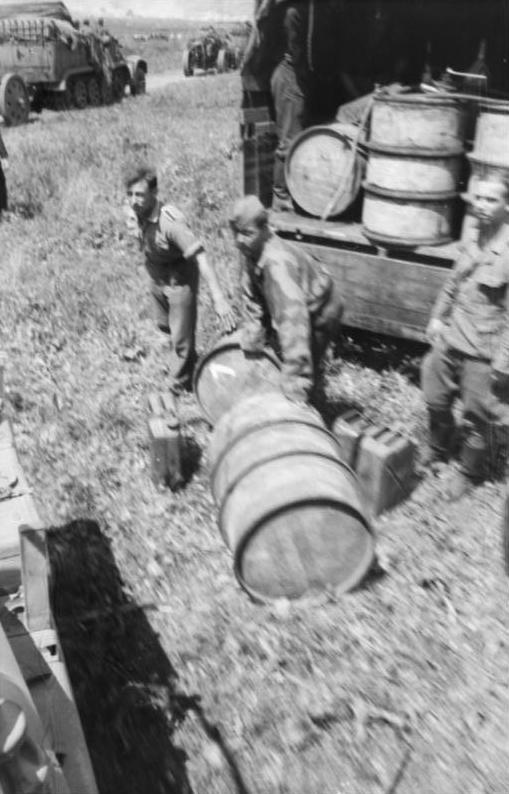
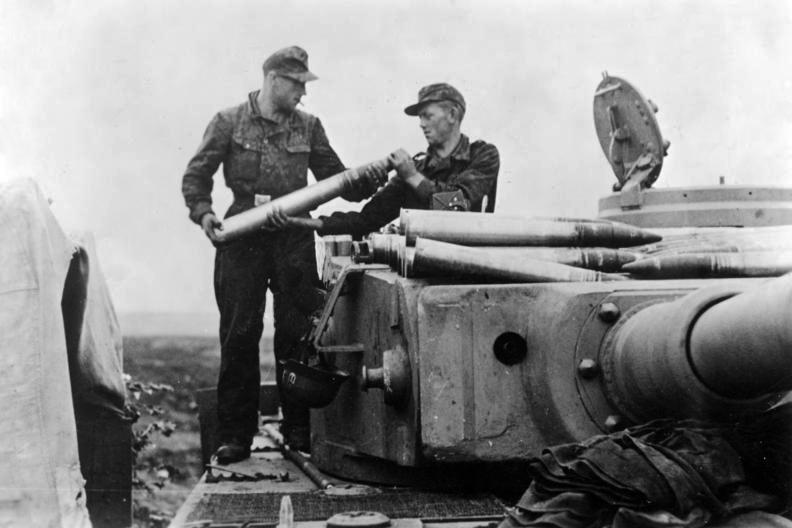
The German attacking force carried some formidable weapons. The Tiger’s gun and armor made it dangerous at long range. The Panther also had a powerful gun, but its hurried introduction brought serious mechanical problems. Many vehicles became unavailable without being destroyed by enemy fire.
Most of the work still depended on a mixture of equipment: older German tanks, assault guns with heavy weapons mounted on armored chassis, artillery, trucks and engineering vehicles. Infantry had to clear positions that armor could pass but could not safely leave behind. Engineers needed protection while they opened routes through obstacles. A disabled heavy tank could block a passage until a recovery team moved it.
Soviet armor was mixed too. The familiar T-34 fought alongside the smaller, more lightly armed T-70 and other types. The T-34-85, with its larger gun, belonged to a later stage of the war. The Tank Museum’s study of German tanks and its companion study of Soviet vehicles help explain why a simple count of tanks tells so little about the forces confronting one another.
5 July: the northern attack slows
The main offensive began on 5 July, following preliminary fighting in the south the day before. Model’s troops broke into the northern defenses, then ran into increasingly hard resistance. Around Ponyri railway station and the heights near Olkhovatka, German formations fought for ground that the Soviets could reinforce and cover with artillery.
The task was slow and dangerous. Infantry, tanks, guns and engineers had to work together to open each route. Soviet counterattacks could force the Germans to halt and fight before they reached the next defensive belt. Capturing a village or a ridge might improve the immediate position while leaving another obstacle ahead.
As the days passed, Ninth Army’s advance lost momentum. This was a problem for the whole German operation. Citadel required two attacking arms to close around the Soviet forces. The northern arm was becoming stuck, even as Hoth’s troops were making more threatening progress in the south.
The southern battle reaches Prokhorovka
Vatutin faced a harder emergency. German armored formations penetrated farther into his defenses, forcing him to shift reserves toward the danger. The fighting spread across neighboring routes rather than following a single straight road north. Progress by one German formation could leave its side exposed when another lagged behind.
As the threat developed, Soviet commanders brought forward Pavel Rotmistrov’s Fifth Guards Tank Army. These troops had been held behind the front; now they were needed to stop a breakthrough. They moved toward Prokhorovka, where railways, river valleys and defended positions restricted the room available for maneuver.
On 12 July Soviet tanks attacked the German II SS Panzer Corps, a formation of armored divisions. The counterattack suffered severe losses and failed to achieve the destruction of the German force. German troops retained important sections of the battlefield, helping them recover damaged vehicles. The Red Army’s eventual victory at Kursk should not conceal how badly this particular attack went.
What the famous tank battle actually decided
Later accounts turned Prokhorovka into a vast, head-on collision that shattered German armor. Research in unit records has overturned that picture. The Tank Museum’s review shows how totals change when writers include different neighboring formations or use different meanings of “lost.”
A tank knocked out during fighting might be repairable. A vehicle recorded as damaged one evening might return to action later, or be abandoned during a retreat. Comparing one army’s permanent write-offs with another’s vehicles temporarily out of action creates a misleading score.
German aerial photographs studied by historian Ben Wheatley add evidence of Soviet wrecks and the restricted terrain. Other historians, including Roman Töppel, have disputed some of the conclusions drawn from that evidence. The sound broad finding is that the Soviet counterattack was much more costly than the heroic legend allowed. Precise totals remain dependent on definitions and sources.
Yet the German corps’ survival did not put Citadel back on course. Its original purpose was to surround the armies around Kursk. By 12 July the northern attack had stalled, and Soviet forces were opening another battle behind it.
12 July: the fighting turns toward Orel
That same day, Soviet troops launched Operation Kutuzov against the German salient around Orel. Attacks from the north and east threatened the region supporting Model’s offensive. Rokossovsky’s forces subsequently joined from the south. German commanders now had to find troops to defend the ground from which their attack had begun.
At a conference on 13 July, Hitler moved to end Citadel. The Allied landing in Sicily three days earlier added another urgent demand. Erich von Manstein, commanding Army Group South, argued for continuing the southern battle and was allowed further limited operations. But the two-pronged drive toward Kursk was breaking down.
Sicily therefore belonged to the decision, alongside the stalled northern attack and the new Soviet threats. It did not interrupt an otherwise completed victory. The Germans had not closed the salient, and their opponents still possessed forces capable of attacking elsewhere.
The Soviet advance on Orel was itself hard fought. German defenses delayed it, and the withdrawal west took time. Orel returned to Soviet control on 5 August. The Germans withdrew toward the Hagen defensive line farther west. As that withdrawal continued, they gave up the northern bulge that had helped make Kursk vulnerable in the spring.
August: on to Belgorod and Kharkov
The southern Soviet offensive, Operation Rumyantsev, opened on 3 August. Belgorod fell two days later, on the same day as Orel. The Red Army was now advancing beyond the positions from which the German attack had started a month earlier.
German armored units remained dangerous. Counterattacks around Bogodukhov and Akhtyrka damaged Soviet formations and disrupted their progress. The campaign did not become an effortless pursuit once Citadel ended. Soviet commanders had to replace losses, bring supplies forward and keep their advances connected.
On 23 August Soviet troops recovered Kharkov, now Kharkiv. That date conventionally closes the wider Kursk campaign. From there the summer fighting carried the Red Army toward the Dnieper.
The sequence explains Kursk’s importance better than any claim about the world’s largest tank battle. The Germans had gathered a major striking force, attacked a position their enemy had prepared, and failed to cut it off. The Soviets then launched offensives on both sides of that position. By late August, German commanders were fighting to preserve a retreating front rather than choosing where to begin their next major attack.
Sources and further reading
- David M. Glantz, Soviet Defensive Tactics at Kursk, July 1943 (Combat Studies Institute, 1986)
- The Tank Museum, Background to the Battle of Kursk
- The Tank Museum, German Tanks at Kursk
- The Tank Museum, Soviet Tanks at Kursk
- The Tank Museum, Prokhorovka and the Myth of the Largest Tank Battle
- Claudio R. Innocenti, Battle Analysis: Operation Citadel (Kursk), ARMOR, March–June 2014
- Ben Wheatley, A Visual Examination of the Battle of Prokhorovka, Journal of Intelligence History 18, no. 2 (2019)
- Roman Töppel, Die Panzerschlacht bei Prochorowka: Fakten gegen Fabeln (2019)
- Christopher A. Lawrence, Kursk Aerial Photos (The Dupuy Institute, 2019)
- Earl F. Ziemke, Stalingrad to Berlin, chapters VII–VIII (U.S. Army Center of Military History, 1968)
- Earl F. Ziemke, The First Soviet Summer Offensive, chapter VIII
- David M. Glantz and Jonathan M. House, The Battle of Kursk (University Press of Kansas, 1999)
- Michael D. Krause and R. Cody Phillips, eds., Historical Perspectives of the Operational Art (U.S. Army Center of Military History, 2005)