
Warsaw 1944: Why Allied Aid Could Not Save the Uprising
Flights from Italy and Britain carried help to Warsaw, but political refusals, German fire and shrinking drop zones kept that help from becoming a lifeline.
On the night of 17 August 1944, two ambassadors argued with Soviet Foreign Minister Vyacheslav Molotov about aircraft trying to reach Warsaw. What, they asked, should happen if a British plane carrying supplies was damaged and could not make the long journey home? According to the American ambassador's subsequent report, Molotov would accept the crew parachuting onto Soviet territory. He would not agree to let the aircraft land. The distinction was extraordinary: an ally might shelter the airmen while withholding the airfield that could help them complete their mission. [1]
Inside Warsaw, the uprising against German occupation was already more than two weeks old. Its defenders needed weapons, ammunition and medical supplies. Getting those things to them required aircraft to cross Europe, find a patch of friendly ground in a burning city, and return safely. It also required cooperation among governments that shared an enemy but disagreed over Poland's future. The distance between those governments' priorities would become as consequential as the distance the bombers had to fly.
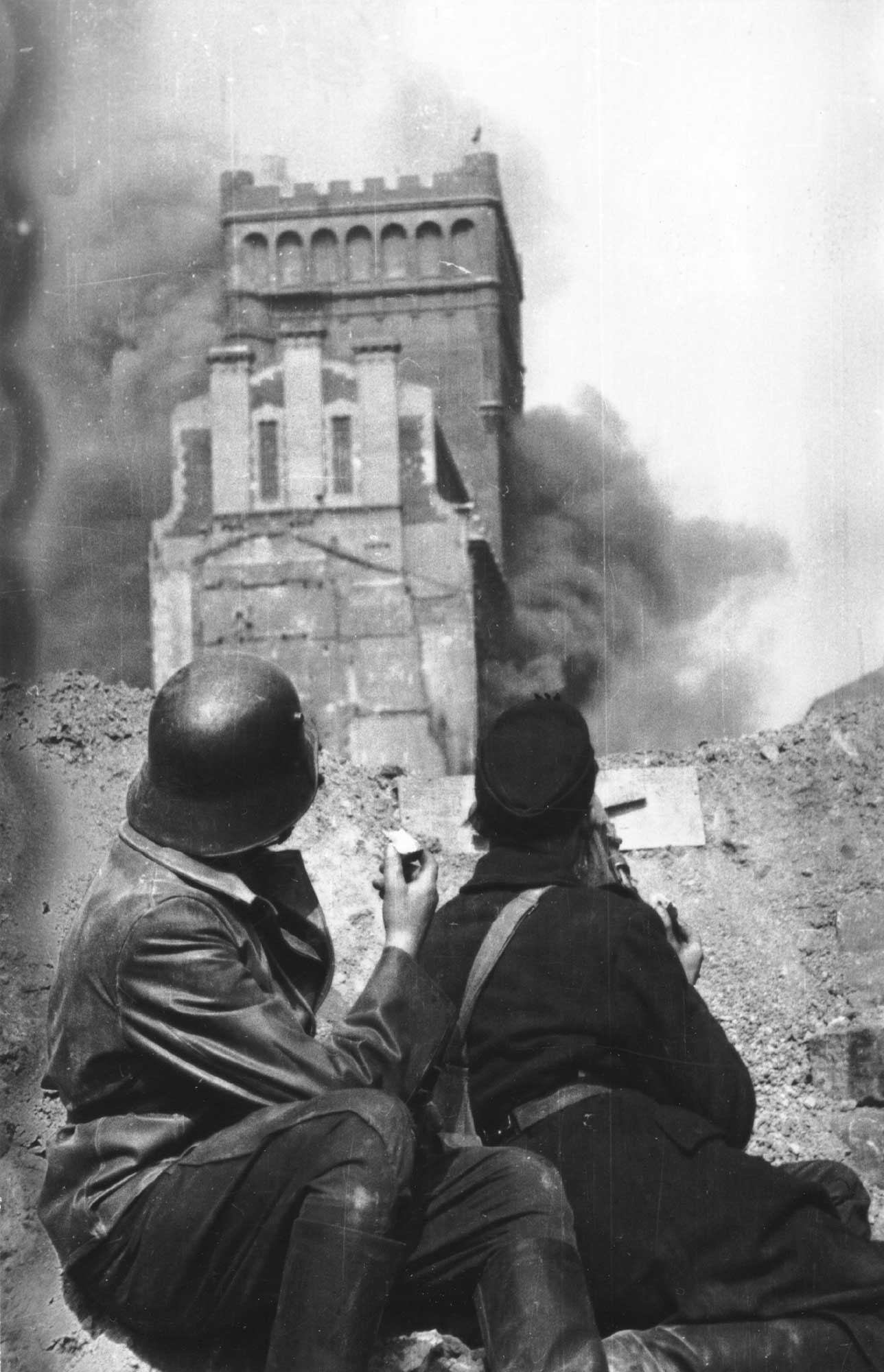
A capital that could not wait
The Home Army, known by its Polish initials AK, answered to the Polish government-in-exile in London. Its leaders intended to fight the retreating Germans and establish Polish authority before the arriving Red Army could determine who governed the liberated country. Operation Tempest put that intention into action across occupied Poland. Experience elsewhere had already shown the danger: cooperation with Soviet troops against Germany could be followed by the disarming and arrest of Home Army personnel. A shared battlefield did not secure recognition of an independent Polish state. [2]
Warsaw had initially been excluded from the plan. The rapid Soviet advance in the summer of 1944 changed the calculations of the underground leadership. A rising in the capital might demonstrate that the government-in-exile represented a functioning authority at home. Waiting seemed to risk surrendering that claim; acting meant depending on military developments beyond the AK's control. This was a decision made under pressure, but its political urgency could not supply the weapons the fighters lacked. [2]
The uprising began on 1 August and lasted until the capitulation of 2 October. It was distinct from the Warsaw Ghetto Uprising of April and May 1943, when Jewish resistance fighters confronted the Germans' attempt to complete the ghetto's destruction. The United States Holocaust Memorial Museum estimates that roughly 45,000 Home Army members participated in the 1944 uprising, with only about a quarter initially armed. That imbalance helps explain why assistance from outside mattered from the opening days. [3]
The AK gained control of substantial areas, but not an intact city with secure approaches and an uninterrupted supply network. Streets, buildings and districts became contested boundaries. Insurgents could win a local engagement while remaining cut off from the resources needed for a prolonged battle. The expectation that Soviet arrival would soon transform their position made the gap between short-term hope and long-term endurance particularly dangerous.
Daily life became part of the battle
A photograph by Eugeniusz Lokajski shows an improvised field kitchen in early September. Three members of the Koszta company stand around a small stove. Zofia Domańska, the photographer's sister, is among them. The picture records a routine that had become essential military work: finding and preparing food for people who could no longer rely on ordinary city life. It is also a reminder that the uprising was sustained by identifiable individuals, not an abstract force waiting for rescue. [4]
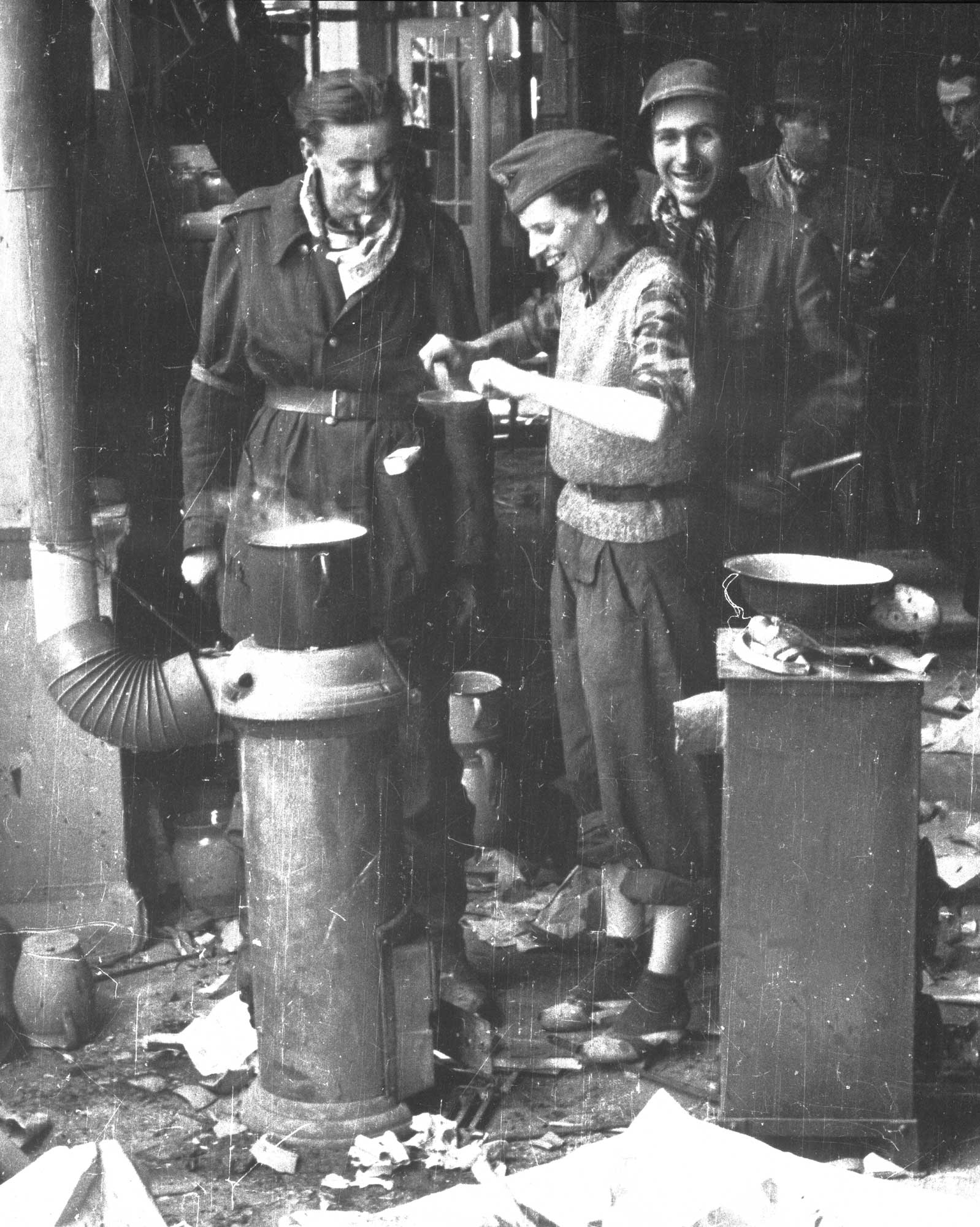
Women served as combatants, nurses, messengers and organizers. Civilians made shelters, cared for wounded people and helped keep communications working. As the National WWII Museum's study of civilian experience shows, the first days' enthusiasm did not prevent exhaustion, fear or anger as the battle lengthened. Families were separated and homes destroyed. Maintaining resistance meant asking an increasingly vulnerable population to continue living inside the battlefield. [5]
German forces imposed that catastrophe through bombardment, assault and deliberate mass killing. The Wola massacres were not an accidental consequence of confused fighting: civilians were murdered as German units suppressed the uprising. The violence must remain central to an explanation that also examines Allied decisions. Diplomatic failure restricted the possibilities of relief; German forces were responsible for crushing the city and killing its inhabitants. [17]
Water and food became urgent problems as the defenders lost territory. The Museum of Warsaw's account describes how the failure to secure the water-pumping stations left inhabitants exposed to German control of the supply. Losing food stores made survival still harder. A district could have determined fighters and functioning barricades while lacking the necessities that allowed either soldiers or civilians to hold out. [7]
The long journey from Italy
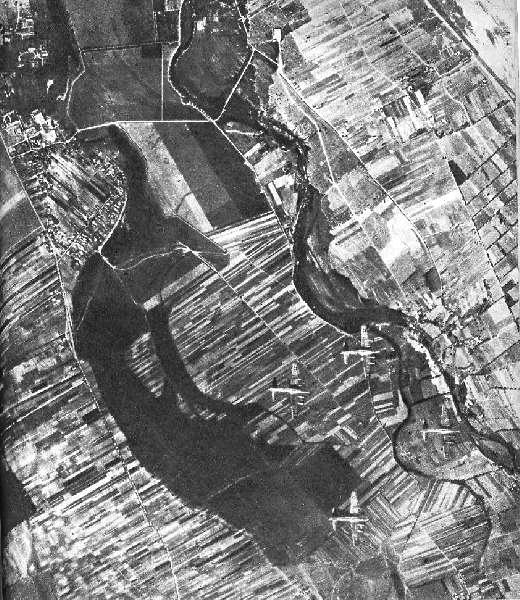
Polish and Commonwealth crews began flying supplies from southern Italy. Liberators and Halifaxes carried cargo over hostile territory on journeys the Warsaw Rising Museum describes as roughly 3,000 kilometers for the round trip. The operation involved Polish, British and South African airmen, alongside personnel from other Allied countries. These were long missions undertaken for a city that offered no friendly landing ground at the destination. [8]; [16]
The journey imposed choices before a crew even reached Warsaw. Fuel for the return leg occupied carrying capacity. Night flying offered some concealment but made navigation and the identification of dropping grounds difficult. Close to the city, fires and smoke complicated an approach threatened by searchlights and anti-aircraft weapons. Flying low could improve delivery accuracy while bringing a large aircraft within reach of the defenses. [16]
The Warsaw Rising Museum preserves airmen's recollections of the city burning beneath them. Their testimony gives the operation a human scale, but the central logistical problem needs no imagined cockpit scene. Reaching Warsaw was one achievement; delivering usable supplies to the people holding it was another. A container that fell beyond an insurgent position could become unavailable or benefit the enemy. The diminishing area held by the AK made successful recovery more difficult just as its need increased. [8]
The crews' effort therefore cannot be measured only by aircraft dispatched or loads dropped. What mattered inside Warsaw was the amount recovered, distributed and used before the next German attack. Courage could carry a bomber across the intervening countries. It could not enlarge a dropping zone or prevent the ground beneath it from changing hands.
The airfields were a separate decision
The military situation east of Warsaw was complicated. Soviet armies had advanced a great distance, their formations were dispersed, and German counterattacks remained formidable. Jennifer Popowycz's account for the National WWII Museum cautions against treating the Red Army as a fully prepared force capable of an effortless crossing of the Vistula in early August. Being near the city did not mean that every condition for liberating it had been met. [9]
But permission to land Allied aircraft was not the same problem as mounting an immediate ground offensive. In August the Soviet government refused the use of its territory for the supply operation. Harriman's report of the meeting with Molotov records hostility toward the uprising's leadership and a determination to avoid association with it. The refusal was expressed in political terms, even as the ambassadors explained the practical risks it imposed on aircrews. [1]
Washington pressed for reconsideration. An instruction to Harriman authorized him to approach Stalin or Molotov and urge cooperation with a supply operation using the existing shuttle-bombing arrangements. The document also stated that American forces intended to provide feasible assistance even without Soviet agreement. It captures both a willingness to help and the limits of declarations made far from the receiving ground. [10]
By 4 September, Churchill was warning Roosevelt that the refusal of airfield facilities threatened more than the immediate operation. It could destroy the position of Polish Prime Minister Stanisław Mikołajczyk and damage hopes for a political settlement. Britain's War Cabinet understood Warsaw as a crisis in the alliance itself. Yet recognizing those stakes did not give London the power to compel Soviet cooperation. [11]
Permission arrived as the city contracted
The position changed in September. Soviet aircraft began dropping supplies, Soviet and Polish forces captured Praga on the Vistula's east bank, and troops of the Soviet-subordinate First Polish Army attempted to cross to the insurgents. Those crossings failed to establish a lasting relief of the uprising. The Institute of National Remembrance's chronology places this assistance in the final weeks, when German pressure had already greatly reduced the resistance's position. [12]
The American mission of 18 September offered a different scale of air support. More than a hundred B-17s flew from Britain, with permission to continue to Soviet airfields. Fighter opposition still exacted a cost: the Warsaw Rising Museum records the loss of one bomber and two escorting Mustangs. The large formation and its parachutes made help unmistakably visible, but visibility was an uncertain guide to what the defenders received. [13]
That distinction survives in the American diplomatic record. Ambassador John Winant informed Roosevelt that 107 aircraft had dropped supplies in clear weather after earlier weather delays. An editorial note accompanying the telegram gives a less encouraging measure: of 1,284 containers, no more than 288, and possibly as few as 130, reached Polish hands. Other accounts use different totals, but the record clearly distinguishes the mission's completion from the recovery of its cargo. A proposed second American mission did not receive Soviet clearance. [14]
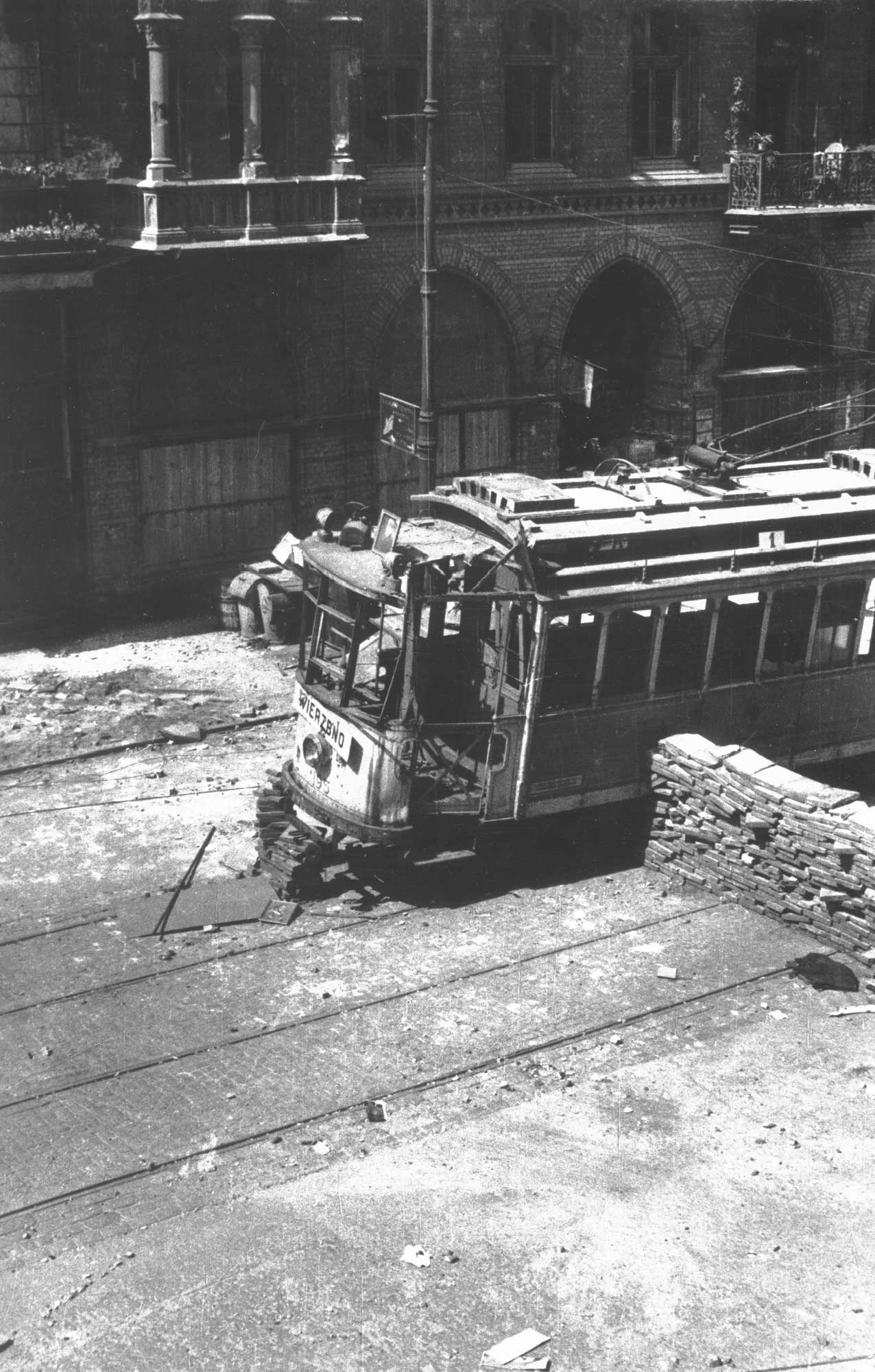
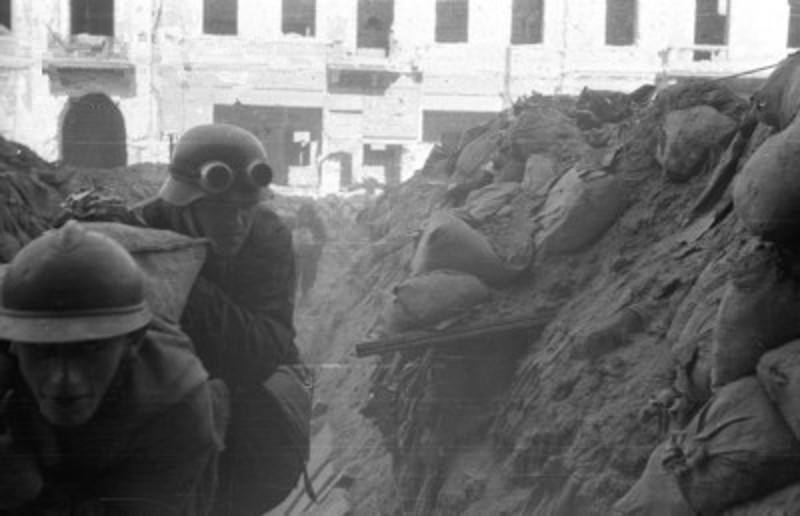
Late deliveries could sustain particular units without repairing the city's overall position. A successful drop still required a secure place to fall, people able to recover it, and routes by which its contents could reach those in need. Warsaw was losing those conditions. A photograph of the protected passage across Aleje Jerozolimskie shows how even movement within insurgent-held districts required improvised defenses against German fire. [15]
What relief could not replace
The Home Army capitulated on 2 October after 63 days. German forces expelled the remaining civilian population and continued the systematic destruction of Warsaw. Soviet and Polish troops entered the devastated city in January 1945. Estimates of civilian deaths during the uprising vary, but the losses reached well into six figures. They included people deliberately murdered as well as those killed by bombardment and fighting. [3]; [6]
The uprising's defeat does not make every attempted delivery meaningless. Nor does the existence of those deliveries establish that Warsaw received adequate support. Aid arrived through a fragile sequence of decisions and operations, any one of which could reduce its value before it reached a barricade or hospital. The insurgents needed that sequence to work repeatedly while their territory was shrinking.
Earlier and greater assistance might have changed the battle. It cannot be treated as proof of a rescue that never occurred. What the evidence does establish is that military constraints and political obstruction operated together, while Germany retained the force to destroy the uprising. Aircrews risked their lives to reach Warsaw. They could carry supplies across Europe, but they could not give the city the secure ground connection or Allied agreement on which its survival ultimately depended.