
Power & Politics
The Tally Sticks That Burned Parliament: Trust, Accounts and the Fire of 1834
For centuries, a split piece of wood could help prove a payment to the English Crown. The disaster that made tally sticks famous began after their accounting work was over.
On 16 October 1834, workmen at Westminster were disposing of old wooden accounts. Two cartloads of Exchequer tally sticks had become an administrative encumbrance. Burning them in the stoves beneath the House of Lords was supposed to finish a clearing-out job. That evening, fire spread through the parliamentary complex.
The sticks are remembered because their destruction helped destroy Parliament’s home. But the joke about a government burning down its own buildings can obscure the more interesting question. Why had pieces of notched wood been trusted with public money in the first place?
A tally was a way of carrying evidence between people and offices. Its shape, writing and matching counterpart could help establish that a transaction had occurred. Understanding that system makes the fire more revealing: a technology built around careful comparison ended its working life in a disposal operation that paid too little attention to its surroundings.
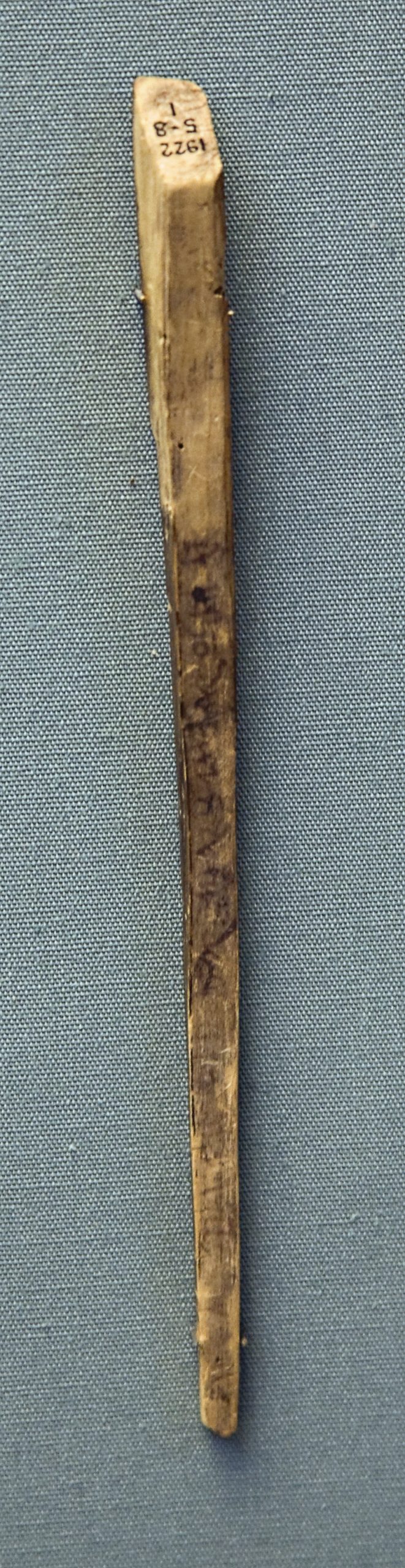
A record made to be separated
A split tally began as one piece of wood. An amount was recorded in notches, with written information identifying the transaction. The stick was divided lengthwise, leaving corresponding marks on two pieces. The National Archives’ glossary describes the basic arrangement: one half went to the person paying the Exchequer, while the other remained there.
The force of the device lay in its future reunion. A claimant did not arrive with an unsupported statement of what had been paid. The wood could be compared with a piece already held by the receiving institution. Matching notches and the split surface made an alteration on only one side easier to detect.
This did not make fraud physically impossible. It supplied a practical check which officials could perform. A missing counterpart, an incorrectly made tally or an entry attributed to the wrong account still created problems. Trust depended on custody and procedure as well as on a clever object.
Surviving examples preserve very particular obligations. Parliament’s catalogue identifies tallies of 1293–1294 for a fine from Roger de Boulton, payments from the hamlet of Huntingdon and debts of Ralph, son of Ancher. Such records connected a named payer, a sum and a reason. A notch had meaning inside that administrative relationship.
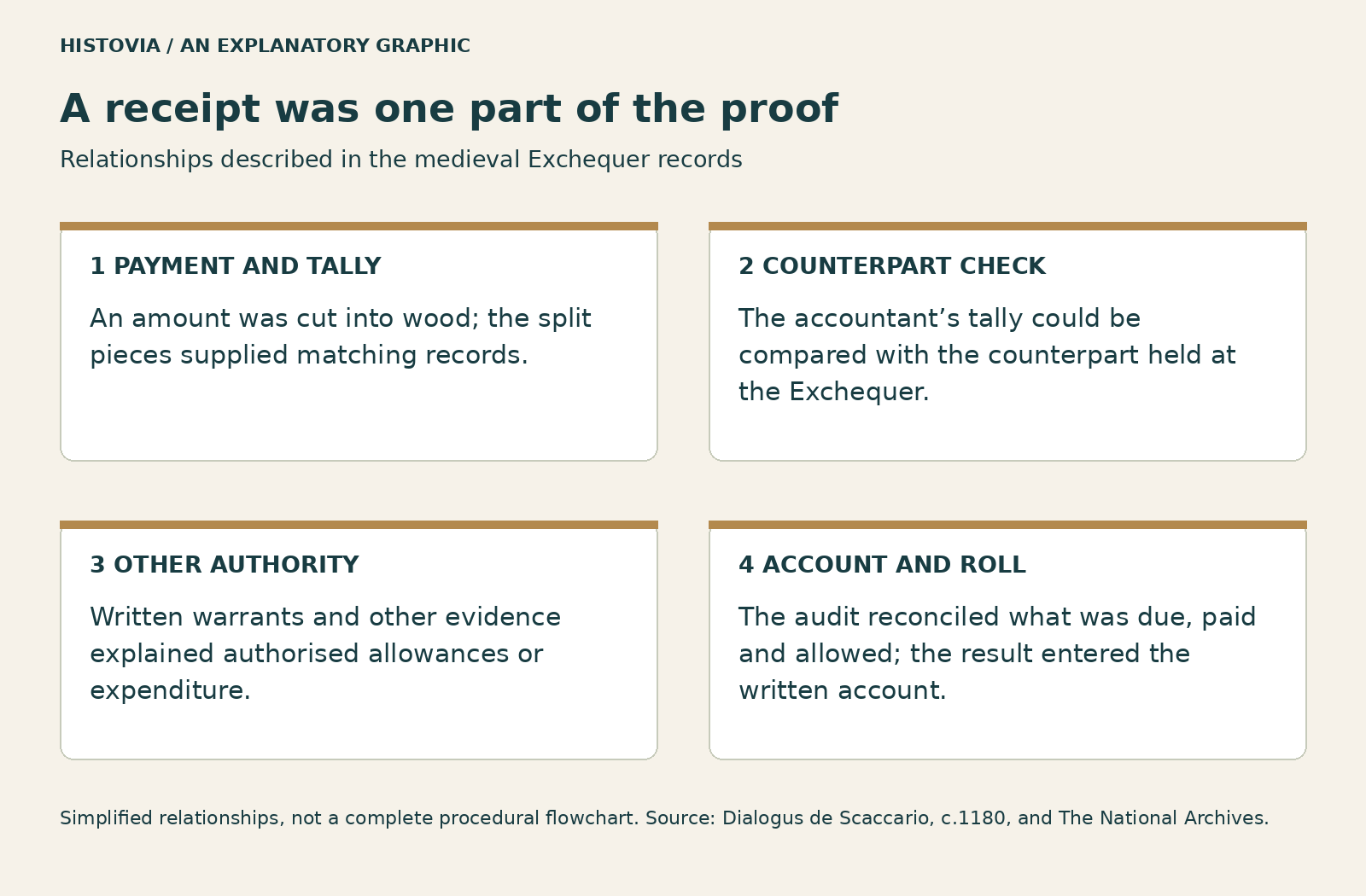
The institution around the stick
The fullest medieval explanation comes from the Dialogue concerning the Exchequer, written by the royal treasurer Richard fitz Nigel in the late twelfth century. Its master-and-pupil format turns questions about offices, money and accounts into a description of government at work. It is an insider’s account of how the machinery was supposed to operate, not proof that every session worked perfectly.
The name Exchequer referred to a table covered with a chequered cloth and, by extension, the court assembled around it. Counters placed in the spaces made amounts visible during the reckoning. The Dialogue distinguishes a lower Exchequer, concerned with receiving money, from the upper session in which accounts were examined.
Wooden receipts, counters and parchment rolls therefore belonged to the same working environment. The counters helped a calculation proceed; the tally could attest a payment; the roll preserved the resulting account. Treating these as rival technologies misses the different tasks they performed.
The money itself also had to be tested. Richard describes procedures for counting and weighing coins, and for sampling the silver delivered by a sheriff. A sealed sample moved between officers before being melted and weighed under observation. Loss in the assay affected the amount credited to the payer. The account therefore depended on judgements about the substance of money, not merely on adding up its face value.
Even that test could be questioned. The Dialogue allows for a further trial from a reserved sample if the sheriff disputed the result. A tally would eventually express an amount, but the amount was the product of a witnessed process. Reading the notches cannot tell us by itself how the coins had passed through the hands, scales and furnace that helped determine it.
Richard describes an arrangement in which several officers held related responsibilities. When his pupil asks whether so many checks imply distrust of the treasurer, the master answers that they protect him and suit the importance of royal business. Responsibility is distributed rather than placed entirely on one person’s reputation.
That distribution extended to writing. Different scribes made rolls which could be compared, allowing an error in one record to be corrected from the others. The Dialogue also attends to mundane supplies: the usher provided wood for tallies, knives, containers, straps and ink. Night watches guarded the treasure. Reliable administration rested on these materials and repeated acts of maintenance as much as on the authority of a royal office. The surviving tally is the portable part of a much larger physical infrastructure.
Paying was not the same as finishing the account
One passage gives this distinction unusual clarity. The tally-maker compared the accountant’s tally with its counterpart from the treasury. At the Easter session, the longer piece could be returned to the sheriff, who would bring it again at Michaelmas. At that later reckoning, the amount entered the written roll and the tally passed into official custody.
The pupil naturally asks why a payment needs to appear twice. Richard’s answer is that a second appearance does not mean the sheriff must pay the same money again. He must account for the payment already made. Until the reckoning has discharged the obligation, a receipt in his possession does not complete the process.
This is the difference between evidence of a transaction and settlement of an account. A sheriff might also produce royal writs authorising expenditure or allowances. Officials had to decide how those items affected the amount still due. A surviving piece of wood is consequently only a fragment of the reasoning that once surrounded it.
The crown could govern at a distance because its officers could require such evidence to be brought together. That power had a coercive edge. The Dialogue discusses summonses, unpaid debts and the custody of those who failed to satisfy demands. The orderly table was part of a system capable of compelling attendance, not a voluntary association of bookkeepers.
Numbers, words and a longer working life
Richard’s description assigns different cuts to different values. A large sum required a broad notch; a penny could be indicated by an incision without removing wood. The scheme allowed amounts to be recognised materially rather than relying on a written numeral alone. Written details still mattered because an amount by itself could not name its owner or explain the transaction.
The two forms of information supported each other. A person examining a tally had both the shape of the cuts and an inscription to consider. At an audit, that object could be tested against another physical object and placed alongside written authority. The system’s strength was the combination, not a belief that wood was inherently more truthful than parchment.
Tallies also outlasted the medieval setting described by Richard. An illustration published in the 1911 Encyclopædia Britannica reproduces a tally for a loan to the king in 1739. It records £236 4s. 3½d. from Edward Ironside and refers to annuities. The old medium could document borrowing as well as the kinds of royal receipts found in medieval accounts.
That example should discourage an easy progression from “primitive sticks” to sophisticated finance. Materials can remain useful after the institutions using them have changed. Conversely, the persistence of an established form does not mean every earlier procedure or purpose survives unchanged with it.

Checks could expose failure without preventing it
The National Archives’ study of a fourteenth-century Irish financial scandal describes records in which payments lacked the usual tally authorisation and other tallies were incorrectly made. Related rolls had been brought from the Dublin Exchequer to Westminster for scrutiny. Multiple records gave investigators something to compare, but their existence had not prevented disorder.
This is a useful limit on the ingenuity of the split stick. An authentic object can record an improper transaction; a sound procedure can be ignored. Where people control the making, handling and interpretation of records, an account of security must include their actions.
The same surviving irregularities also show why a system of checks matters. A discrepancy can become evidence after the event. Historians learn about financial administration not only from a manual’s orderly instructions, but from the failures officials tried to explain, correct or conceal.
When evidence became fuel
By 1834, the stockpile awaiting disposal belonged to a discontinued practice. Parliament’s history of the fire dates the end of the tally system’s use to 1826. That should not be confused with one simple abolition date for everything called the Exchequer: its offices and functions underwent a longer series of changes.
The disposal decision placed a large quantity of dry wood in two stoves beneath the Lords chamber. During the afternoon of 16 October, visitors noticed heat from the floor and smoke. The stoves were put out by late afternoon, but that did not end the danger. The alarm came that evening as the fire took hold.
The setting was already vulnerable. Parliament’s account of the old estate records an architectural warning about fire risk in 1789, signed by fourteen architects including John Soane and Robert Adam. A dangerous disposal method entered a building complex whose risks had not been adequately addressed.
The causal story therefore concerns decisions about a place, a quantity of fuel and a warning, not a mysterious property of medieval accounts. Burning unwanted tallies was not unprecedented. Feeding this stockpile into these stoves created a hazard with consequences far beyond the records being cleared away.
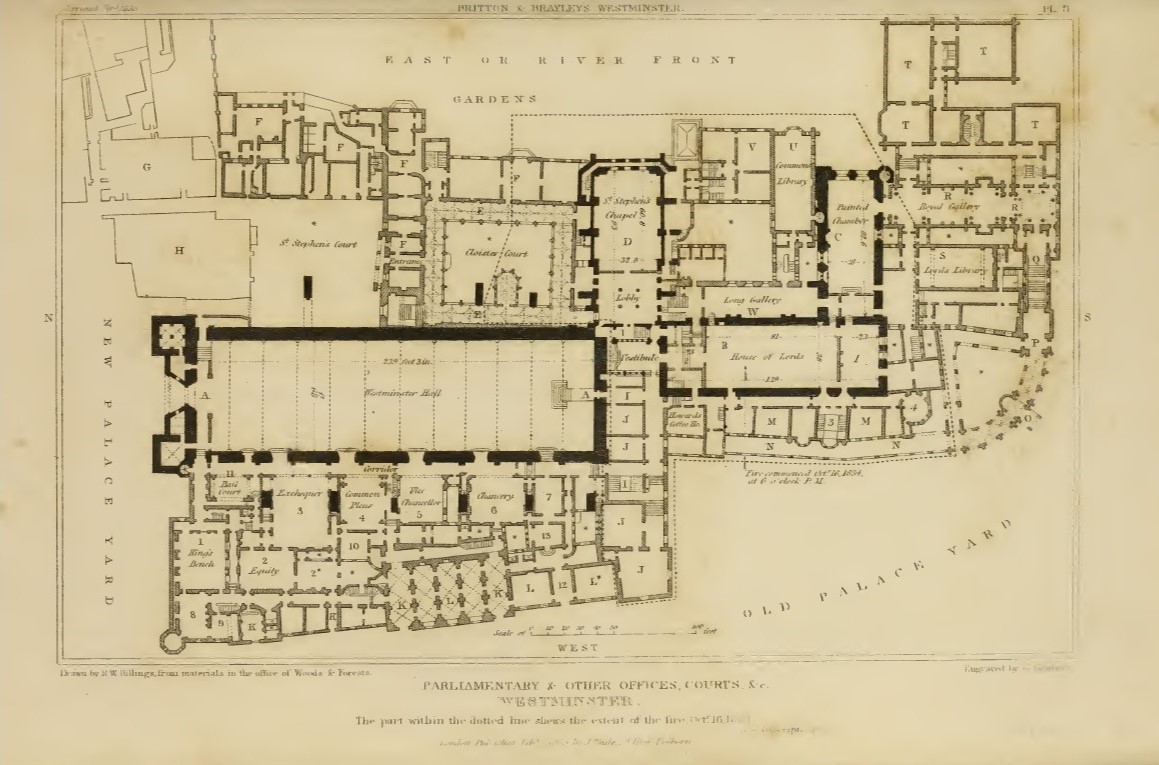
The losses did not fall evenly
Most of the parliamentary complex was devastated, but Westminster Hall survived. The history of its rescue describes firefighting close to the timber roof, aided by repair scaffolding, substantial medieval walls and a change in the wind. Survival depended on a particular combination of structure, access, weather and human effort.
The documentary consequences were also uneven. Almost all the House of Commons’ records were lost, with the important exception of its Journals. The Lords archive’s history explains that much of its material was protected by storage in the detached Jewel Tower. Clerk Henry Stone Smith also helped save bundles from the burning main buildings.
This asymmetry still shapes what a historian can ask of the archive. An absent document may reflect destruction rather than an event that never occurred. Nor does a surviving bundle necessarily stand for the whole business of an institution. The fire rearranged the evidence available to later generations.
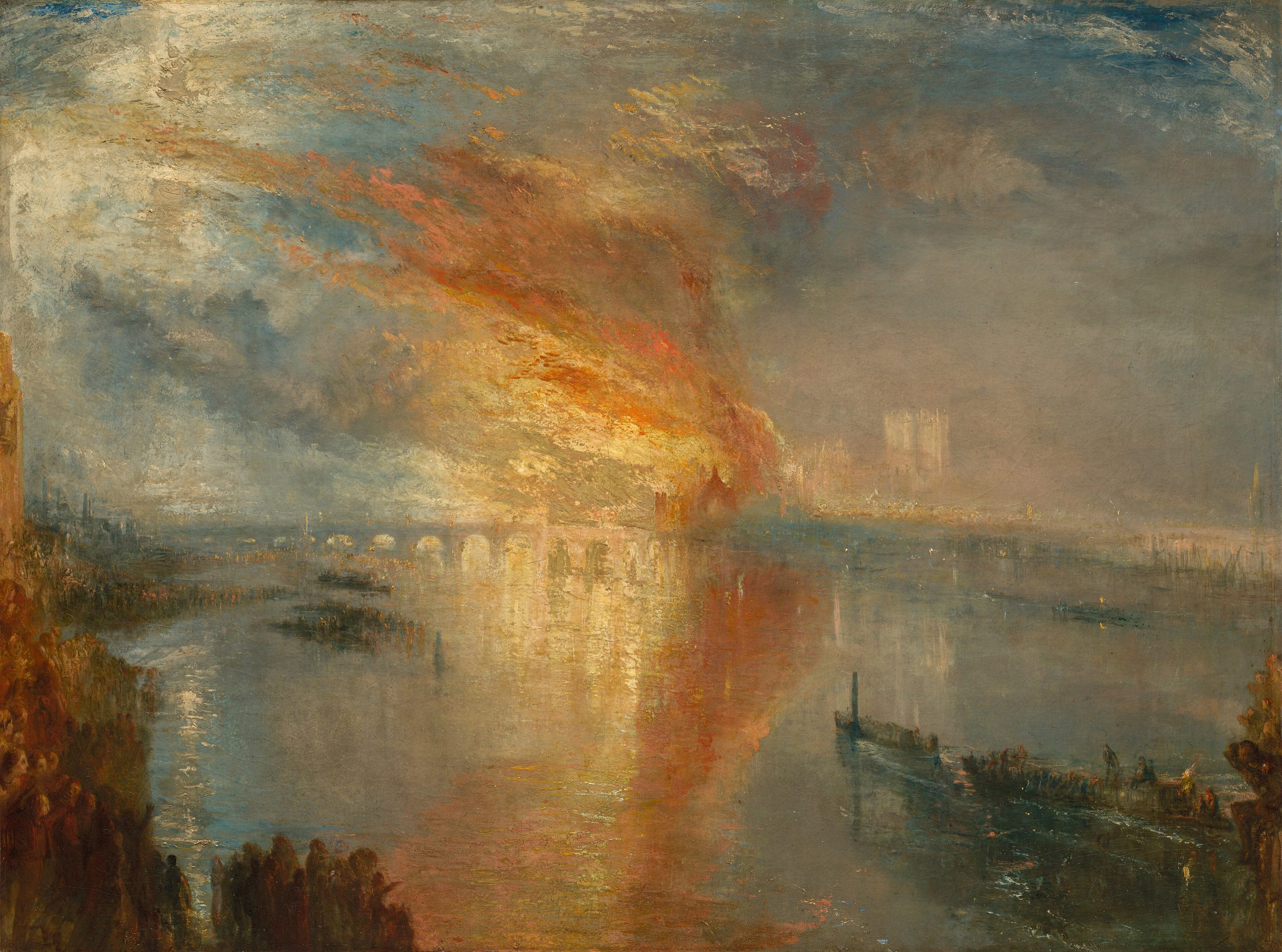
Turner’s 1835 painting in Cleveland offers another kind of survival. It makes the fire visible through heightened colour, scale and reflected light. A painting can preserve the event’s imaginative force while leaving the administrative sequence to other records. Its flames should not be used as a technical reconstruction.
What the remaining wood can still tell us
The tally’s history is larger than its spectacular ending. A small wooden object helped people carry claims into an institution, compare them and connect them to written accounts. Its effectiveness depended on organised relationships: who issued it, who kept the counterpart, who checked the amount and who recorded the outcome.
The fire did not demonstrate that such relationships had always been foolish. It showed how badly the afterlife of records could be managed once their immediate purpose had expired. A system accustomed to asking whether a payment was properly evidenced failed to treat disposal as a task requiring equal care.
The surviving tallies deserve attention as working records before they become props in a story about flames. Their cuts and inscriptions belong to centuries of attempts to make obligations verifiable. The destruction at Westminster is the final episode of that story, not an explanation of everything that came before it.