
Dark History
Rebuilding Greenwood: Property and Power After the Tulsa Massacre
After white attackers destroyed much of Tulsa’s Black district in 1921, survivors faced a second struggle over land, insurance and the means to return. Photographs of new houses record an achievement. They do not show that the losses were repaid.
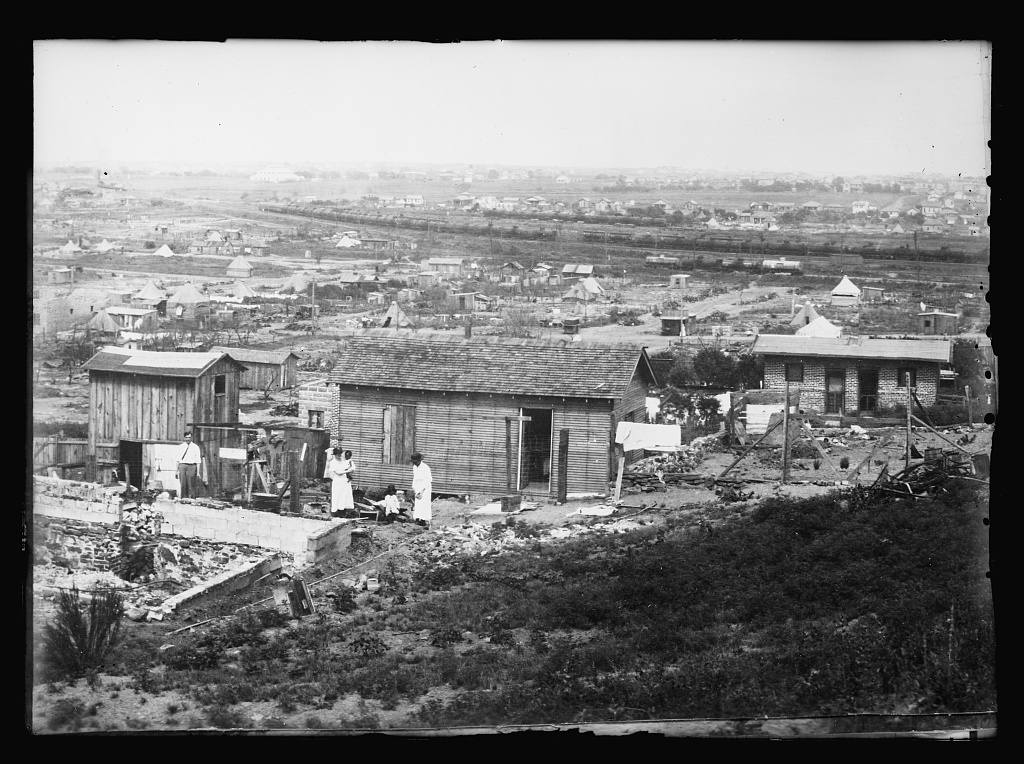
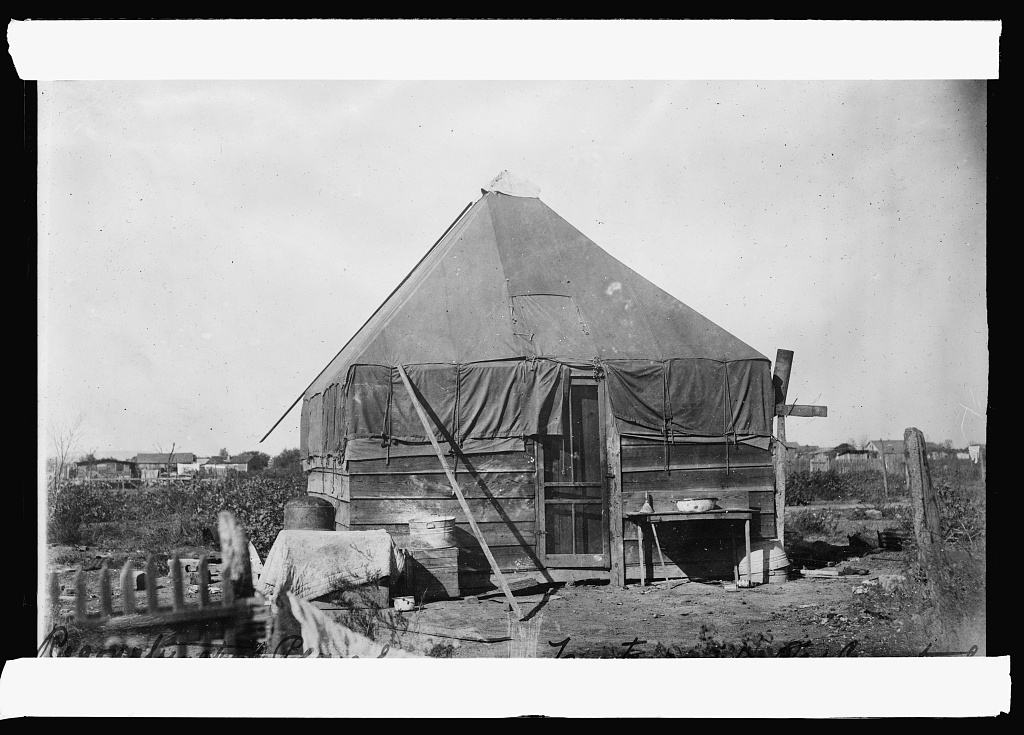
In a Red Cross photograph taken after the Tulsa massacre, small wooden houses rise beside broken foundations. Tents remain visible farther back. The camera records several stages of recovery in one view: a building standing, another space cleared, the remains of an earlier structure still interrupting the ground. Its archival caption calls the scene reconstruction.
That is an accurate description, but an incomplete account of what happened next. A house could be rebuilt without its owner recovering the money lost in the fire. A family could return to its land while living in a tent. A business could reopen after its stock, equipment and customer relationships had been disrupted. Returning, rebuilding and receiving compensation were different outcomes.
During May 31 and June 1, 1921, white attackers killed Black residents and burned and looted much of Greenwood, Tulsa’s principal Black neighborhood. Police participation and the deputizing of white men helped turn racist violence into an attack backed by public authority. The struggle afterward also involved public authority: officials controlled movement, proposed a new use for the land and restricted the buildings survivors could erect.
Reading the photographs alongside relief records and court proceedings makes that second struggle visible. It also changes the meaning of a familiar ending. Greenwood’s reconstruction was an accomplishment of its survivors, not evidence that Tulsa had repaired what it destroyed.
What disappeared when a district burned
Greenwood’s commercial strength was real. Its shops, hotels, theaters and professional practices served Black residents excluded from, or humiliated in, many white establishments. Loula Williams operated the Dreamland Theater and a confectionery business. J. B. Stradford owned a hotel. Churches, newspapers and neighborhood businesses provided institutions through which people could organize their lives.
The familiar description “Black Wall Street” can nevertheless distort this landscape if it suggests that everyone was wealthy or that the district was chiefly a financial market. Greenwood was a place to live and trade, not a miniature stock exchange. The Justice Department’s 2025 historical review also emphasizes unequal municipal services: prosperity existed alongside inadequate sanitation, water provision and street paving. Commercial achievement did not cancel segregation.
The immediate crisis began with the arrest of Dick Rowland, a young Black man accused of assaulting a white elevator operator. A white crowd gathered at the courthouse amid the threat of a lynching. Armed Black men came to help protect him. After a confrontation and gunfire, attacks spread toward Greenwood. Rowland’s charges were later dismissed; his arrest had become the occasion for violence against an entire community.
Destruction reached far beyond prominent buildings. The Red Cross’s assessment, cited in the federal review, counted more than 1,250 houses burned and another 215 looted. The full death toll remains uncertain. A count of buildings is more recoverable than a complete count of the people killed, yet it too reduces many different losses to a single unit. A house might contain a family’s savings in furniture and possessions, provide rental income, or offer the space from which someone earned a living.
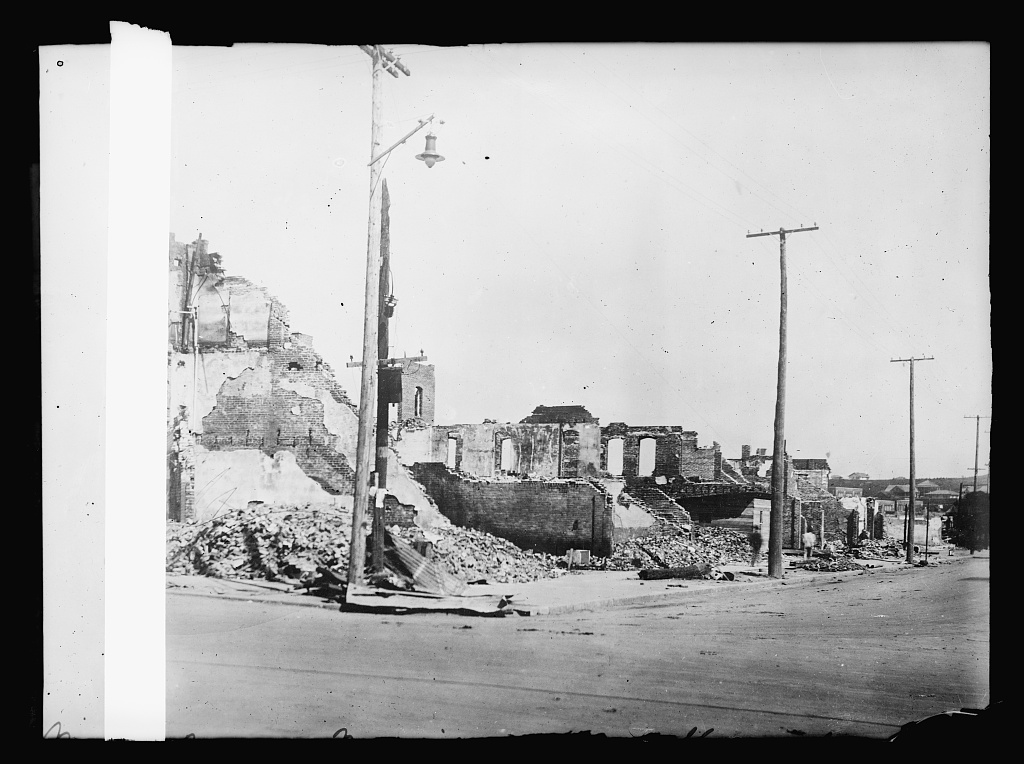
The photograph of the Williams building shows ruined walls along a street. It cannot tell us the value of the stock inside before the attack, the income interrupted, or the work required to establish the business in the first place. Those questions require other records.
Surviving did not mean being free to return
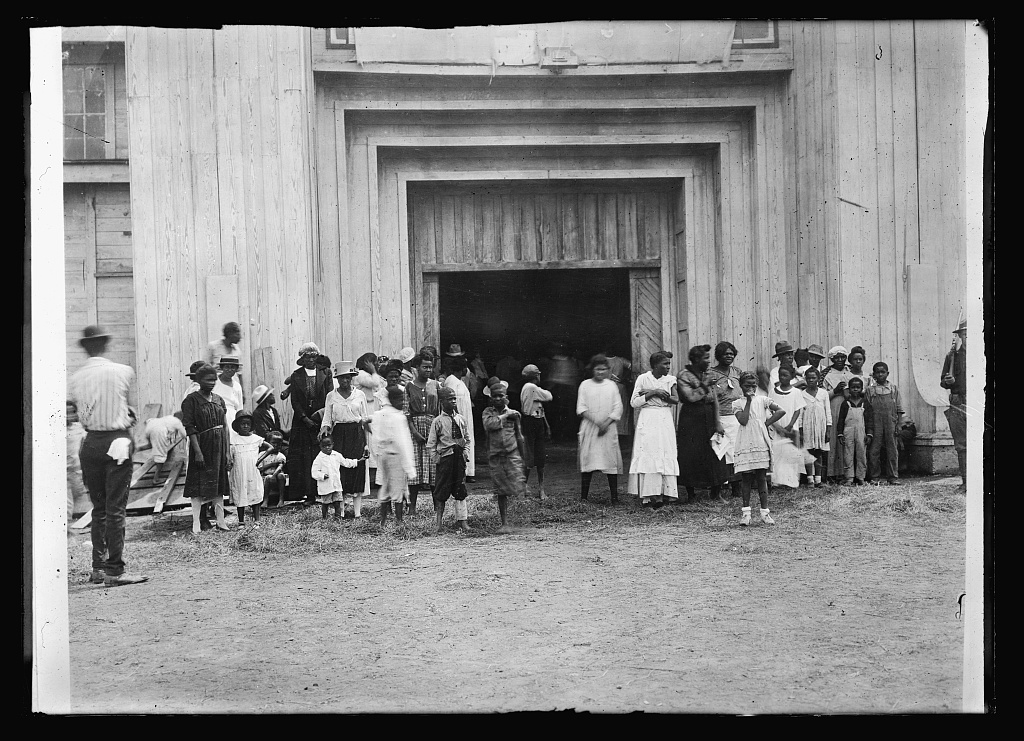
Black residents who escaped the burning district were not simply allowed to resume their lives. Authorities confined thousands at the Convention Hall, McNulty Park and the fairgrounds. Detention did not depend on evidence that an individual had committed an offense. Armed guards controlled people whose homes had just been attacked.
Release depended on an identification system tied to white sponsorship. Black workers with employment in white homes or businesses could receive permanent passes; others received more limited permits. Those without acceptable papers risked renewed detention. The system continued after martial law ended. It placed the ability to move through Tulsa under the supervision of institutions that had failed to protect Greenwood.
This matters when looking at photographs labeled “refugee camp.” The label describes displacement, but it can obscure coercion. A crowded building may have sheltered people and also served as a place of confinement. A photograph of families outside its entrance does not establish whether they were free to leave, who had obtained a pass or what conditions awaited them elsewhere.
The federal review reconstructs these restrictions from military orders, newspaper reports and survivor accounts. It also records compulsory labor requirements imposed on detained men without other employment. The aftermath was therefore more than the practical problem of finding roofs and meals. Survivors faced rules about movement and work while trying to recover from the attack.
Relief kept people alive; it did not settle their claims
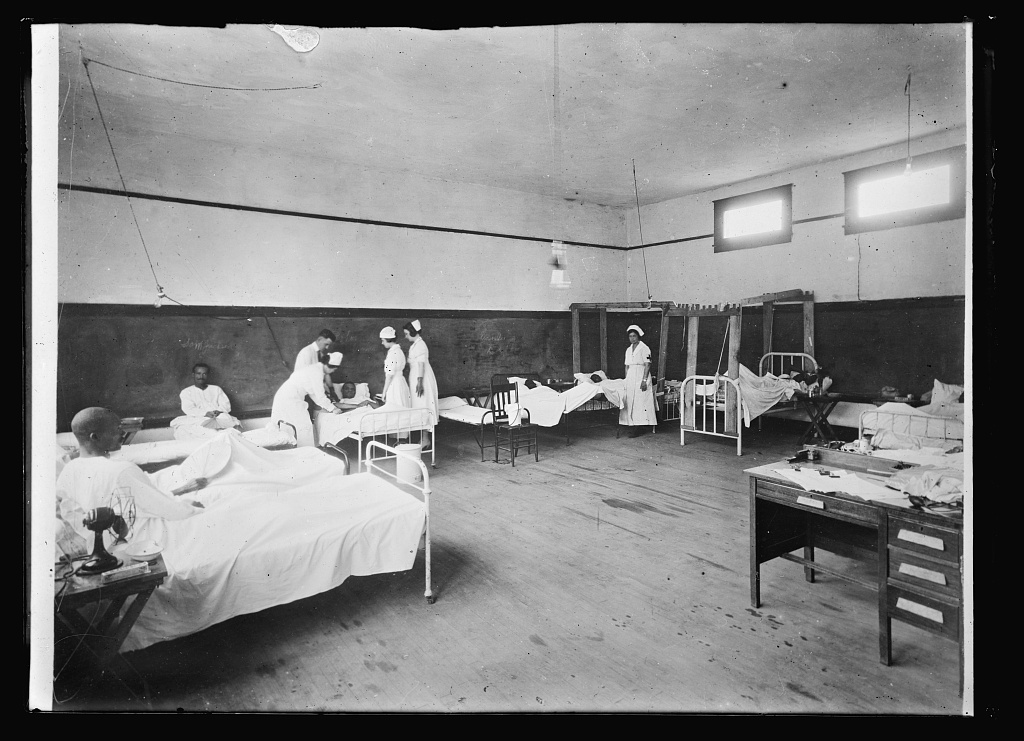
The Red Cross provided medical care, food and shelter. Booker T. Washington High School was converted into a hospital, and volunteers helped care for the injured. The surviving photographs of wards, camps and temporary homes document an extensive emergency operation. They should be read as records of necessary work, rather than as proof that the city had fulfilled its obligations.
Relief and compensation answer different questions. Relief asks what someone needs immediately: treatment, food, clothing, somewhere to sleep. Compensation asks who should bear a loss and how much should be restored. A food distribution can be indispensable while leaving the recipient’s property claim entirely unresolved. The distinction was particularly important in Tulsa, where public promises of rebuilding exceeded the assistance that followed.
According to the federal review, the city’s Public Welfare Board concentrated on immediate necessities rather than paying for destroyed buildings. It also rejected outside contributions, including a check from the Chicago Tribune. The precise motives behind that refusal are uncertain. What can be established is that refusing help and failing to fund reconstruction made the residents’ problem harder.
The hospital photograph belongs to this history without supplying a reassuring conclusion. It shows care being given after violence. It does not show an insurance payment, a replacement business or the recovery of a family’s financial position.
A fire ordinance became a struggle over the land
Within a week of the massacre, a municipal rule threatened to prevent survivors from rebuilding where they had lived. On June 7, Tulsa enacted Fire Ordinance No. 2156, extending its fire limits across most of Greenwood. Buildings in the affected area were to use concrete, brick or steel and stand at least two stories high. Those requirements placed reconstruction beyond the means of many owners who had just lost their homes.
This was not merely a neutral safety measure with unfortunate consequences. Contemporary statements connected the ordinance to an industrial future for the district. Mayor T. D. Evans advocated moving the Black settlement farther north and east, while a newspaper announcement explained that the new building requirements would prevent the neighborhood’s return. The federal review treats displacement as an intended result.
The value of a lot and the ability to use it had become separate matters. A survivor might retain title to land while being unable to construct an affordable home on it. If owners were forced to abandon rebuilding, the destruction could be followed by a transfer of the district to other uses. A rule about construction materials thus had consequences for who would occupy Greenwood.
B. C. Franklin and fellow lawyers established a temporary office in a tent on Archer Street and challenged the ordinance. An initial challenge halted enforcement over inadequate notice. In September 1921, they secured a permanent injunction on property-rights grounds. Before the restriction was defeated, residents had been arrested during efforts to rebuild.
The injunction mattered enormously: it defended the possibility of returning. It did not provide the money to do so. A courtroom victory over a construction barrier still left families facing the cost of timber, labor and everything a functioning household required.
Why a fire insurance policy did not guarantee payment
Some owners had insured their buildings. The existence of a policy, however, did not mean that the loss would be covered. Insurers invoked exclusions for damage caused by riot. These contractual provisions became one of the principal obstacles between physical destruction and the money needed to replace it.
A surviving example is Redfearn v. American Central Insurance Co., decided by the Oklahoma Supreme Court in January 1926. William Redfearn was a white property owner in Greenwood; the action concerned his insured theater and hotel buildings destroyed in the attack. The court upheld judgment for the insurer, concluding that the evidence did not support the owner’s attempt to establish a cause of loss outside the policy’s riot exclusion.
The opinion is disturbing in part because it preserves evidence of destruction while denying recovery. Its account includes armed white men obstructing firefighters and witnesses describing fires after groups of men entered buildings. Some of those men wore police or deputy badges. Yet the question before the court was whether this owner could recover under the policies, not a criminal determination of responsibility for the massacre.
Calling the event a massacre today more accurately conveys its racial targeting and asymmetry. It does not, by itself, explain away the historical insurance decisions. The courts applied contract terms to the evidence as they understood it. The important distinction is between the name historians use for the violence and the coverage questions the litigants had to argue.
The case also demonstrates a limit of legal records. They can preserve testimony that would otherwise be lost while organizing it around a narrow issue. A court’s refusal to award insurance proceeds is not proof that the destruction was unimportant, that the owner suffered no loss or that public officials bore no responsibility. It establishes the outcome of that particular claim.
A ledger could record a loss without repairing it
Survivors also created their own evidence. Mary E. Jones Parrish’s Events of the Tulsa Disaster brought together her account, other witnesses’ testimony and a partial list of property and financial losses. Her work placed the residents’ descriptions beside the figures. It preserved a community’s account rather than leaving its history entirely to officials, insurers and white newspapers.
The word “partial” matters. No surviving list should automatically be treated as a complete ledger of the massacre. Different records count different things: buildings, household possessions, claimed damages, insured values or relief recipients. Adding figures together without examining their categories can count the same loss twice or omit people whose losses never entered the record.
Nor does a sum claimed in a lawsuit tell us what was paid. Claims are evidence of what plaintiffs sought and alleged; judgments and payment records answer different questions. The Justice Department’s review reports that survivors’ early civil suits against the city and other defendants were dismissed, while acknowledging that it could not locate opinions explaining those dismissals. That gap should remain visible rather than being filled with an invented legal rationale.
Return to the photograph of wooden houses among the ruins. It shows that rebuilding began. It cannot show every person who lacked the resources to return, every business that failed to reopen, or the debt and labor behind a replacement home. The achievement belongs to the people who made Greenwood habitable again. Their success does not convert relief into restitution, or erase the decisions that left them to bear so much of the cost.
Sources and evidence
This article distinguishes photographs, contemporary testimony and court decisions from later historical reconstruction. It uses “massacre” in the narrative; historical catalog titles and legal records often use “riot.” No scenes, dialogue or personal thoughts have been invented.
- U.S. Department of Justice, Civil Rights Division, Review and Evaluation: Tulsa Race Massacre (2025, updated version). Especially printed pages 10–11 and 48–55, with the accompanying endnotes: Greenwood before the attack; detention; relief; property losses; the fire ordinance; insurance and civil claims. The report evaluates contemporary records alongside subsequent historical scholarship; its estimates are not treated here as exact totals.
- Redfearn v. American Central Insurance Co., 1926 OK 22, 243 P. 929 (Oklahoma Supreme Court, January 12, 1926). Public-domain judicial opinion, in a digital transcription. Used for the insurance question, evidence summarized by the court and disposition, not as a neutral account of the entire massacre.
- Oklahoma Commission to Study the Tulsa Race Riot of 1921, final report (2001). The discussion of Redfearn’s litigation identifies him as a white owner of a theater and hotel in Greenwood; his case is not presented as a Black survivor’s personal claim.
- Mary E. Jones Parrish, Events of the Tulsa Disaster, New York Public Library digital collection. The catalog dates its copy to 1922 and identifies the witness testimony and partial record of property losses. The catalogue’s description establishes the volume’s contents; no individual loss entry is reproduced here.
- Library of Congress, American National Red Cross photographs of Tulsa, 1921. The five individual records are linked in their captions. Their creation dates are not represented as verified first-publication dates. Each has an item-level advisory of no known restrictions on publication; this is not a Creative Commons license or a guarantee of copyright clearance. The collection statement distinguishes staff photographs from material collected from other sources.