
The Irish Great Famine: Relief, Eviction, and the Families Who Left
Relief records, eviction testimony and passenger lists reveal how Ireland’s potato failure became a prolonged struggle for food, shelter and passage across the Atlantic.
The Irish Famine survives in bundles of urgent correspondence as well as population statistics. Local committees described hunger, sought money and submitted lists of proposed public works. Individuals appealed for assistance. The National Archives of Ireland’s Relief Commission papers preserve these exchanges with an administration repeatedly reorganised as the emergency worsened. A request had to travel, be assessed and fit the rules of an available scheme before it could become food or wages. Following that process brings the catastrophe into focus: a failed harvest became a prolonged struggle over how families could obtain their next meal, keep a roof above them or leave the country. The surviving paperwork also shows people trying to make institutions respond, rather than simply waiting for rescue. [1]

When a staple crop failed
The immediate agricultural cause was potato late blight, produced by the organism Phytophthora infestans. It reached Ireland in 1845 during an outbreak that spread across Europe. Modern analysis of infected nineteenth-century herbarium leaves has recovered genetic evidence of the lineage involved, connecting the disaster to a specific plant disease rather than a mysterious failure of the soil. Yet identifying the pathogen does not explain why a crop failure became so deadly in Ireland. The missing part of that explanation lies in the households whose ordinary access to food depended on the crop, and in the effectiveness of the measures introduced when that access collapsed. [2]
Dependence on potatoes was already visible in official inquiries before 1845. The National Library of Ireland draws attention to dietary evidence from Limerick and Tipperary in an 1840 Poor Law Commissioners’ report. These records describe a food system in which potatoes supplied the core of many poor people’s meals. They should not be read as a menu shared equally by every Irish household. Their significance is more precise: the crop that failed was an everyday subsistence resource for people with little room to replace it. A family that lost its potatoes needed purchasing power or direct assistance, not merely knowledge that other food existed. The earlier records help explain the extraordinary consequences of the later harvest reports. [3]
Relief did begin. Robert Peel’s government arranged the purchase of £100,000 worth of American maize in November 1845 and organised a Relief Commission. Public works offered wages through tasks including road construction and stone breaking. These measures confronted practical difficulties, among them preparing an unfamiliar grain with inadequate milling facilities. They also operated against a changing emergency. John Russell’s Whig ministry replaced Peel’s government in 1846, as a second and more destructive potato failure removed the hope that assistance would be needed for only one season. The scale of hunger expanded while policy continued to rely heavily on the assumption that employment could enable destitute people to buy their food. [4]
Working for food, then receiving it directly
That assumption broke down at the works themselves. Treasury official Charles Trevelyan’s account, published in 1848, described restrictions intended to keep relief wages below ordinary local pay and to connect earnings to tasks completed. He also acknowledged that rising food prices made the resulting income inadequate for labourers’ families. This admission is important because his book defended the administration rather than offering a detached assessment. A person could obtain employment and still fail to secure enough to eat. The weakest workers were particularly ill placed to earn through exhausting manual tasks. Public works were therefore neither the absence of government action nor proof that sufficient relief had reached the hungry. Their rules and purchasing power mattered more than the existence of a wage list. [5]
Local organisers explored another approach. Research on Skibbereen shows that residents established direct food assistance and pressed for wider support before the government’s large soup-kitchen programme. A committee organised gratuitous relief in November 1846, and local advocates promoted public funding rather than accepting that subscriptions alone could carry the burden. Skibbereen’s later association with mass death can obscure this activity. The town was also a place where people experimented with relief, collected information and tried to influence policy. Their agency did not make the resources adequate, but it helps explain how alternatives to the public works developed. The practical advantage of cooked food was clear: it could reach people unable to earn wages by breaking stones. [6]
A Quaker relief report from Waterford, dated 16 February 1847, gives the work a tangible scale. Its committee described visits to surrounding districts and the establishment of soup kitchens. In the city, it estimated weekly distribution at about 9,000 quarts of soup and 12,000 pounds of bread, free or at reduced prices. Fuel and straw for bedding were supplied as well. Children’s condition appeared to improve where cooked food was available. Nevertheless, the same report insisted that the help was insufficient. People arriving from the countryside increased the demand, including families who had recently supported themselves. The document records both effective assistance and the speed at which an emergency could outrun a charitable organisation’s resources. [7]
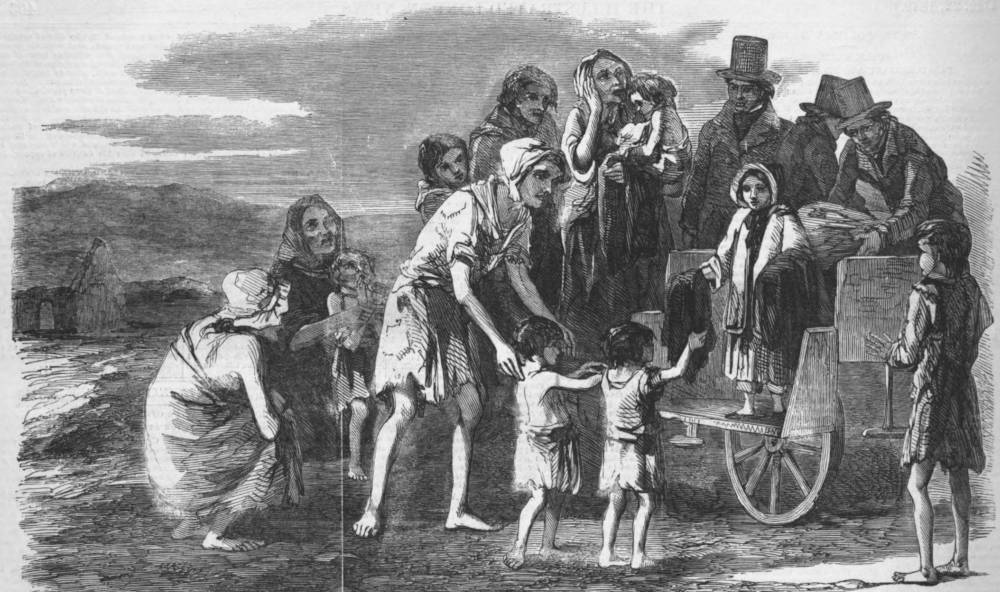
The Temporary Relief Act of 1847 expanded direct food distribution dramatically. Trevelyan recorded 3,020,712 recipients of separate rations in July. But this was a temporary system: distribution under the scheme had ceased by 12 September. The need for relief had not disappeared with its closure. [5]
The workhouse gate and the quarter-acre rule
The alternative depended increasingly on the Poor Law system. Introduced in Ireland in 1838, it originally divided the country into 130 unions, each administered by a board of guardians. Its workhouses had been designed to accommodate about 80,000 people, approximately one percent of the population. They were institutions for managing destitution on a much smaller scale than the famine imposed. By March 1851, nearly four percent of Ireland’s population was in workhouses, according to the National Archives’ guide. Those figures span changes in the system and should not be treated as a simple occupancy rate for the original buildings. They demonstrate the enormous growth of institutional dependence. Admission, supplies and the decisions of guardians had become matters of survival for a much larger population. [8]
The 1847 Poor Law Extension Act also placed the burden of relief on Irish ratepayers, including communities whose resources were being devastated. Its Gregory clause required applicants occupying more than a quarter acre to surrender the excess land before receiving relief. A household could thus face a choice between seeking immediate help and retaining the ground on which a future livelihood depended. Outdoor relief, given without workhouse residence, was permitted under specified conditions, but the land qualification still narrowed access. Economic historian Cormac Ó Gráda shows that the crisis continued long after the soup kitchens closed: almost 900,000 people remained dependent on indoor or outdoor poor relief in early August 1849. Local resources and administration varied, so neither the law’s promises nor its failures were experienced uniformly. [9]
Eviction reached inside the household
Landlord decisions compounded these pressures. Responsibility for poor rates on the smallest holdings increased incentives to remove impoverished tenants, while rent arrears and estate debts intensified conflict. Some owners spent heavily on relief; others pursued clearances. The landscape of small farms changed rapidly. University College Cork’s document pack, drawing on the Atlas of the Great Irish Famine, notes the disappearance of around 93,000 holdings of one to five acres between 1847 and 1853. That is not an eviction count. Holdings also vanished when occupants abandoned them to seek assistance, emigrated or died. The distinction prevents a large statistic from hiding different experiences, while still making clear that loss of land was a central part of the disaster and its aftermath. [10]

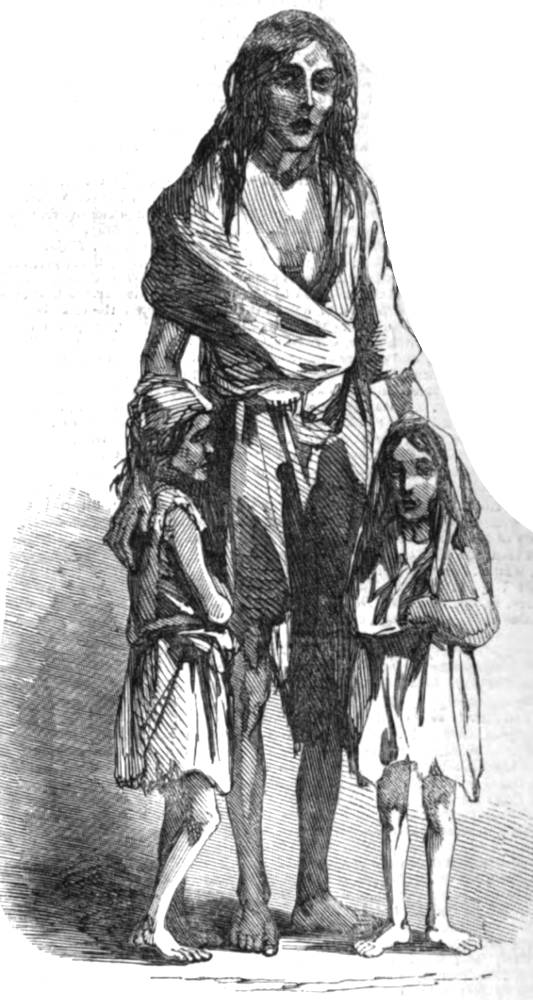
One reported experience belonged to Bridget O’Donnel. The Illustrated London News published her account with a picture of her and her children on 22 December 1849. She described eviction for unpaid rent while she was suffering from fever and pregnant. As the house was being demolished, two women neighbours, Nell Spellesley and Kate How, carried her away. She subsequently delivered a stillborn child. Her thirteen-year-old son died while the family was ill. This is testimony mediated through a newspaper, not an independently complete case record, and it does not tell us her later life. It does connect processes often separated into different historical categories: rent arrears, removal from a dwelling, illness, childbirth and the efforts of neighbours to keep someone alive. [11]
Death, movement and the limits of the count
Many famine deaths came through infectious disease rather than literal starvation alone. Hunger could weaken people, while overcrowding and movement in search of relief exposed them to infection. Joel Mokyr and Cormac Ó Gráda’s analysis also explains why the death toll cannot be read directly from the 1851 census tables. Much information was collected retrospectively from surviving relatives; whole households could have died or emigrated, leaving nobody to report a death. An estimate of roughly a million excess deaths describes the scale without pretending to supply a complete register. Ireland’s recorded population fell from about 8.18 million in 1841 to 6.55 million in 1851, but that difference is not itself a death toll: births and migration must also enter the calculation. The uncertainties arise partly from the same destruction of households that historians are trying to measure. [12]
Migration offered escape, but a passage ticket did not guarantee safety. In 1847, nearly 100,000 immigrants, most of them Irish, arrived at Grosse Île, the quarantine station in the St Lawrence near Quebec. That was several times the usual annual number. Typhus overwhelmed the station’s capacity, and Parks Canada records 5,424 burials on the island during the crisis. Thousands more died during voyages or after moving onward. These figures belong to a specific migration emergency and should not be applied indiscriminately to every ship leaving Ireland. They show how the famine’s effects travelled with people: passengers who had reached the other side of the Atlantic still required food, shelter and care, while quarantine workers confronted needs far beyond the station’s ordinary operation. [13]
Passenger lists preserve smaller, unequal outcomes. Research published by the US National Archives identifies Margarette Gavin, aged thirty-four, and her daughter Catherine, born during the Elizabeth Denison’s passage. Both died before the vessel’s recorded arrival in New York on 5 November 1847. Another entry records Bridget Kerny’s birth aboard the Garrick, which arrived on 20 January 1848. Such entries do not let us reconstruct private conversations or the future of every child. They do prevent emigration from becoming an abstract subtraction from Ireland’s population. Families crossed while pregnant, ill or caring for children; a voyage could include both birth and death. Arrival lists, like relief applications, preserve fragments of lives that a national total cannot recover. [14]
Reading what survives
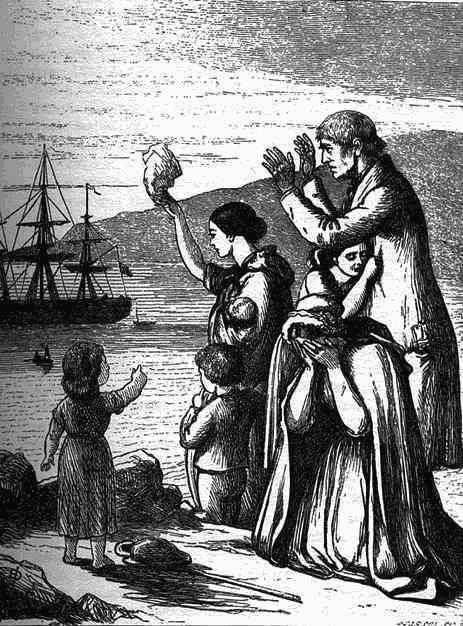
The familiar famine images need similar care. As the National Library of Ireland explains, photography was still new, and photographs of famine sufferers are scarce. Newspaper engravings supplied much of the visual record, shaped by the work of artists, engravers and editors. A contemporary print can document how an event was reported without functioning as a photograph of everything it depicts. Later illustrations of departure belong to the history of remembering migration, not automatically to a particular 1847 crossing. Read alongside relief reports, legislation and passenger lists, these images help recover the famine at the scale of households: food obtained or refused, homes lost, neighbours assisting, and relatives separated by death or distance. [15]
Sources and further reading
- National Archives of Ireland, Famine Records: Distress Papers and Relief Commission
- Kentaro Yoshida and colleagues, The rise and fall of the Phytophthora infestans lineage that triggered the Irish potato famine, eLife, 2013
- Sarah O’Connor, Researching the Irish Famine, National Library of Ireland
- University College Cork, A Short History of the Great Irish Famine
- Charles Edward Trevelyan, The Irish Crisis, 1848, CELT edition
- Coping with the Great Irish Famine: the agency of Skibbereen, Irish Historical Studies
- Waterford Auxiliary Committee to the Central Relief Committee, 16 February 1847, reproduced by Library Ireland
- National Archives of Ireland, Poor Law Records
- Cormac Ó Gráda, The Next World and the New World: Relief, Migration, and the Great Irish Famine, UCD working paper 18/21, 2018
- University College Cork, Ireland in the Nineteenth Century: Document Pack
- Illustrated London News, Bridget O’Donnel and Children, 22 December 1849: contemporary testimony reproduced with the Commons image record
- Joel Mokyr and Cormac Ó Gráda, What do people die of during famines? The Great Irish Famine in comparative perspective, 2002
- Parks Canada, Commemorating the Irish tragedy of 1847 at Grosse Île, 2022
- Mark Holan, Ireland’s Famine Children Born at Sea, US National Archives, 2017
- National Library of Ireland, Searching for images of the Great Famine