
Everyday Life & Culture
A Penny, a Tub and a Drying Room: Laundry in Victorian London’s Public Washhouses
Public washhouses brought heat, water and machinery within reach of crowded households. Their rules and records reveal both the relief they offered and the women’s work they did not remove.
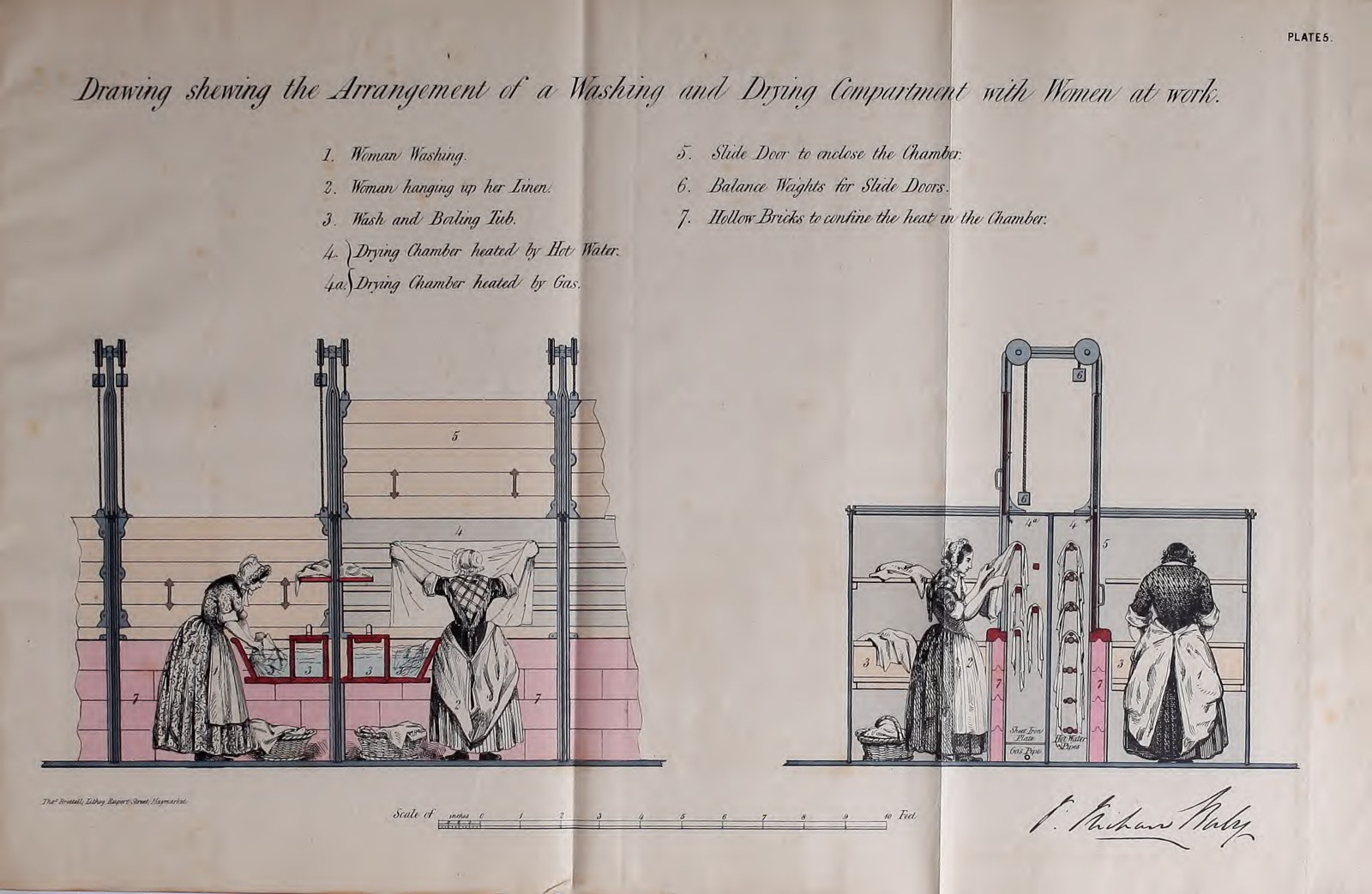
In an engineer’s drawing published in 1852, the women are part of the machinery’s explanation. One bends over a tub; another raises a sheet beside a tall drying compartment. Pipes, counterweights and sliding doors occupy the same carefully labelled space as their bodies. The apparatus is meant to make washing easier. Nobody has proposed that the women should stop doing it.
Price Prichard Baly’s plate, reproduced below, belonged to a report promoting public baths and washhouses. It illustrates an arrangement, not a candid moment in an identified woman’s working day. Yet it makes the promise of the Victorian washhouse unusually clear: facilities too expensive or bulky for a crowded home could be supplied collectively, while much of the work remained with the user.
The public washhouse was therefore more than an early version of a coin-operated laundry. It joined household labour to urban government, charitable ambition, engineering and disputes about who deserved subsidized services. Its history is not simply the discovery that poor people should be clean. It is the slower recognition that cleanliness required water, heat, space, time and money—and someone’s sustained physical effort.
What a crowded room could not provide
Clothes washing created problems that did not end at the edge of a tub. Water had to be supplied and heated; wet textiles needed somewhere to drain and dry; the room had to remain usable for the rest of domestic life. A household might possess determination without possessing any suitable place to spread a sheet.
In the House of Lords debate of 8 June 1846, the Bishop of London described overcrowded dwellings and the difficulty of drying laundry within them. He also reported that women he had spoken with valued the convenience of washing away from home. Their testimony reaches us through a reformer’s speech, not through interviews preserved in their own words.
The same speech associated cleanliness with moral improvement. This mixture matters. Reformers could identify a genuine material deprivation while treating those who endured it as people requiring correction. Their proposals should not be dismissed because they were paternalistic; nor should their social judgments be adopted as factual descriptions of their neighbours.
The parliamentary history of baths and washhouses places the movement within contemporary concern about unhealthy air. Removing damp laundry from overcrowded rooms appeared a sanitary measure as well as a convenience. These campaigns began before germ theory supplied the explanations familiar today. A useful facility did not depend upon its advocates possessing a fully correct theory of every disease.
From charitable experiment to a power that parishes could adopt
London’s early experiments were not all municipal institutions. The Glasshouse Yard establishment near the docks opened in 1845; George Street, near Euston Square, followed in 1846. Goulston Square’s model establishment opened in 1847. The sequence included voluntary associations, demonstration projects and, subsequently, parish provision. Calling every one of them a council laundry obscures how the system developed.
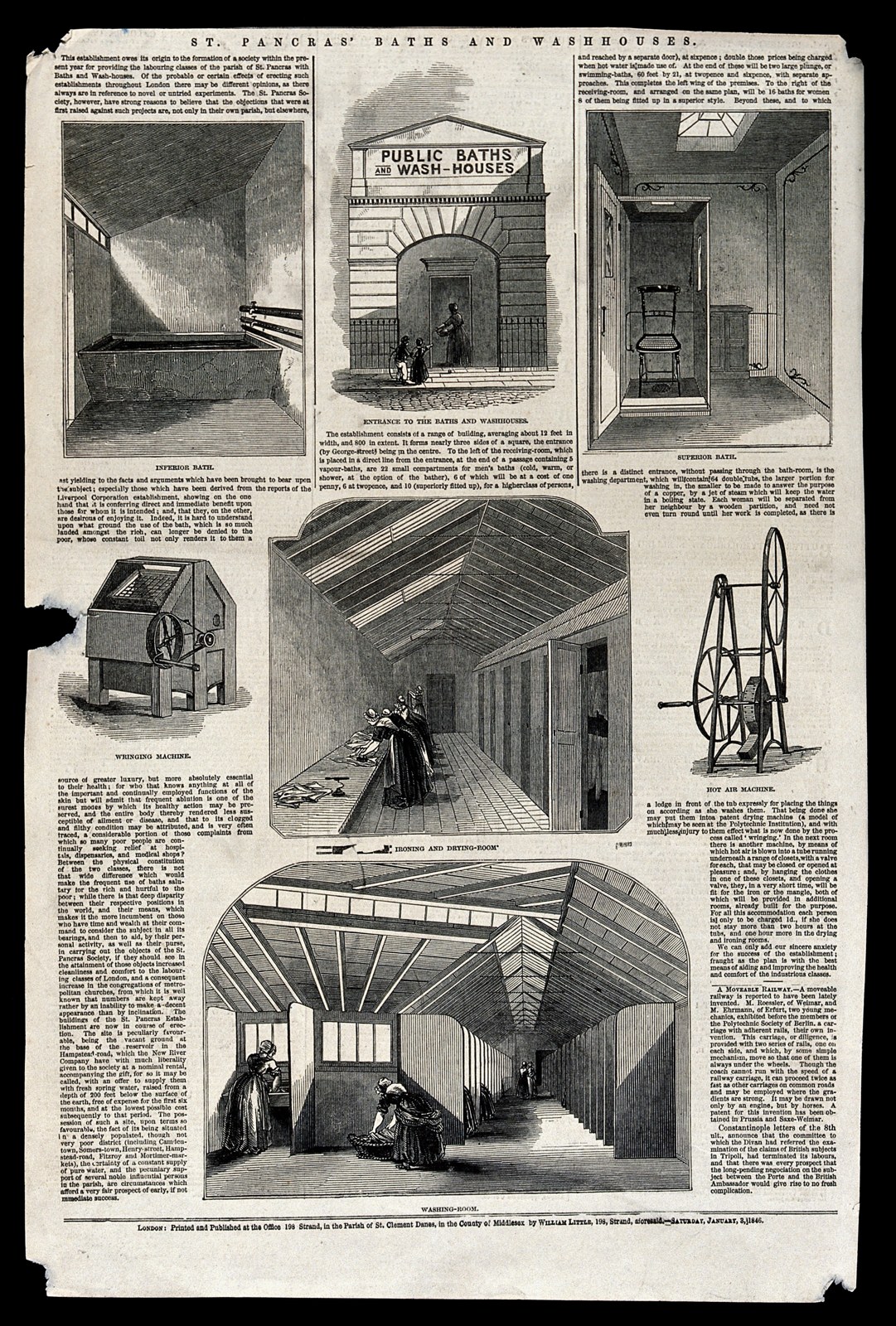
An engraving of St Pancras baths and washhouses, now catalogued by the Wellcome Collection, presents a small visual tour: entrance, bathing accommodation, washing room and machinery. Its multiple views invite readers to understand a functioning establishment rather than admire a façade alone. Baths for bodies and facilities for clothes belonged to the same reforming programme, but they were not the same service.
The Baths and Washhouses Act of 1846 enabled local authorities to provide facilities. It did not order a washhouse into existence in every neighbourhood. Parish adoption required a specially convened vestry meeting and a two-thirds majority among the votes cast, followed by central approval. Decisions about public need passed through institutions concerned with local rates and expenditure.
This distinction between permission and provision is essential. An Act could create a route to borrowing, building and management without supplying a universal service. The existence of a legal power tells us what a locality might do. Dates of construction, opening hours and charges tell us more about what residents could actually use.
The price of an hour—and the work inside it
The original 1846 statutory schedule set maximum working-class washhouse charges of a penny for one hour and threepence for two consecutive hours. It included use of drying apparatus and expressly excluded drying time from that hour or two. These were provisions of a particular schedule, not a timeless price list applying unchanged to every London establishment.
The detail shows why a low entrance charge was only part of access. A washer had to fit the task around paid employment, childcare and the journey with a bundle. A facility could reduce expenditure on domestic fuel or spare a crowded room without making those other demands disappear. The relevant saving was a change in the whole job, not merely the cost of hot water.
Later arrangements could be very precise. A New York municipal report of 1897, examining British examples, described women at Hornsey Road receiving tickets recording their names and starting times. Numbered equipment connected each user with a washing place and drying space. The ticket was both an aid to organizing a busy room and a means of calculating payment.
The washhouse moved domestic activity into a regulated shared setting. That offered resources a home might lack, but also introduced an attendant’s decisions, posted rules and other users’ claims on limited equipment. Collective provision did not mean an absence of boundaries. It made the management of those boundaries part of everyday washing.
Machines changed the task; they did not abolish it
The St Pancras engraving labels separate washing, wringing, drying and ironing facilities. That sequence corrects a familiar anachronism. A public washhouse was not necessarily a room in which a user loaded a modern automatic machine and returned when an entire cycle had finished. Different operations required different equipment and repeated handling of the clothes.
In Baly’s report, rapid drying was an engineering problem inseparable from fuel economy and the separation of different customers’ linen. The drawing’s compartment doors made privacy and possession material features of the design. A drying chamber was not merely a hotter cupboard: its arrangement affected waiting, identification and the possibility of mixing up garments.
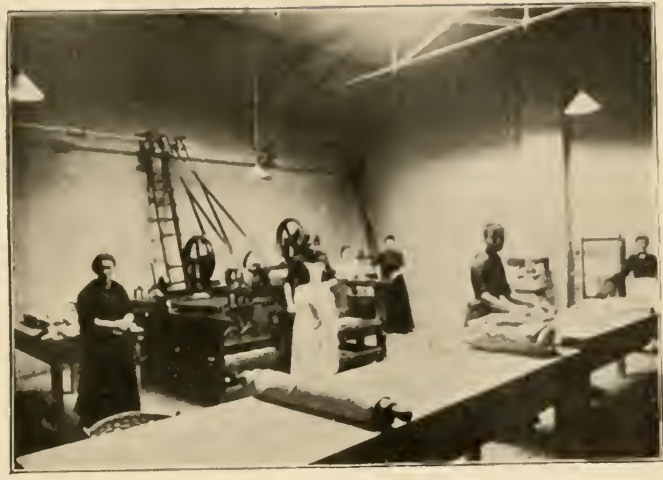
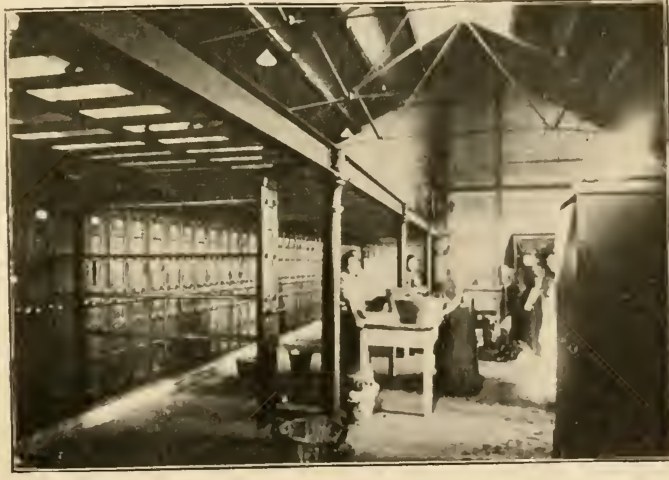
The later Hornsey Road photographs show another stage of this organization. The mangling room contains tables, machines and people; the drying room places large apparatus beside a working passage. Neither image should be treated as a complete record of the pace of an ordinary day. The figures may have paused for the camera, and a report promoting municipal provision had reasons to present its examples favourably.
Even with that limitation, the photographs resist a story of effortless mechanization. Textiles still had to be lifted, carried, spread, collected and finished. Machinery redistributed exertion between tasks and between users and attendants. Its presence alone cannot tell us how many hours a particular woman saved, or whether the saved time became rest rather than another form of work.
Washing for the household, washing for wages
The distinction between domestic service and commercial competition could become awkward at the washhouse door. A woman washing her own family’s linen and a woman washing a customer’s linen might use identical equipment. Administrators nevertheless had reasons to treat them differently.
The 1897 report said Hornsey Road’s rising hourly charges were intended to discourage professional washerwomen. It also explained a high charge for mangling alone as protection for poorer women earning money from that work. Public provision thus confronted a conflict within the same broad social group: cheap equipment for one user could undercut another person’s livelihood.
Paid laundry work should not be imagined as a marginal activity performed only by young servants. The Englishwoman’s Year-book of 1888, discussing occupational statistics, emphasized the older age profile of laundry and charing workers. Its categories and national figures cannot identify the people in a particular London washhouse photograph, but they warn against making a single youthful housewife stand for every washer.
Anne Spurgeon’s research on women factory inspectors examines the separate world of commercial laundries, where heat, long working hours and increasingly powerful machinery created occupational dangers. Those workplaces were not interchangeable with self-service public washhouses. Keeping them distinct helps explain the overlap: the same urban demand for clean linen sustained unpaid household work, small earnings and organized businesses.
A history concerned only with consumers’ convenience misses this economy of labour. Clean cuffs and sheets were finished products. Their cleanliness concealed the time and bodily effort invested by people whose work was often least visible precisely when it had been done successfully.
The uneven map behind the municipal façade
By the end of the century, impressive public buildings could make collective cleanliness look like an established civic duty. Their architecture did not demonstrate that every district had comparable facilities. The London County Council’s 1899 return recorded when parishes adopted the legislation, what they provided and how far charges met expenditure.
Earlier buildings could already operate on a substantial scale. John Marius Wilson’s gazetteer of 1870–1872 described Marylebone’s establishment as containing 107 baths and 89 washing stands. These are the categories of a contemporary description, not a count of customers at one moment. They show why the provision demanded land, construction and coordinated management: even a service purchased in small units of time depended on a large shared installation. Scaling it up meant more than distributing additional tubs.
The dates reveal delays. Islington adopted the Acts in 1889 and opened its first provision in 1892. Lambeth’s adoption in 1890 preceded provision in 1897. Other entries recorded facilities still being built or powers not yet adopted. A map of parliamentary authorization would have looked more complete than a map of open doors.
At Woolwich, the Survey of London traces arguments over whether washhouses should be omitted from the new complex. The baths opened in 1894, while an additional well and associated works followed. Water supply was an engineering and financial question, not something a handsome frontage could guarantee.
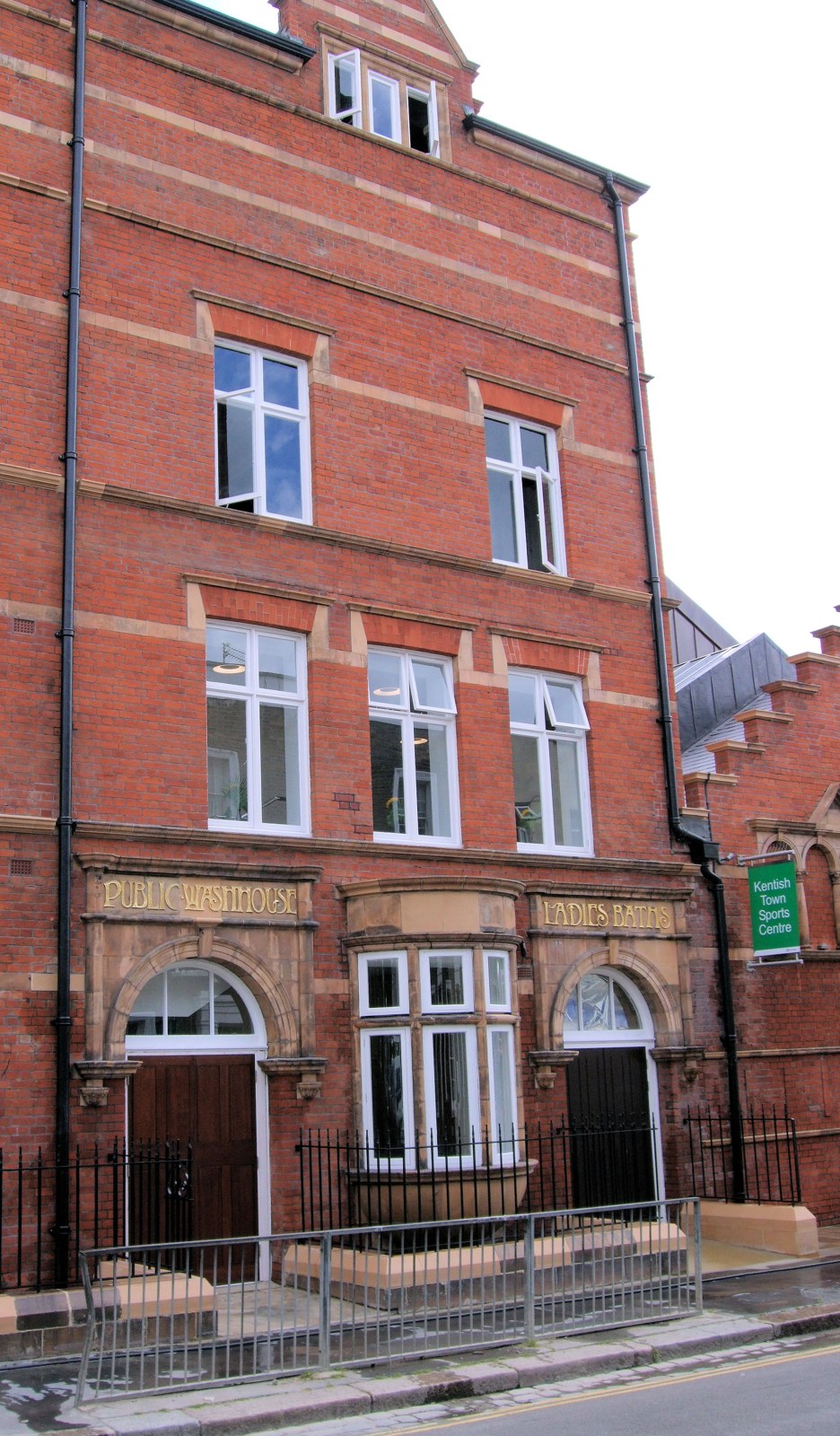
Woolwich’s layout also separated users by sex and class. Such divisions were not incidental decorations. Entrances and internal routes organized who could occupy which spaces and on what terms. The surviving lettering at Kentish Town, a complex opened in 1900, similarly makes the association between the public washhouse and women’s facilities visible on the street.
Sally Sheard’s comparative study of Liverpool, Belfast and Glasgow identifies a recurring tension between sanitary ambitions and municipal financial expectations. Those cities are not substitutes for London evidence. They clarify the wider question London’s own accounts pose: was a washhouse successful because it served people who needed it, because it covered its costs, or because it did both?
What the records count—and what they leave out
Reports accumulated visits, receipts, compartments and hours. These numbers matter, but they are not interchangeable. A total of washing visits need not represent that many different people. A full room demonstrates demand at a particular time, not universal access. An institution’s balance sheet does not record all the work its users continued to perform without wages.
The most revealing feature of the public washhouse is therefore the bargain embodied in Baly’s drawing. The community supplied an expensive setting for a task still treated as someone else’s domestic responsibility. That bargain could provide substantial relief without redistributing the work equally between women and men, or between those who washed and those who wore the clean clothes.
Victorian London’s washhouses made private need a matter of public infrastructure. Their achievement was practical and conditional: fewer operations forced into unsuitable rooms, shared access to heat and equipment, and new arguments about what local government ought to provide. The women beside the pipes and counterweights remind us what that infrastructure supported. It was not cleanliness in the abstract. It was work.