
Science, Invention & Exploration
Maria Sibylla Merian in Suriname: The Work Behind the Wings
Merian followed insects through their transformations. Her Suriname book also preserves the labor, local knowledge, uncertainty, and colonial violence behind its beautiful plates.
In January 1701, Maria Sibylla Merian found a red caterpillar near a flowering tree in Suriname. She intended to feed it leaves from that tree. Before the test could settle anything, the caterpillar pupated. When she later described the encounter, she left the uncertainty in print: she did not know whether she had found its proper food plant.
That small admission in the commentary to Plate LX is a good entrance to her work. Merian’s insects are famous for their beauty, but the pages contain more than attractive wings. They preserve observations made over time, attempts to keep animals alive, information from other people, and moments when an expected result did not arrive. They also carry the inequalities of the Dutch colony in which she worked. Her achievement becomes clearer when those parts remain together.
A question the cabinet could not answer
Merian was born in Frankfurt in 1647 and developed as both an artist and an observer of insects. In the preface to her Suriname book, she traced her interest back to silkworms and to the discovery that other caterpillars produced still more varied moths and butterflies. She collected larvae, watched their changes, and painted them. European volumes published in 1679 and 1683 preceded the voyage that would make her especially well known.
Her practice involved continuity. A captured caterpillar had to survive long enough to reveal what it became. That required food, containers, repeated attention, and a record connecting one stage to another. An adult specimen displayed in a cabinet could be astonishing, but it could not by itself show the sequence of its own development. Merian wanted to recover those missing relationships.
In the Netherlands she visited impressive collections belonging to men such as Nicolaas Witsen, Frederik Ruysch, and Livinus Vincent. Her preface praises the extraordinary creatures brought from overseas while identifying the missing information: how they originated and changed. The gap between a collected specimen and a known life history helped motivate her expensive journey to Suriname in 1699.
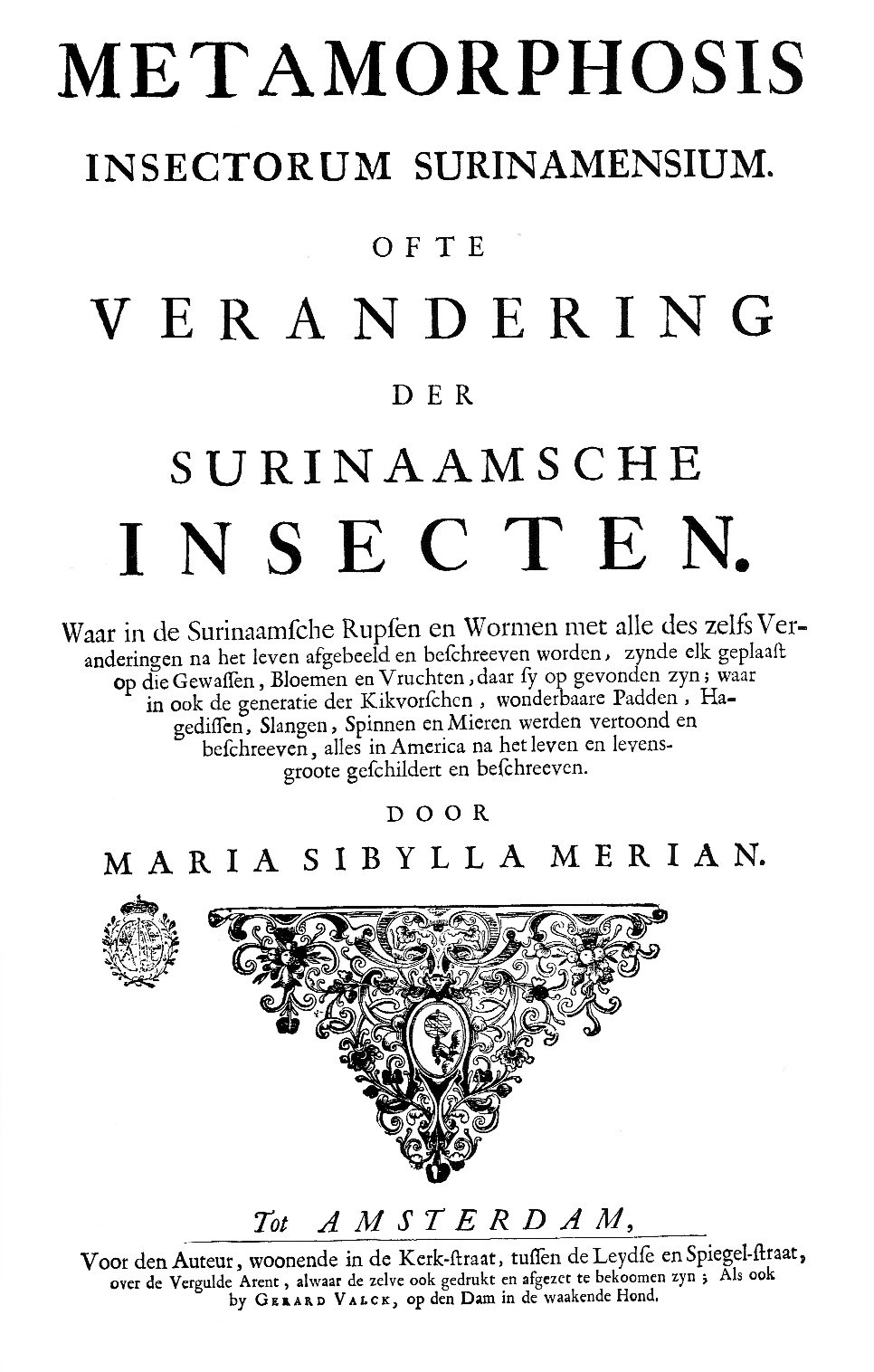
Merian did not begin scientific observation in an intellectual vacuum. The Royal Collection Trust’s account places her among readers and correspondents who included Jan Swammerdam, Jan Goedaert, Stephan Blankaart, Antoni van Leeuwenhoek, and James Petiver. She learned from other naturalists and could disagree with them.
Across the Atlantic with an established method
Merian was fifty-two when she traveled to Suriname with her younger daughter, Dorothea Maria. The journey took an experienced artist and investigator into a new environment. It also required money and professional support. Her work belonged to a market for drawings, prints, pigments, and specimens. A 1693 study now at the Metropolitan Museum of Art illustrates the kind of independent sheet she and her workshop could produce for collectors in Amsterdam.
Suriname was a Dutch colony, and the routes available to a European traveler were shaped by colonial settlement and plantations. From Paramaribo, Merian traveled into other settings to observe and collect. Utrecht University’s study of the book describes plantation bases and journeys along the Suriname River. The forest was neither empty territory nor an unknown world awaiting its first knowledgeable visitor. Indigenous people and people of African origin already possessed names, practices, and experience that the newcomer needed.
The task was also physically difficult. In her own preface Merian wrote that the heat disagreed with her and that conditions had proved less suitable for her investigations than she expected. She returned earlier than planned, leaving in 1701. Her published account records the limits that health and environment placed on the undertaking.
A plate could contain weeks of work
The opening commentary gives the pineapple a place of honor among edible fruits. Around that celebrated plant Merian discussed cockroaches, including their eggs, young, growth, and capacity to damage stored goods. The first plate’s text connects natural history with ordinary experience in the colony. A specimen could be an object of close attention and a troublesome household presence at the same time.
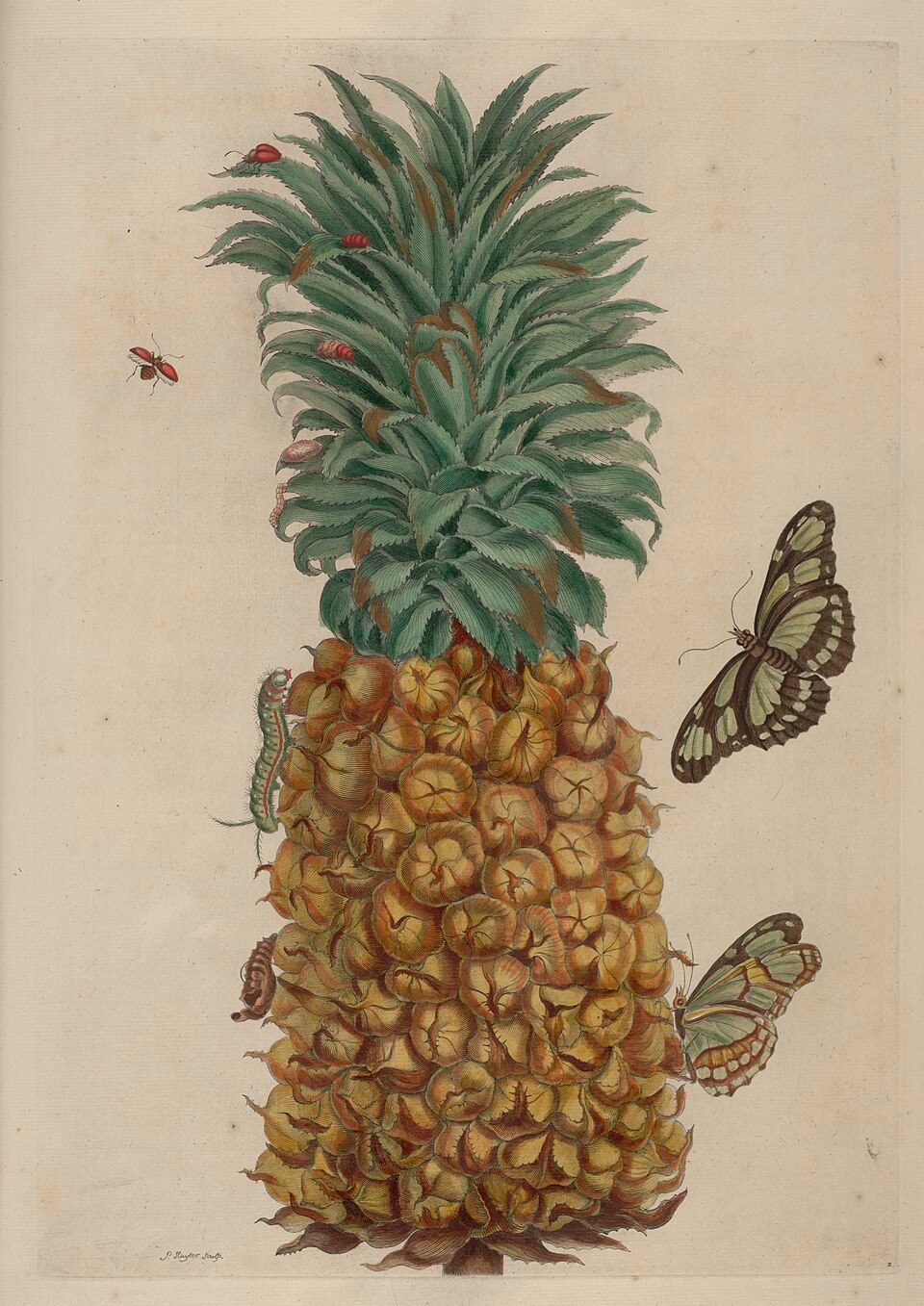
Her images brought several stages of life into one composition. A larva, pupa, and adult might share a plant even though they could not represent the same individual at one moment. The page condensed elapsed time. Its beauty helped a reader hold that sequence in view, while the accompanying words supplied dates and circumstances that a picture could not carry alone.
The arrangement is especially important when looking at plants. A branch was often part of an argument about the insect’s food or habitat, rather than decoration placed behind a specimen. This is why her work is frequently associated with an early ecological way of seeing. The phrase is useful if it describes her attention to relationships; it becomes misleading if it turns her into a modern ecologist with modern classifications and methods.
Observation also involved intervention. In the commentary to Plate XXXVI, Merian explained that a plant wilted too quickly when cut. An Indigenous assistant dug it up with its root and brought it home, where she planted it in her garden. The living plant then became something she could continue to watch. What appears on the finished page as an elegant botanical subject had passed through collecting, transport, transplantation, and care.
Whose work reached the page
That same commentary makes the structure of the expedition uncomfortable and unmistakable. Merian complained that local Europeans were interested in sugar rather than other things the forest contained. Yet her own access to the forest depended on enslaved labor. She described sending people she called her slaves ahead with axes to cut a way through dense growth.
The passage prevents a simple opposition between an enlightened observer and an entirely separate plantation world. Merian could criticize the narrowness of a sugar-centered economy while making use of the labor relations that sustained the colony.
Knowledge traveled along those unequal relationships too. In her preface Merian distinguished most of the observations she claimed to have made herself from some information added on Indigenous testimony. She also stated that she retained plant names used by inhabitants, with further botanical names supplied by Caspar Commelin. These acknowledgments are valuable. They remain filtered through an author who controlled which words and names entered the European publication.
The Natural History Museum’s discussion therefore emphasizes both her dependence on local assistance and the hardships described in her text. The people who found a plant, knew an animal’s habits, or made a path through the forest contributed to the conditions of discovery. They rarely received the durable personal identification available to engravers, European correspondents, and the author herself.
The peacock flower and colonial violence
Plate XLV is among the most difficult pages in the book. Beside a flowering plant and the stages of a moth, Merian reported that Indigenous women used the plant in response to enslavement, seeking to prevent children from being born into the same condition. She also described African women’s refusal of motherhood under brutal treatment and accounts of death associated with a hoped-for return to freedom. This is historical testimony about suffering and resistance, not a medical recommendation.
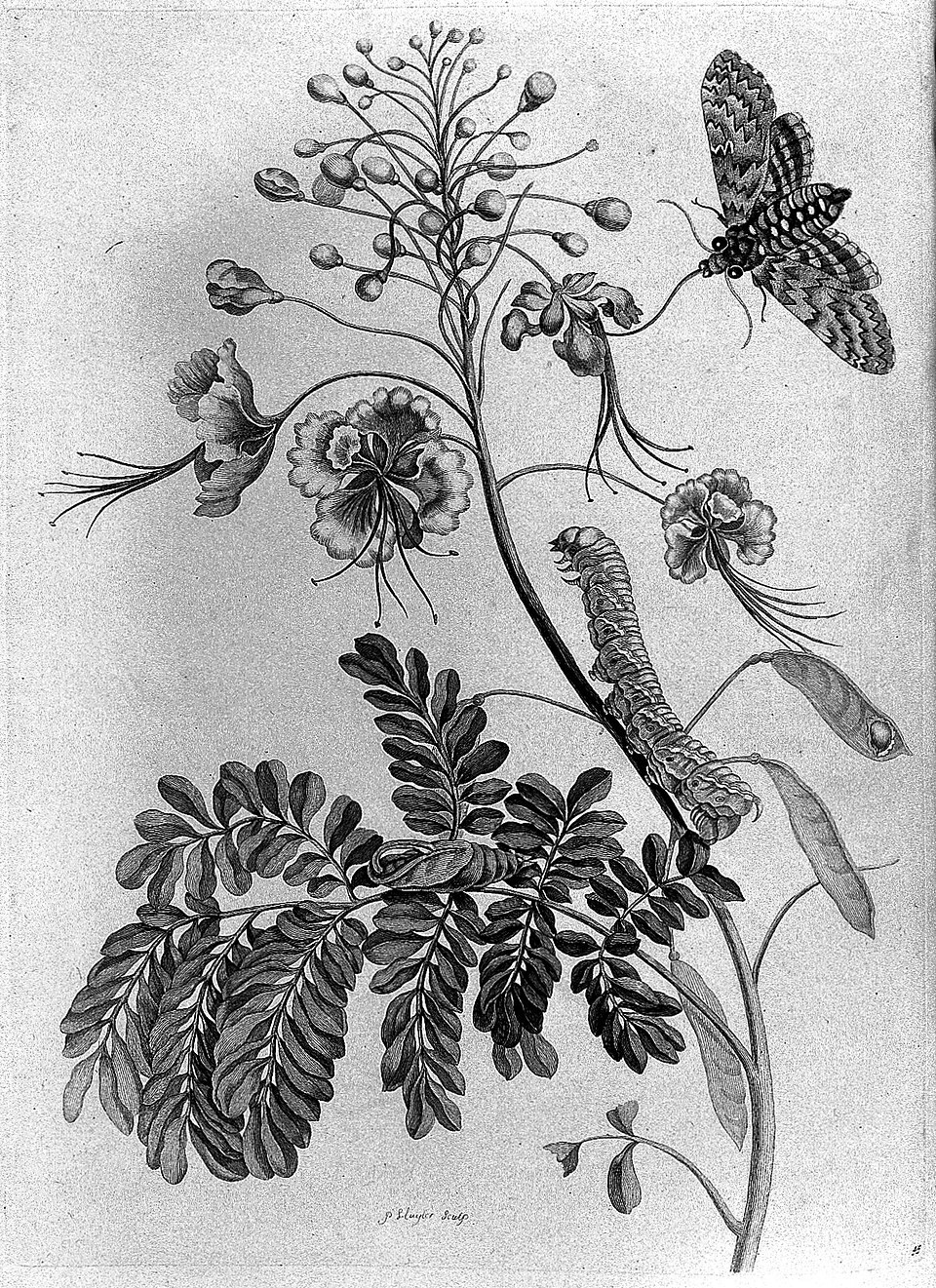
The original commentary matters for what it says and for the limits of who is speaking. Merian presented these accounts as information people gave her. Their voices survive through her selection, wording, and publication, rather than as independently recorded statements.
Nor does recording cruelty establish that Merian stood outside slavery or rejected every part of the system. Her account of commanding enslaved labor appears elsewhere in the same work. Both facts belong in the history. The book makes room for an unusually direct description of colonial violence while remaining a product of colonial access and unequal authority.
The page then returns to the caterpillars: when they became pupae, when moths emerged, and how the adults fed at flowers. That proximity can be startling to a modern reader. Plant knowledge, human reproduction, insect life, and the conditions of slavery occupy one printed surface. They were connected in the place where the research occurred, even if later readers preferred to isolate the beautiful illustration.
Accuracy, surprise, and error
Merian’s best-known animal drama appears in Plate XVIII, where spiders, ants, and small birds occupy a guava branch. Her commentary describes large spiders taking birds from nests, alongside accounts of ants and their behavior. The picture was a designed synthesis of observations and claims. It should not be read as a photograph of a single event she necessarily witnessed exactly as arranged.
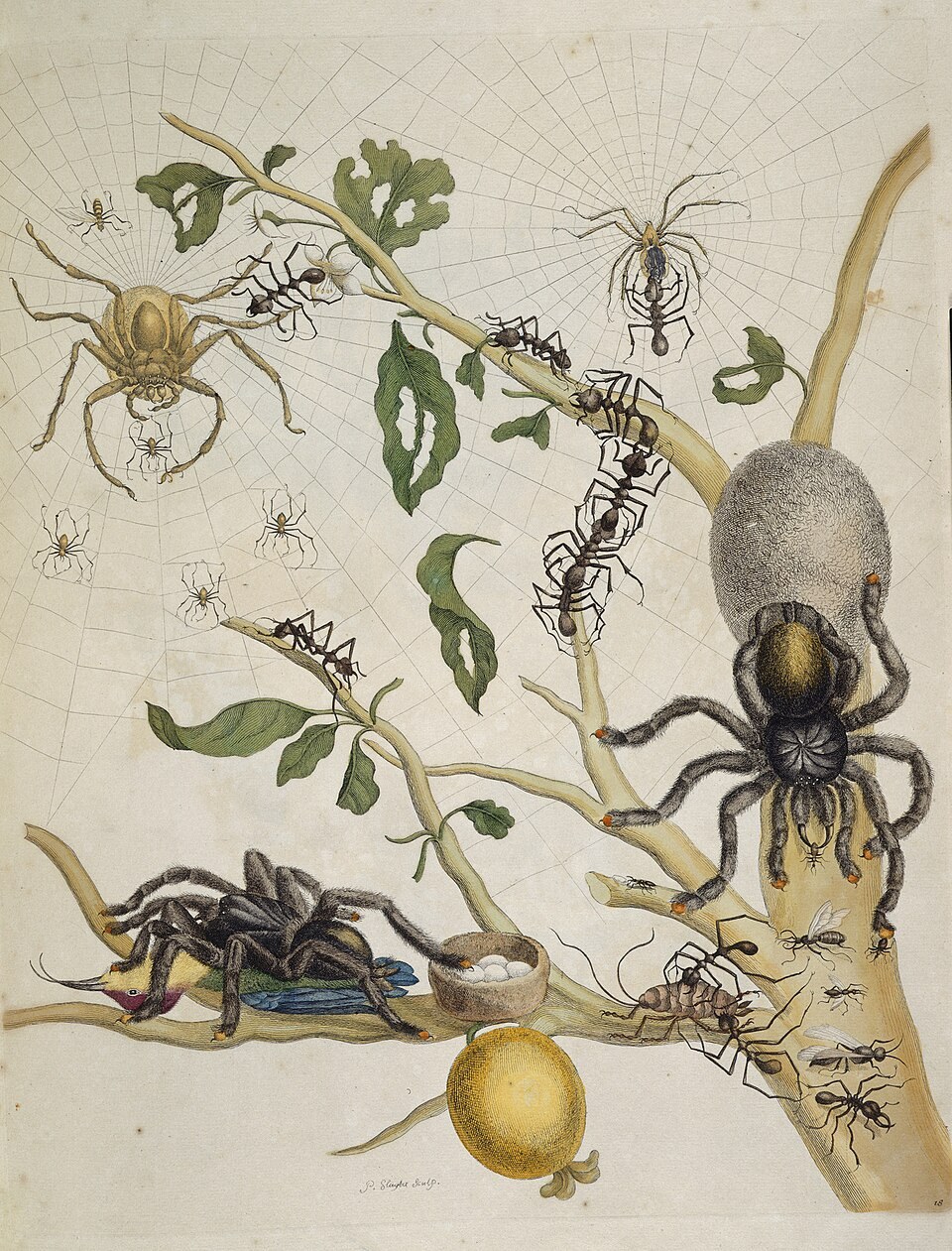
Historical natural history needs to be assessed claim by claim. An observation that sounded improbable to a European reader could be substantially sound; an appealing explanation could still be wrong. Merian’s pages include mistaken associations, and museum accounts acknowledge that not every caterpillar is matched correctly to its adult or food plant. The suggestion that materials became confused after the voyage is an explanation, not a proven account of every error.
Her explicit uncertainty in Plate LX gives a different example. Finding a larva on or near a plant did not establish that it normally ate that plant. Because it pupated before she could observe feeding, she withheld certainty. The point is small but methodologically important: the published image looks complete, while the text identifies a relationship that remained unconfirmed.
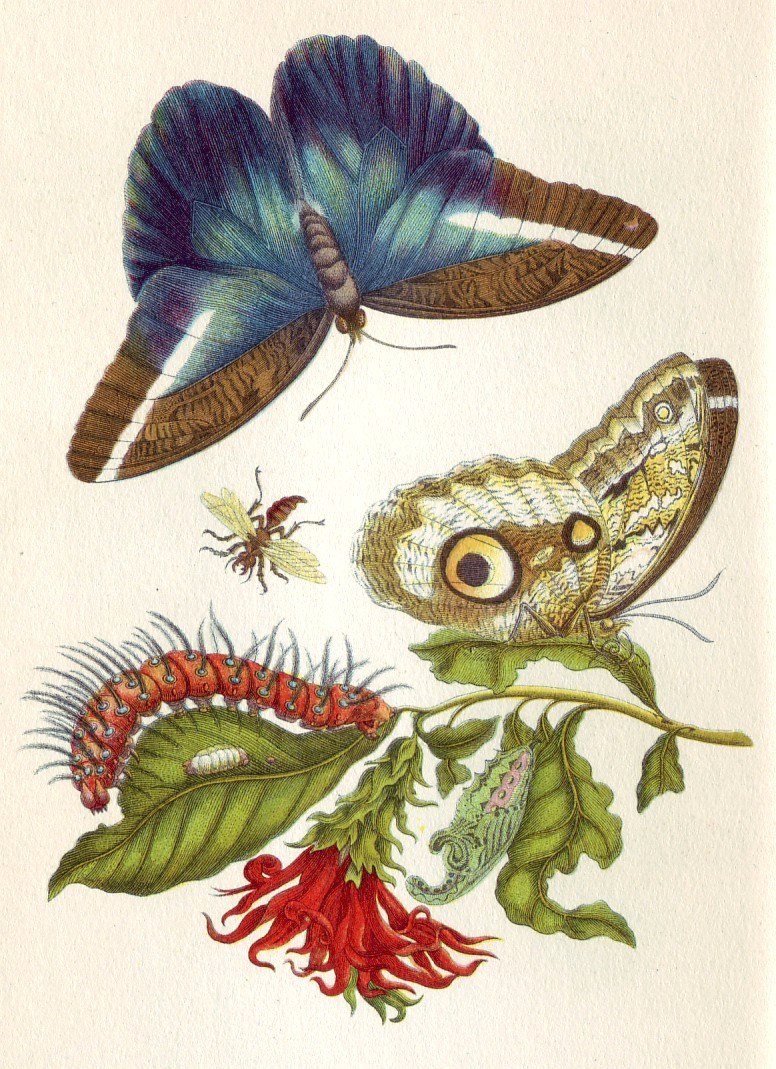
Reading the words beside the plate is therefore essential. An illustration can make an association seem more settled than the author intended.
The return journey continued in print
Back in Amsterdam, Merian worked her material into the book published in 1705. Sixty copperplates accompanied the descriptions. Producing them involved additional hands: Utrecht identifies engravers Jozef Mulder, Pieter Sluyter, and Daniel Stoopendael, alongside plates Merian engraved herself. Her daughters helped with coloring. The field journey had ended, but the conversion of experience into a saleable, reproducible work continued.
Merian’s preface is unusually clear about that effort. She wrote of the costs, the quality of paper and engraving, and her wish to satisfy people interested in art as well as those interested in plants and insects. She said she would be content to recover her expenditure. This statement belongs to the author’s presentation of her project; it also reveals that scientific communication needed a material and financial structure.
Later editions complicate the visual record. The 1719 edition expanded the work to seventy-two plates, and subsequent publications carried the images to new audiences. Counterproofs could reverse an image, and coloring could differ between copies. A plate reproduced from a 1726 edition is evidence of the work’s continuing life, but it should be labeled accordingly rather than silently presented as the exact sheet issued in 1705.
Merian’s lasting contribution is visible in that combination of patient sequence and composed image. She made transformations intelligible and drew attention to the plants that sustained them. Her book also preserves the conditions that helped make such knowledge possible: daughters’ work, engravers’ skill, collectors’ money, Indigenous expertise, and enslaved labor. To look closely at the wings is to look closely at all of them.
Sources and further reading
- Maria Sibylla Merian, To the Reader, Metamorphosis insectorum Surinamensium (1705)
- Merian, Plate I commentary (1705)
- Merian, Plate XXXVI commentary (1705)
- Merian, Plate XLV commentary (1705)
- Merian, Plate LX commentary (1705)
- Merian, Plate XVIII commentary (1705)
- Royal Collection Trust, Merian and Metamorphosis
- Utrecht University Special Collections, Metamorphosis by Merian
- Natural History Museum, Maria Sibylla Merian: Metamorphosis unmasked by art and science
- The Metropolitan Museum of Art, Study of Capers, Gorse, and a Beetle (1693)