
WORLD WAR II · EASTERN FRONT
Kursk: The Campaign Beyond the Tank Battle
Prokhorovka became the campaign’s defining image. The outcome depended on what happened across the salient, around Orel and in the August struggle for Kharkov.
On 12 July 1943, Soviet tanks attacked German positions near Prokhorovka, southeast of Kursk. The fighting became the most famous episode of the campaign. On the same day, much farther north, Soviet armies opened Operation Kutuzov against the German-held Orel salient. One action tested whether a German penetration could be checked; the other threatened the base from which the northern German offensive had begun.
Holding those events together changes the picture of Kursk. Its outcome developed through prepared defenses, breaches, costly counterattacks and successive offensives across a broad front. Prokhorovka mattered within that sequence. Making its tank losses stand for the whole campaign obscures both the difficulty of the Soviet victory and the reasons the German offensive failed.
The salient left by the winter
By spring 1943, the fighting after Stalingrad had left a large Soviet-held bulge around Kursk. German territory projected eastward around Orel to its north and around Belgorod and Kharkov to its south. The German counterstroke that retook Kharkov in March had demonstrated that Soviet advances could still be overextended and punished. It also helped establish the geography of the next major confrontation.
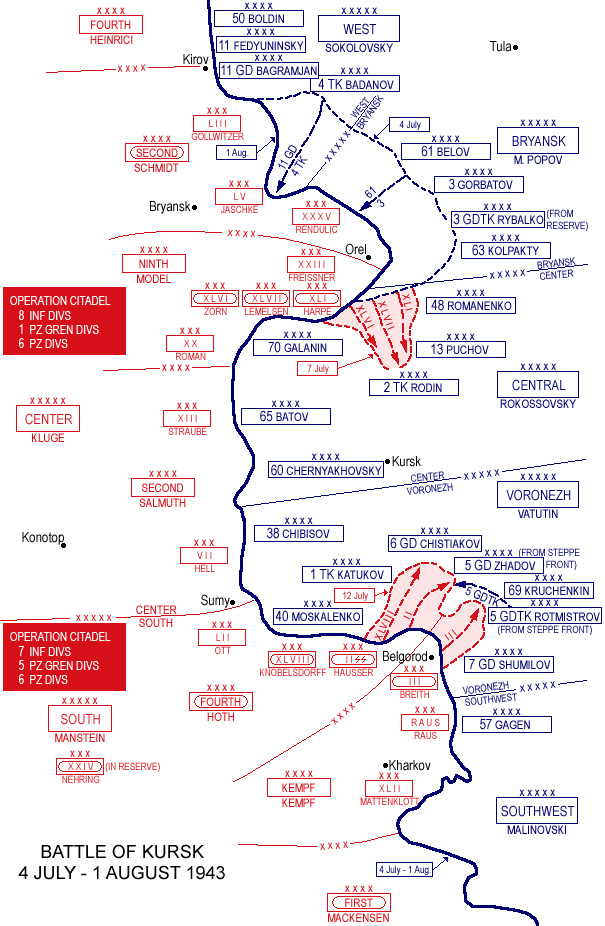
Operation Citadel proposed to cut off the Kursk salient with converging attacks. Walter Model’s Ninth Army would move south from the Orel region. Hermann Hoth’s Fourth Panzer Army would advance north from around Belgorod, with Army Detachment Kempf supporting its eastern flank. If they joined, the Germans could encircle Soviet forces and shorten their own line.
The obvious shape of the target also advertised the approach. As the Tank Museum’s campaign background explains, successive postponements gave both armies time to prepare. Germany accumulated reinforcements and new equipment, while Soviet forces strengthened the ground through which that equipment would have to pass. Delay changed both sides of the calculation.
,_Aufmunitionieren.jpg)
Defense with another operation behind it
Konstantin Rokossovsky’s Central Front defended the northern face of the salient; Nikolai Vatutin’s Voronezh Front held the south. Additional forces assembled behind them in the Steppe reserve, subsequently organized as Steppe Front under Ivan Konev. Soviet planning allowed for a defensive battle followed by counteroffensives against the German concentrations on either side.
This required distributing strength across several problems. Forward formations needed enough artillery and anti-tank weapons to hold or delay the first attacks. Reserves had to remain available to seal dangerous penetrations. Other forces would be needed to take the offensive. Committing everything to the first line would endanger the later stages; holding too much back could let the defensive battle collapse.
David Glantz’s Soviet Defensive Tactics at Kursk, July 1943 describes a system of positions arranged in depth and supported by mobile reserves. Its strength depended on how those elements worked together. The existence of additional lines gave commanders somewhere to absorb an attack and time in which to respond. It did not ensure that every threatened formation would survive.
The work behind the defensive lines
The defenses were built through months of labor by soldiers and civilians. Trenches, shelters, anti-tank ditches and minefields altered the terrain on likely axes of approach. Artillery and anti-tank guns covered obstacles so that a halted vehicle or an engineer clearing a lane could come under fire. Infantry protected gun positions against close assault.
The effect was cumulative. A minefield could force tanks toward a gap; the gap could be covered by guns; clearing or bypassing it could cost time and disrupt an attacking formation. Even a successful breach could bring the attackers to another defended position before they reached the open country they needed.
Conditions varied across the battlefield, and the Germans did penetrate the defenses. The distinction between a breached position and a defeated defensive system is essential here. An attacker might win the immediate engagement while giving the defending command additional time to move its reserve. At Kursk, each side was fighting over the rate at which those local successes could accumulate.
What the tanks could and could not do
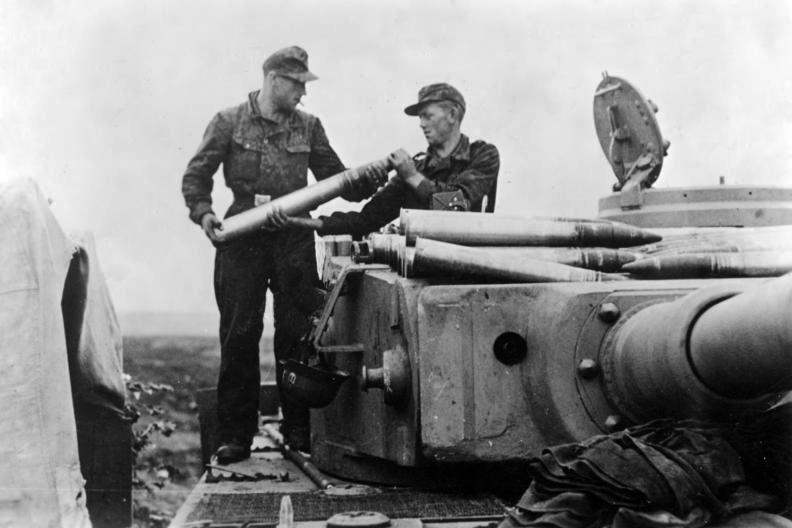
The Tiger and the newly introduced Panther attracted attention because their armor and weapons could give them substantial advantages in particular engagements. Yet older Panzer IIIs and IVs, assault guns, infantry, engineers and artillery remained integral to the German attack. New machines also introduced maintenance and recovery problems. A powerful tank that broke down before reaching the firing line contributed little to that day’s advance.
The Tank Museum’s examination of German vehicles shows the importance of distinguishing their roles. The Ferdinand heavy tank destroyer, employed in the northern battle, offered formidable long-range firepower but was difficult to recover when immobilized. The battlefield imposed demands beyond the thickness of armor or the size of a gun.
Soviet formations were equally mixed. T-34s fought alongside lighter T-70s and other vehicles; the later T-34-85 had not yet entered service. The museum’s Soviet vehicle study describes production choices shaped by the need to replace catastrophic earlier losses. A tank total therefore conceals differences in firepower, crew workload and survivability. Numbers mattered, but they never made the machines interchangeable.
The northern attack loses its momentum
After preliminary fighting, the main German offensive opened on 5 July. In the north, Model’s army encountered Central Front’s prepared positions and reserves. The fighting around Ponyri and the heights near Olkhovatka demanded repeated attacks against successive obstacles. German armor could support an assault without finding the room for a rapid exploitation beyond it.
Claudio R. Innocenti’s U.S. Army analysis of Citadel explains the combined-arms work needed to make a breach: suppressing defenders, screening engineers, clearing obstacles and getting assault forces through before the opponent could react. Those demands help explain why the advance cannot be understood as a succession of tank duels.
In the northern sector the slowing attack had consequences for the entire German plan. Hoth’s army in the south could not complete a double envelopment alone. Even if it continued moving, the distance and Soviet resistance between the two attacking groups remained. The northern battle placed a limit on what southern tactical success could achieve.
.jpg)
A more dangerous penetration in the south
Hoth’s forces made deeper progress against Voronezh Front. The Soviet command had to bring reserves into a battle whose direction and tempo changed as the Germans advanced. German formations also faced their own coordination problem: the progress of one corps could expose it if a neighboring force lagged behind.
By the time the fighting approached Prokhorovka, the Soviet command was attempting to restore the situation with major reinforcements, including Pavel Rotmistrov’s Fifth Guards Tank Army. Its commitment reflected the seriousness of the penetration. It also meant that forces intended to help exploit a later victory were now being used to contain an immediate threat.
Glantz and Jonathan House’s The Battle of Kursk places these movements within a sequence of hurried commitments and engagements on neighboring axes. That wider setting matters: Prokhorovka was reached through several days of fighting, and the forces arriving there were responding to an evolving battlefield rather than assembling for a single, prearranged armored contest.
What happened at Prokhorovka
On 12 July, the Soviet counterattack struck the German II SS Panzer Corps near Prokhorovka. Soviet armored formations suffered severe losses and did not destroy the German corps as later heroic accounts suggested. German troops held important parts of the battlefield after the fighting, with corresponding opportunities to recover damaged vehicles.
Postwar descriptions often compressed the action into an enormous head-on collision in which masses of German tanks were annihilated. Research using unit records has dismantled that version. The Tank Museum’s review of the Prokhorovka debate explains why even the number of vehicles involved depends on which adjacent formations and sectors are included.
Ben Wheatley’s study of German reconnaissance photographs added visual evidence of Soviet wrecks and the battlefield’s restrictive terrain. The images support an account of a costly Soviet attack. They do not turn a local German defensive success into proof that the whole Citadel operation remained close to achieving its original objective.
Why loss figures need their labels
A vehicle reported out of action was not necessarily destroyed beyond repair. A tank could be damaged, recovered and returned to service, or abandoned during a later withdrawal. Reports compiled on different dates may therefore describe different stages of the same vehicle’s fate. Personnel losses, damaged vehicles and permanent equipment write-offs answer different questions.
Christopher A. Lawrence of the Dupuy Institute identifies three recurring problems: defining the battlefield, identifying the day of loss and deciding what a loss means. Roman Töppel’s review of the Prokhorovka evidence likewise challenges the certainty of some highly specific claims made from the photographs.
These cautions allow the broader finding to remain clear without offering a spurious exact score. The Soviet attack was much more costly than its subsequent legend admitted. The German armored formations were not obliterated there. Establishing those points still leaves a separate question: what could the surviving forces accomplish as threats multiplied across the front?
12 July also meant Orel
Operation Kutuzov began while the fighting at Prokhorovka was taking place. Soviet attacks from the north and east threatened the Orel salient and compelled the Germans to divert forces toward its defense. Central Front subsequently joined the offensive from the south. Model’s command increasingly had to protect a position behind and beside the starting area of his own attack.
The Army’s Historical Perspectives of the Operational Art stresses that the Soviet advance against Orel itself became a hard struggle. German defenses and countermeasures prevented a quick, inexpensive exploitation. Nevertheless, the offensive forced a change in the German problem: reserves required for renewed movement toward Kursk were now needed to prevent the deterioration of another sector.
Orel was retaken on 5 August, and German forces withdrew toward the Hagen position farther west. The northern campaign had carried the fighting beyond the restoration of the lines held before Citadel. It had removed the German salient from which one half of the planned envelopment had been launched.
From the end of Citadel to the battle for Kharkov
At the conference of 13 July, Hitler moved to terminate Citadel. The Allied landing in Sicily on 10 July increased his concern about the Mediterranean. The danger around Orel and other anticipated Soviet attacks also constrained his choices. Manstein argued for further action in the south and received time for limited operations, but the original two-pronged offensive was coming apart. Earl F. Ziemke’s account of these decisions shows why Sicily alone cannot explain the outcome.
The Red Army then renewed the southern campaign. Operation Rumyantsev opened on 3 August against the Belgorod–Kharkov area. Belgorod fell on 5 August. German counterattacks around Bogodukhov and Akhtyrka inflicted further losses and disrupted Soviet advances, demonstrating that the armored forces still retained considerable combat power. Their success in particular engagements did not restore the position from which Citadel had begun.
Kharkov returned to Soviet control on 23 August, the conventional endpoint of the wider Kursk campaign. By then the fighting had moved from defending the salient to pressing German forces back across a broad stretch of the front. Soviet units had paid heavily and still faced difficult river crossings and fresh battles. The next major operations would carry them toward the Dnieper, as described in Ziemke’s history of the Soviet summer offensive.
Sources
- David M. Glantz, Soviet Defensive Tactics at Kursk, July 1943, Combat Studies Institute, 1986.
- The Tank Museum, “Background to the Battle of Kursk”, “German Tanks at Kursk”, “Soviet Tanks at Kursk”, and “Prokhorovka and the Myth of the Largest Tank Battle”, 2017.
- Claudio R. Innocenti, “Battle Analysis: Operation Citadel (Kursk)”, ARMOR, March–June 2014; used here for the combined-arms breaching discussion.
- Ben Wheatley, “A Visual Examination of the Battle of Prokhorovka”, Journal of Intelligence History 18, no. 2 (2019), pp. 115–163.
- Christopher A. Lawrence, “Kursk Aerial Photos”, The Dupuy Institute, 22 July 2019.
- Roman Töppel, “Die Panzerschlacht bei Prochorowka: Fakten gegen Fabeln”, Portal Militärgeschichte, 2019.
- Michael D. Krause and R. Cody Phillips, editors, Historical Perspectives of the Operational Art, U.S. Army Center of Military History, 2005, discussion of Soviet operational maneuver.
- Earl F. Ziemke, Stalingrad to Berlin: The German Defeat in the East, U.S. Army Center of Military History, 1968, chapters VII–VIII. Its operational chronology is read alongside later scholarship on Prokhorovka.
- For extended study: David M. Glantz and Jonathan M. House, The Battle of Kursk, University Press of Kansas, 1999.