
WORLD WAR II · EASTERN FRONT
Stalingrad: The City Battle and the Trap Beyond Its Flanks
The struggle along the Volga consumed German strength and attention. Operation Uranus struck the wider front on which the army in Stalingrad depended.
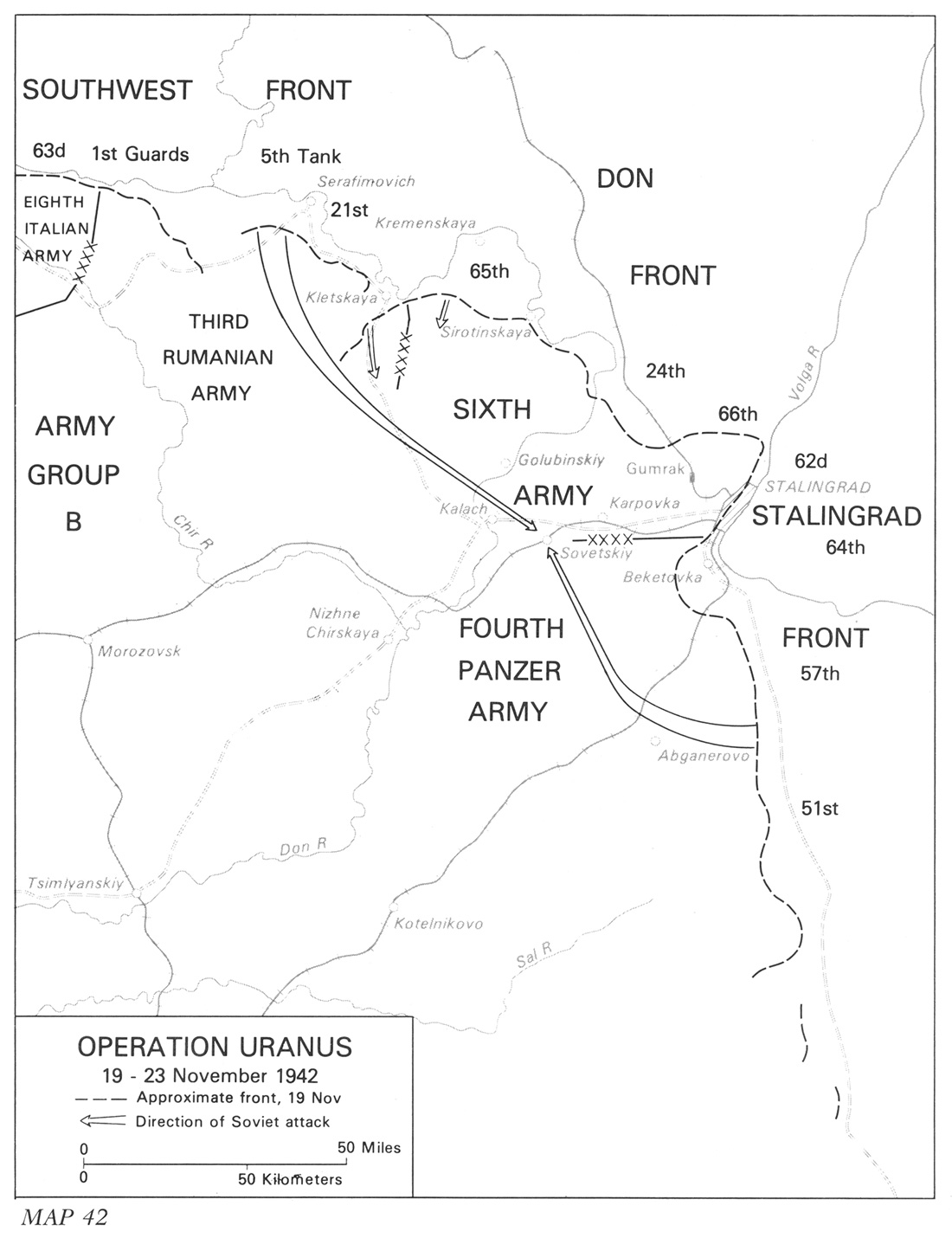
On 19 November 1942, German soldiers were still fighting for the last Soviet positions in Stalingrad when artillery opened against the Romanian army far to their northwest. Another Soviet attack followed south of the city the next day. Within four days, the attackers had joined behind the German Sixth Army. The force that had spent the autumn trying to push its enemies into the Volga now faced an enemy across its own routes of retreat and supply.
That reversal grew out of the relationship between two battlefields. Inside Stalingrad, fighting narrowed to factory buildings, cellars and landing places. Outside it, the campaign stretched across river bends and open steppe. German commanders could measure progress in the city and still lose control of the conditions that made continued fighting possible. Operation Uranus attacked that widening gap.
How the southern offensive reached the Volga
Germany’s summer offensive of 1942 began with ambitions extending well beyond Stalingrad. The Caucasus oilfields offered a resource the German war economy badly needed, while the Volga carried traffic through the Soviet interior. As the offensive developed, Army Group South was divided: Army Group A moved toward the Caucasus, and Army Group B advanced toward the Volga. These operations increasingly competed for transport, supplies and reserves across an enormous area.
The Red Army’s retreat was costly and disorganized in places, but it was accompanied by repeated counterattacks. Historian Yan Mann’s contribution to the National WWII Museum’s study of Soviet adaptation emphasizes the fighting on the approaches to Stalingrad. Newly organized armored formations suffered from poor coordination and mechanical difficulties, yet their attacks obliged German formations to deploy, consume ammunition and interrupt their advance. The army that entered the city had already fought a demanding campaign. Its arrival did not mark the beginning of Soviet resistance.

A city that could still receive reinforcements
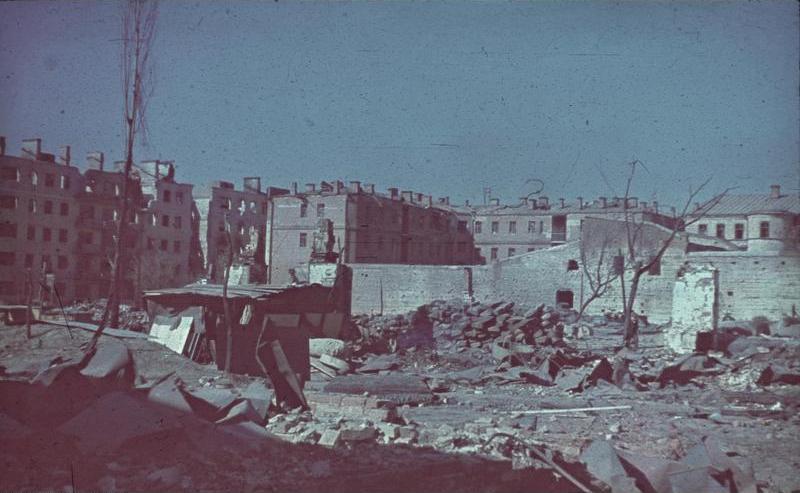
German troops reached the Volga north of Stalingrad on 23 August, the same day that heavy bombing devastated the city. During September the struggle moved into its central districts; in October the industrial area became a principal focus. The Soviet 62nd Army, commanded by Vasily Chuikov, eventually held a collection of cramped positions along the western bank.
The river made those positions precarious, but it also connected them to a rear area the Germans had not captured. Men and ammunition crossed under fire, often at night. Wounded men traveled back. Soviet artillery on the eastern bank could support troops in the city without sharing all the dangers of the shattered streets. As the military study Sharp Corners observes, the Germans never completely isolated the defenders.
This distinction mattered every time an assault seemed to have exhausted a Soviet formation. A narrow foothold with an operating crossing could be reinforced. German success therefore depended on more than occupying most buildings: it required breaking the remaining defenders’ connection with the army beyond the river.
The civilians inside the battlefield
Stalingrad was still inhabited when the fighting arrived. Evacuation had been delayed by production demands, official resistance to departure and failures of preparation. Some residents escaped across the Volga; others remained in ruined houses and shelters while the front moved through their neighborhoods. Crossing the river itself could be deadly, and safety on the opposite bank did not necessarily bring food or accommodation.
The National WWII Museum’s account of civilian witnesses describes how women, children and elderly residents survived amid bombardment and shortages. It also cautions that casualty estimates remain contested. A single precise total would obscure the difficulty of counting people killed in raids, buried beneath buildings, displaced or later dead from deprivation.
For commanders, a factory or apartment block could become a position on a map. For its remaining inhabitants, the same space was shelter, a source of water or the route to a family member. Military control could change without removing civilians from danger.
Why another assault kept looking worthwhile
Urban fighting imposed a punishing cycle. Engineers opened routes or attacked strongpoints; infantry had to occupy and clear the ground; tanks and artillery supported them where the terrain allowed. Rubble obstructed movement while providing cover. Capturing a building did not automatically secure adjoining rooms, streets or underground approaches. The Combat Studies Institute’s Block by Block treats Stalingrad as a case in the demands such fighting placed on units and supporting arms.
German gains were real. They repeatedly cut deeper into Soviet positions and reached the river in additional places. That helped sustain the expectation that one more concentration of troops would finish the job. Yet each renewed attack required fresh effort from formations already worn down.
The danger lay in how these local successes were valued. Ground won in the city was visible and politically important. The cost appeared elsewhere as fewer rested units available for a crisis, less freedom to reposition armor and another demand on an already strained supply system. An unfinished urban battle continually competed with the protection of the entire army.
The flanks were vulnerable, and the vulnerability was known
Romanian Third Army held the northern flank along the Don; Romanian forces associated with Fourth Army guarded the southern approaches. Farther along the Axis front were Italian and Hungarian armies. The disposition reflected Germany’s dependence on its allies to occupy a frontage German manpower could no longer cover alone.
Explaining the subsequent disaster as a simple failure of Romanian courage misses the military problem. Long sectors, inadequate anti-tank resources and insufficient mobile support left defenders vulnerable to a concentrated armored attack. Soviet bridgeheads on the Don also provided starting points from which an offensive could develop. Once a penetration widened, local resistance needed a reserve capable of restoring a connected front.
German headquarters received signs of Soviet preparations. Earl F. Ziemke and Magna E. Bauer’s official U.S. Army history records the increasing concern alongside continuing demands for attacks inside Stalingrad. The contradiction was practical: acknowledging a threat did not itself provide fuel, reserves or an agreed decision to abandon another objective. The exposed flanks were concealed by the city’s claims on attention and resources more than by complete ignorance of their existence.
Building a counteroffensive around the city
Operation Uranus required a different scale of preparation from the repeated hurried counterattacks of the summer. The Soviet high command assembled forces on both sides of the German concentration, while the defenders in Stalingrad continued holding the enemy’s attention. Southwestern, Don and Stalingrad Fronts had separate tasks within an operation designed to cut the land connections behind the Axis armies.
The problem was more demanding than drawing two arrows on a map. Assault troops had to breach defensive positions; mobile formations had to pass through; following units had to occupy ground and protect the advancing forces. Keeping the Germans engaged while concealing the size and purpose of the buildup improved the prospect that these stages could unfold before a powerful counterattack arrived. The Army University Press study Weaving the Tangled Web places this preparation within the Red Army’s developing use of operational deception.
The city’s continued survival was therefore important to the larger operation. It imposed an immediate German commitment while Soviet commanders prepared to strike at a greater distance.
Four days that changed the campaign
The northern offensive began on 19 November; the southern attack followed on 20 November. Soviet forces broke through the Romanian-held sectors and advanced toward the crossings and communications west of Stalingrad. On 23 November the pincers joined in the Kalach–Sovetsky area. Sixth Army and other Axis formations were enclosed in a large pocket encompassing the city and surrounding country.
Encirclement was an operational achievement, not the immediate destruction of everyone inside. David Glantz’s Endgame at Stalingrad, Book One distinguishes the breakthrough and closing of the ring from the subsequent fighting to reduce the pocket and establish an outer front. Those were different jobs. Troops facing inward had to contain the trapped army; troops facing outward had to prevent its relief.
This helps explain why the battle continued for more than two months. German units retained weapons, command structures and the ability to resist. Soviet forces had achieved the position from which they could destroy the pocket, but still had to defend that advantage against intervention from outside.
An air bridge with no dependable margin
Hitler ordered the encircled forces to hold their positions. The decision depended on supplying them by air while a relief force approached. The Luftwaffe could deliver some supplies and evacuate some wounded, but sustaining an entire army required a dependable daily flow through a system vulnerable at every stage.
Aircraft needed serviceable engines, crews, fuel, navigable weather and usable landing grounds at both ends. Loads had to arrive at the departure airfields and be moved onward after landing. Soviet fighters and anti-aircraft defenses interfered with the routes; Soviet ground advances threatened the bases themselves. Derek M. Salmi’s Air University study, Behind the Light Switch, examines these interacting failures.
A successful flight could feed a unit without making the overall undertaking sustainable. As stocks dwindled, the pocket’s ability to move and fight also declined. Waiting for relief consumed the fuel, strength and time that an attempted escape would have required.
Relief, retreat and the end of the pocket
Operation Winter Storm began on 12 December, sending German armor toward Stalingrad from the southwest. It made progress but failed to establish contact with the trapped army. Meanwhile, Soviet Operation Little Saturn opened on 16 December against the Axis front farther west, including the Italian Eighth Army. The resulting danger to communications and airfields drew German attention and resources away from the relief attempt.
The widening crisis is central to Timothy A. Wray’s Standing Fast: German Defensive Doctrine on the Russian Front During World War II. German commanders were trying simultaneously to protect relief routes, maintain a broad defensive front and preserve forces farther south. By late December, the prospect of rescuing Sixth Army had receded while the struggle to prevent a still larger disaster continued outside the pocket.
Soviet Operation Ring began on 10 January 1943. The remaining German-held area contracted, and the loss of airfields further reduced supply and evacuation. Paulus and the southern pocket surrendered on 31 January; resistance in the northern pocket ended on 2 February. Imperial War Museums gives approximately 91,000 prisoners for the final surrender. That figure describes the surviving prisoners at the battle’s end, rather than everyone originally surrounded or everyone killed during the campaign.
Beyond Stalingrad, Axis forces were already withdrawing and attempting to rebuild their front. The Soviet advance would face further resistance and reverses, including the German counterstroke around Kharkov. Inside the city, the fighting had finally stopped. The army that had reached the Volga the previous summer had ceased to exist as an effective field formation.
Sources
- Earl F. Ziemke and Magna E. Bauer, Moscow to Stalingrad: Decision in the East, U.S. Army Center of Military History, 1987, especially chapters XXI–XXIII.
- National WWII Museum, “Stalingrad: Experimentation, Adaptation, Implementation” and “Unsung Witnesses of the Battle of Stalingrad”, 2022.
- William G. Robertson and Lawrence A. Yates, editors, Block by Block: The Challenges of Urban Operations, Combat Studies Institute, 2003.
- Roger J. Spiller, Sharp Corners: Urban Operations at Century’s End, Combat Studies Institute, 2001.
- Christopher M. Rein, editor, Weaving the Tangled Web: Military Deception in Large-Scale Combat Operations, Army University Press, 2018.
- Derek M. Salmi, Behind the Light Switch: Toward a Theory of Air Mobility, Air University Press, 2020, Stalingrad case study.
- Timothy A. Wray, Standing Fast: German Defensive Doctrine on the Russian Front During World War II, Combat Studies Institute, 1986.
- Imperial War Museums, Second World War Galleries, large-print guide, Stalingrad display.
- For extended operational study: David M. Glantz with Jonathan M. House, Endgame at Stalingrad, Book One: November 1942, University Press of Kansas, 2014.