
Books & Movies · Critical introduction
John Doe Chinaman and the Laws Beyond the Border
Beth Lew-Williams’s 2026 Cundill winner moves the history of Chinese exclusion from the port of entry into the workplace, classroom and family.
On 10 May 1886, the United States Supreme Court decided a case about a San Francisco laundry. The business had passed inspections for fire safety and sanitation. Its proprietor had worked at the same premises for twenty-two years. Yet the city’s supervisors had refused the permission required to operate a laundry in a wooden building. A ten-dollar fine, followed by imprisonment when it was not paid, carried the dispute into constitutional history. The case was Yick Wo v. Hopkins. Its subject was not admission to America, but the terms on which someone already there could earn a living.
That distinction is a useful way into Beth Lew-Williams’s John Doe Chinaman: A Forgotten History of Chinese Life under American Racial Law. On 23 October 2026, the book won the Cundill History Prize. The award supplies a specific reason to revisit it now. The larger reason is its question: what becomes visible when the history of exclusion follows people beyond the immigration checkpoint, into a shop, a school or a household?
Reading scope: This is a critical introduction based on the publisher’s description, the author’s published interview, JSTOR’s contents and public chapter previews, and independently consulted historical documents. It is not a claim to have read the complete book. The historical cases discussed below provide context; they should not be mistaken for a chapter-by-chapter account of Lew-Williams’s treatment.
A different map of exclusion
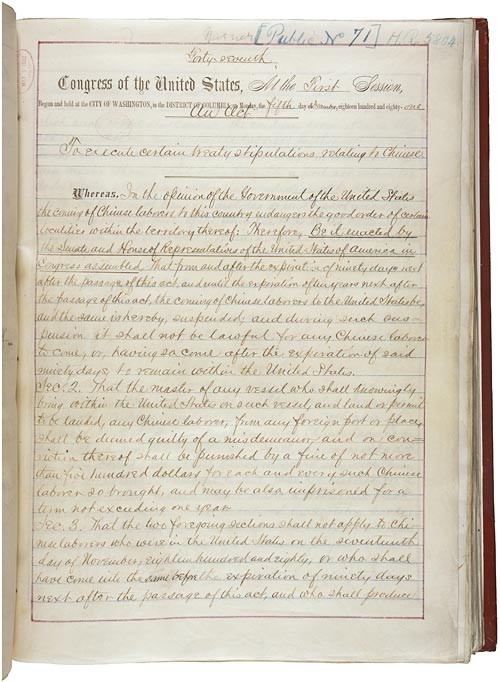
The familiar starting point is the Chinese Exclusion Act. Approved on 6 May 1882, it suspended the immigration of Chinese laborers for ten years, imposed documentary requirements and barred the naturalization of Chinese immigrants. The law was renewed and its restrictions extended. The National Archives’ text of the act makes clear that this was not merely an expression of hostility: it assigned duties, demanded certificates and attached penalties to noncompliance.
Lew-Williams shifts the scale. In a January 2026 author interview, she describes searching local archives, courthouses and historical societies in California, Oregon and Washington rather than relying primarily on centralized federal records. She identifies about five thousand state and local laws from 1850 to 1920 affecting Chinese residents. Their reach extended into education, property, business, healthcare and family relationships. Work with researcher Hannah Postel brought quantitative methods to the identification and categorization of these measures.
The methodological promise is considerable. A border-centered history asks who could enter, leave or return. A local history asks who could rent, trade, learn, marry or move without harassment. These are connected questions, but they are not interchangeable. A person could be physically present in the country while facing repeated obstacles to making a stable life there. Conversely, a successful challenge to a municipal ordinance did not erase federal restrictions on entry or naturalization.
Thinking at several scales also changes what counts as a consequential historical event. A statute signed by a president is easy to mark on a timeline. A licensing refusal or an exclusion from a classroom can seem smaller. But for the person concerned, that apparently minor administrative decision may determine wages, schooling or the possibility of keeping a family together. The book’s stated approach invites readers to regard such encounters as part of governance, not as incidental prejudice surrounding the real political story.
When a neutral rule was not neutral government
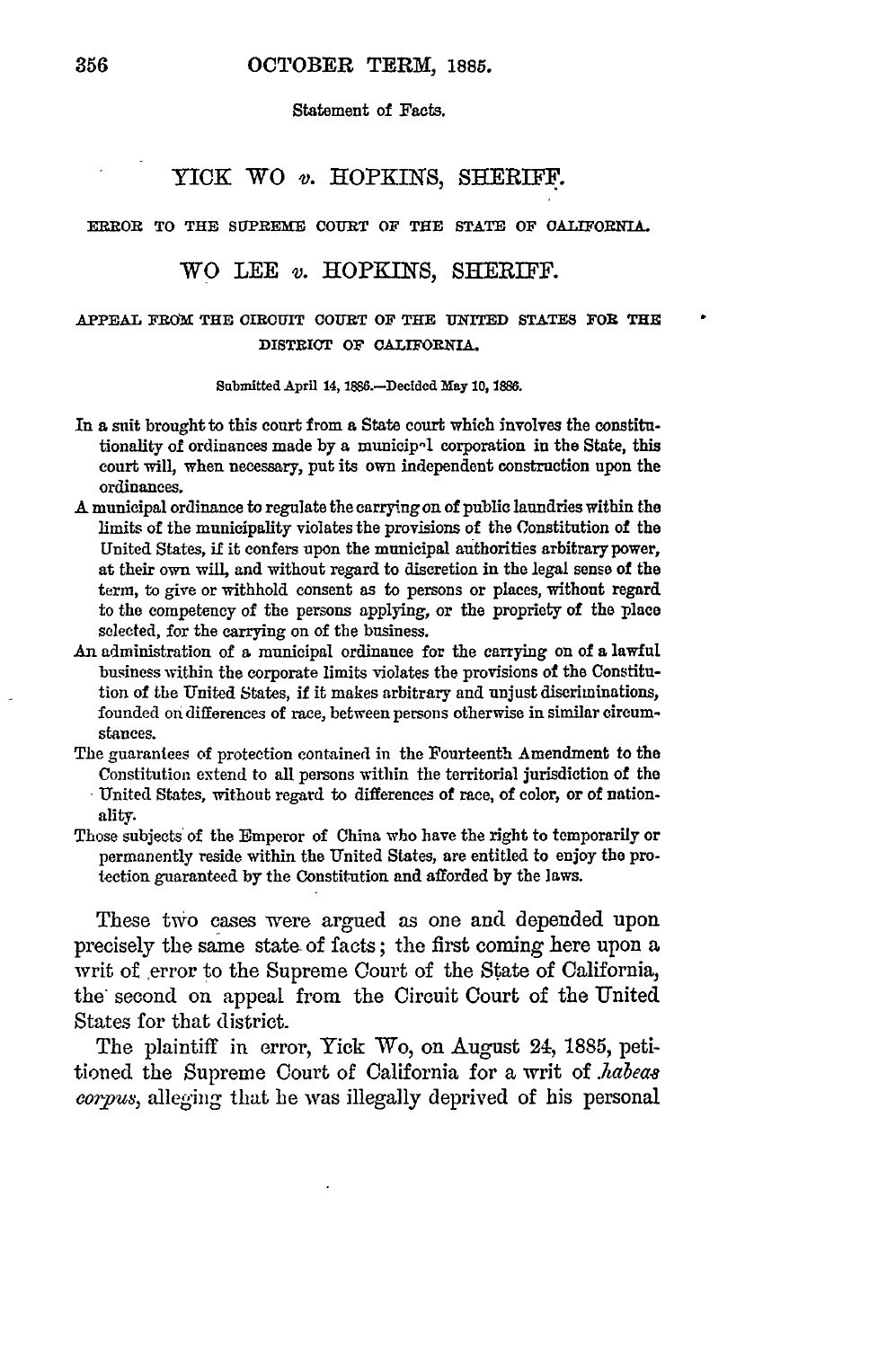
The published opinion in Yick Wo provides an unusually concrete test. The San Francisco ordinance did not simply announce a ban on Chinese laundries. It made permission from the supervisors necessary unless the laundry occupied a brick or stone building. The city contained about 320 laundries, roughly 310 in wooden structures; about 240 were operated by Chinese owners. Construction material thus intersected with the organization of a particular trade.
Fire safety was a legitimate municipal concern. The constitutional problem lay in the power conferred and the discriminatory way it was exercised. The record distinguished an inspected, functioning laundry from the supervisors’ refusal to authorize it. The Supreme Court held that equal protection extended to persons within United States jurisdiction, not only to citizens, and that a rule administered with racial discrimination could violate the Fourteenth Amendment.
One analytical strength of bringing local regulation into the foreground is that it discourages the search for prejudice only in explicit racial vocabulary. A historian must read both the wording of a measure and its operation. Who applied? Who received permission? Who was arrested? Which apparently comparable businesses remained open? The difference between a rule’s stated purpose and its practical effects cannot be settled by the title of an ordinance.
At the same time, counting discriminatory laws and explaining discrimination are different tasks. One enactment may be copied across several jurisdictions; another may be decisive in a single town. A frequently enforced provision can shape daily behavior more than a severe law left dormant. This is not a demonstrated defect in Lew-Williams’s book, which has not been read in full here. It is a question her combination of quantitative research and individual stories makes especially important: how does the numerical pattern connect to the texture of enforcement?
A courtroom victory could move the barrier
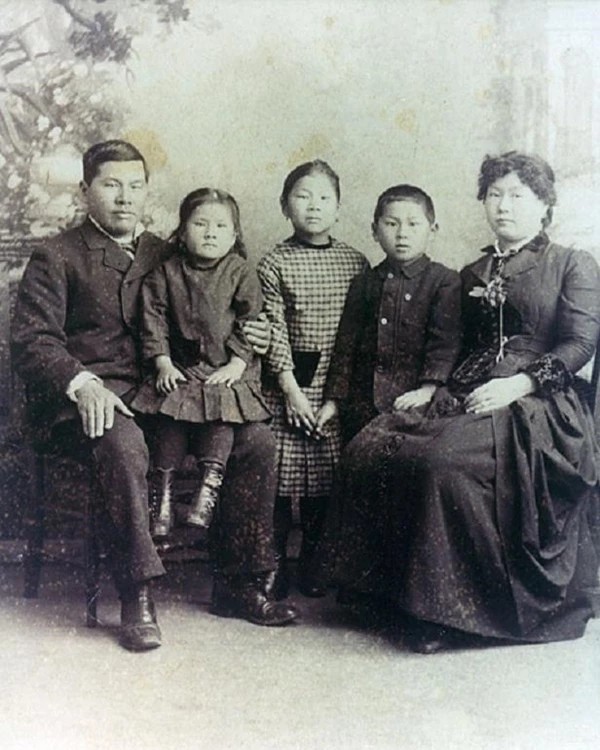
The Tape family’s school dispute supplies another perspective. In 1884, Mary and Joseph Tape sought admission for their eight-year-old daughter Mamie to San Francisco’s Spring Valley Primary School. She was refused because of her Chinese ancestry. Their legal challenge succeeded in 1885, and the California Supreme Court upheld the result. But the authorities responded by obtaining legislation authorizing separate schools for children of Chinese descent. Mamie and her brother Frank subsequently attended the new segregated Chinese Primary School. The National Park Service’s account reconstructs both the litigation and that frustrating aftermath.
It is tempting to fit such a story into a simple sequence: discrimination, resistance, judgment, progress. The outcome resists that sequence. Winning recognition of a right to public education did not automatically secure attendance at the desired school. An institution could respond to a legal defeat by changing the administrative route through which exclusion occurred.
The family also complicates any easy opposition between assimilation and separation. Mary Tape appealed to the family’s English language, clothing and habits. The school authorities treated ancestry as decisive regardless. Her argument exposes a difficult choice confronting people seeking admission to an unequal institution: claim that they already meet its standards, or challenge its authority to rank people by those standards at all. Those positions can coexist uneasily within a campaign for a practical, urgent benefit.
A history attentive to such choices need not turn its subjects into flawless representatives of a modern political position. People seeking a classroom or a livelihood acted under constraints, with partial information and immediate needs. Recovering their agency means taking those circumstances seriously, not awarding them independence from the world they had to negotiate.
Citizenship, residence and the burden of proof
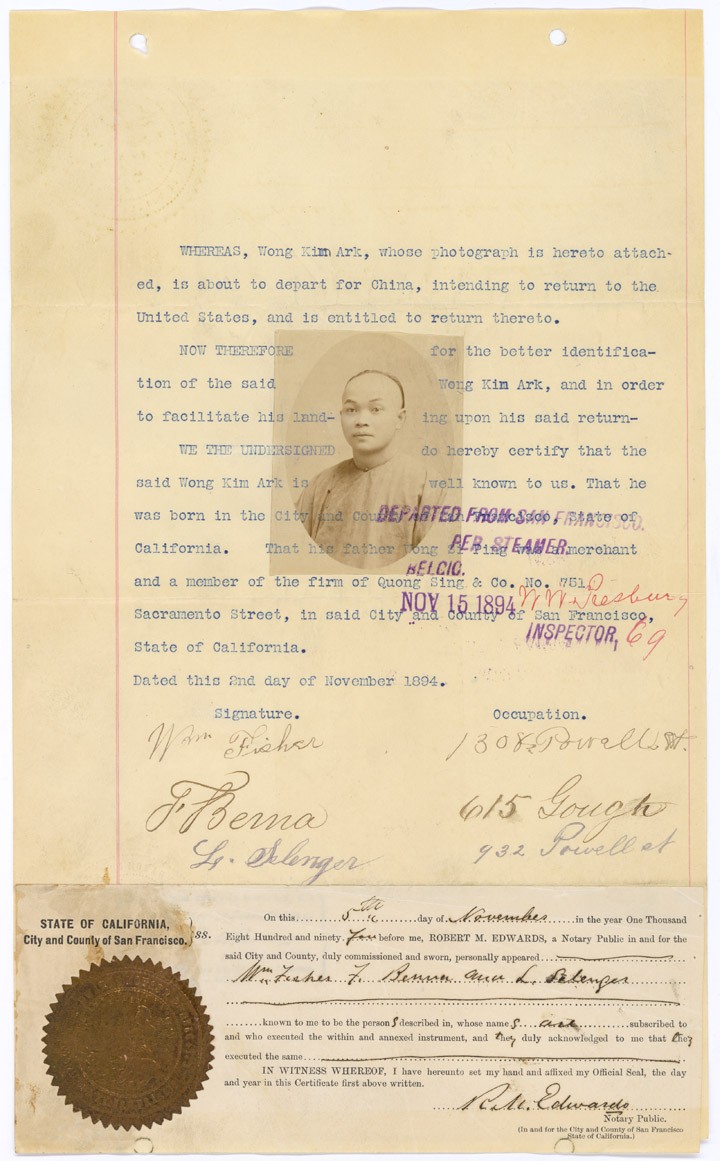
Wong Kim Ark’s 1894 departure statement is a particularly revealing object. It attached a photograph to written assurances that he had been born in San Francisco and intended to return after visiting China. Several witnesses certified his identity. Nevertheless, on his return in 1895 he was denied entry. In United States v. Wong Kim Ark, decided on 28 March 1898, the Supreme Court held that he was a citizen by birth under the Fourteenth Amendment. The case concerned a United States-born child of Chinese subjects domiciled in the country and not serving in a diplomatic capacity.
That holding must be distinguished from the position of Chinese immigrants barred from naturalization. It must also be distinguished from the equal-protection principle in Yick Wo, which did not depend on citizenship. Collapsing these legal categories into a single condition called exclusion would miss both the different mechanisms of discrimination and the different arguments available against it.
The surviving departure paper, presented by the National Archives, makes a further point. Documentation could protect a claim and simultaneously reveal its vulnerability. A photograph, witnesses and a notarized statement were assembled to make a right legible to officials. Possession of evidence did not prevent the dispute. Historical research can recover the paper trail without assuming that paperwork made belonging secure.
Reading against the labels
The book’s title reproduces a demeaning generic designation from official records, rather than endorsing it. That is an important interpretive warning. An archive may preserve a person’s encounter with government while obscuring the person’s name, relationships or account of what happened.
The publicly available contents and previews show a structure organized around imposed identities: laborer, criminal, alien, threatening outsider and immigrant, among others. One chapter preview juxtaposes a named man, Fou Sin, with another recorded under an anonymous racial designation. Another introduces Yun Gee through testimony about coercion. These glimpses suggest a productive tension between categories that institutions manufactured and lives that do not fit neatly inside them.
The risk in writing from hostile records is not only repeating an offensive word. It is allowing the record’s purpose to determine the whole story. A prosecution file is designed around an accusation; an immigration interview around admissibility; a tax record around payment. None was created to provide a rounded biography. Reading them critically means asking why information was demanded, who translated or transcribed it, and which experiences never became an official document at all.
That problem also sets limits on what this introduction can judge. The previews establish topics and some narrative strategies, but not the balance of the complete work or the adequacy of every inference. They justify interest in its construction; they do not justify invented praise for chapters unavailable to us.
What to look for in a full reading
The most compelling promise of John Doe Chinaman is the connection between institutional scale and personal specificity. Laws can be counted, classified and compared; people cannot be reduced to the resulting categories. The author’s described method tries to hold both kinds of evidence together. For readers interested in how historians recover ordinary lives from administrative records, that is a more useful reason to approach the book than the fact that it has won a prize.
Its comparison with Jim Crow also deserves careful attention. A comparison can reveal shared techniques—segregation, unequal access and the use of public authority to enforce hierarchy—without implying identical histories. The relationship between slavery and Black citizenship, the position of Chinese migrants within exclusion law, and the circumstances of different western communities cannot simply be substituted for one another. A rewarding full reading would track both resemblance and difference.
The historical context assembled here points to a second test: whether resistance appears only when it reaches a reported court decision. Litigation leaves unusually visible records, but surviving a restrictive regime could also involve negotiation, adaptation or choices that never generated a celebrated precedent. The book’s advertised attention to evasion and everyday encounters offers a route beyond a parade of landmark cases. Evaluating how fully it follows that route requires the complete text.
The result is a clear invitation, with an equally clear limit. This is a book to consider for its investigation of how law entered daily life, not a substitute for the cases or for the voices it seeks to recover. Its central question changes the map of the subject. The boundary between inclusion and exclusion did not run only through a port. It could run through a business license, a school entrance or the official description of a person whose name a record did not bother to preserve.
Edition reference: Beth Lew-Williams, John Doe Chinaman: A Forgotten History of Chinese Life under American Racial Law, Belknap Press of Harvard University Press, hardcover, 16 September 2025, ISBN 9780674294110. Publisher edition · Amazon: matching hardcover edition. The Amazon link contains no affiliate code; no price or availability is promised.