Myths & Mysteries
The Phaistos Disc: What Its Signs Reveal Before Anyone Can Read Them
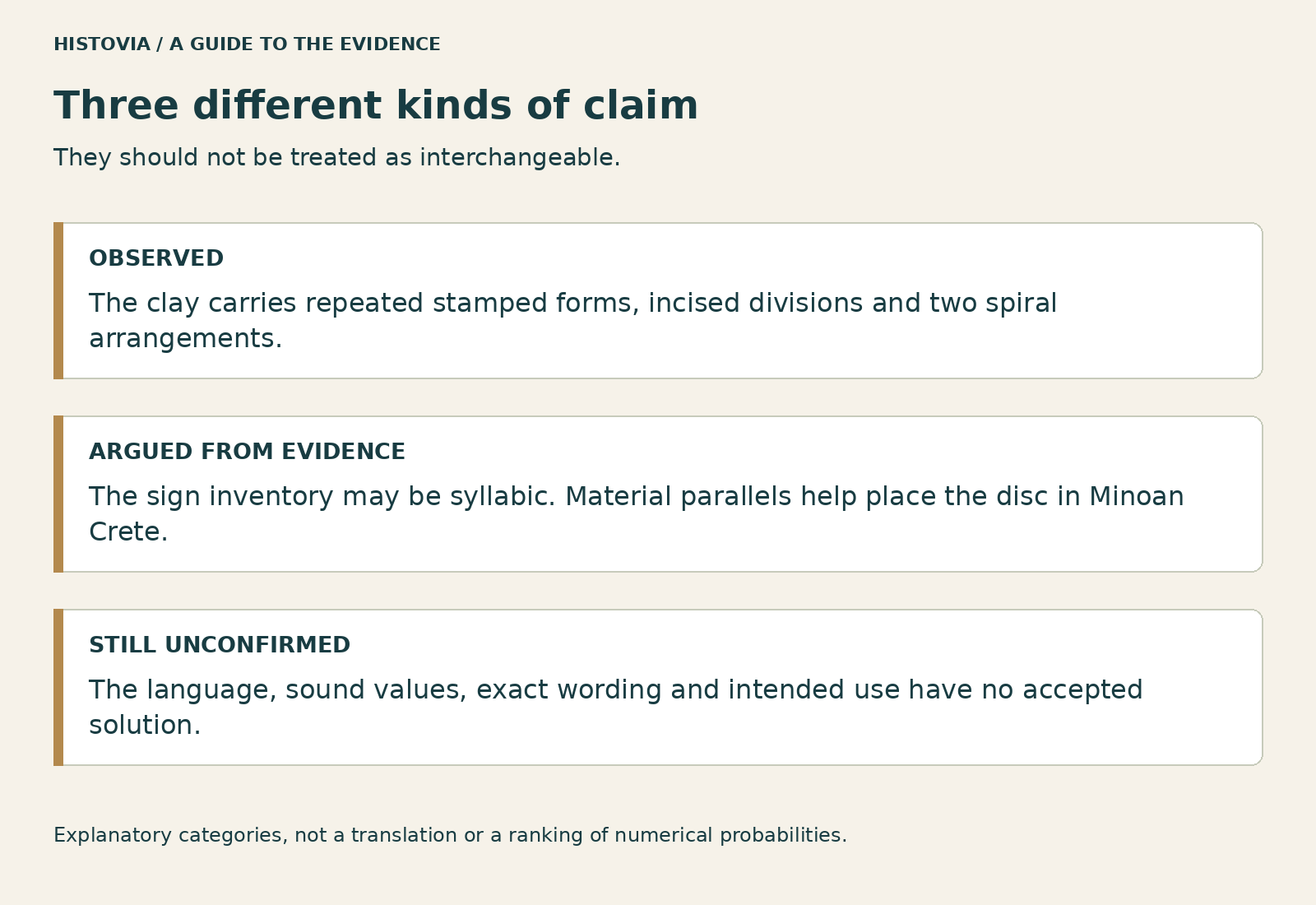
Its clay, stamps and archaeological context can be studied. Its message remains unconfirmed. Keeping those facts separate makes the famous disc more interesting, not less.
On the Phaistos Disc, a human head in profile appears again and again, pressed into clay with a prepared stamp. Recognizing the head does not tell us what an ancient reader was meant to understand. There is no agreed language to search for, no securely assigned set of sounds and no second long text in the same system against which to test a proposed solution.
Yet much of the object is open to inspection. Its maker worked clay, impressed repeated forms into its surface and arranged them within spirals on both faces. Some features can be compared directly. Others require arguments about archaeological context, writing systems or language. A responsible account has to keep those kinds of knowledge apart.
The Heraklion Archaeological Museum, where the disc is kept, dates it to about 1700–1650 BCE. Its current description still reports no definitive interpretation. The achievement of studying the disc is therefore not measured only by whether someone can announce what it says. It also lies in making the boundary between evidence and conjecture more precise.
A small object with several kinds of marks
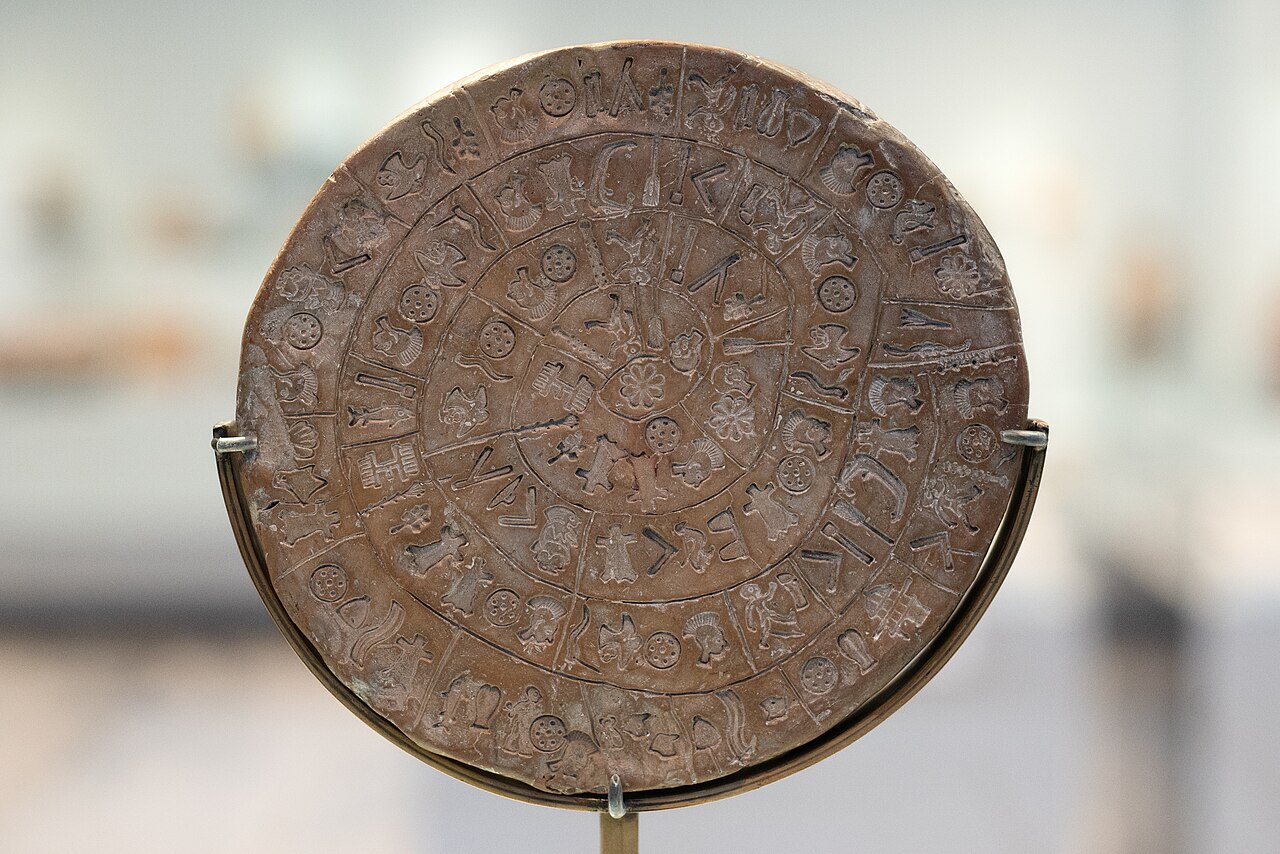
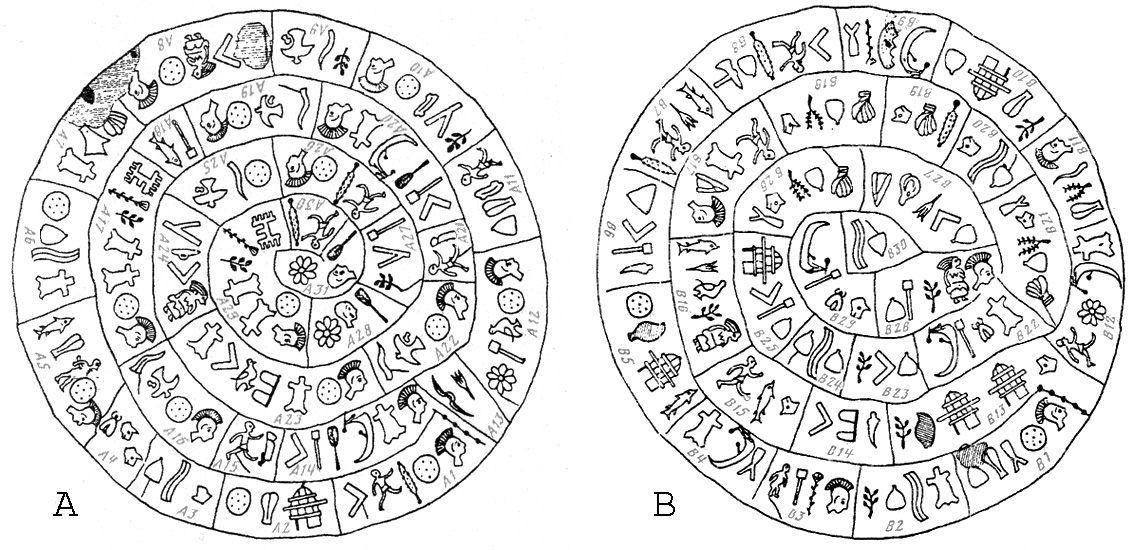
The disc is roughly fifteen to sixteen centimetres across. The museum counts 241 impressed signs, arranged in 61 groups separated by incised lines. There are 45 distinct pictorial sign types. Other scholarly descriptions give 242 occurrences; the Foundation for Research and Technology–Hellas is one example. Such differences should be acknowledged rather than concealed behind an unnecessarily exact total.
The photographs reveal an important distinction before any signs are assigned meanings. The recurring figures have a repeated shape because they were impressed with prepared stamps. The lines between groups and the spiral boundaries belong to another kind of action on the clay. The surface preserves both repeated forms and marks drawn individually.
This difference matters to a transcription. A scholar must decide what counts as a sign, what separates groups and which scratches belong to the original notation rather than to damage. A digital string of numbered symbols is already a carefully made representation of the object. It is not the object itself.
Nor should a photograph’s orientation become an instruction from the ancient maker. Rotating the disc on a screen can make a familiar-looking figure stand upright, but that alone cannot establish where the text begins, how the faces relate or what the group divisions mean.
A discovery inside an archaeological record
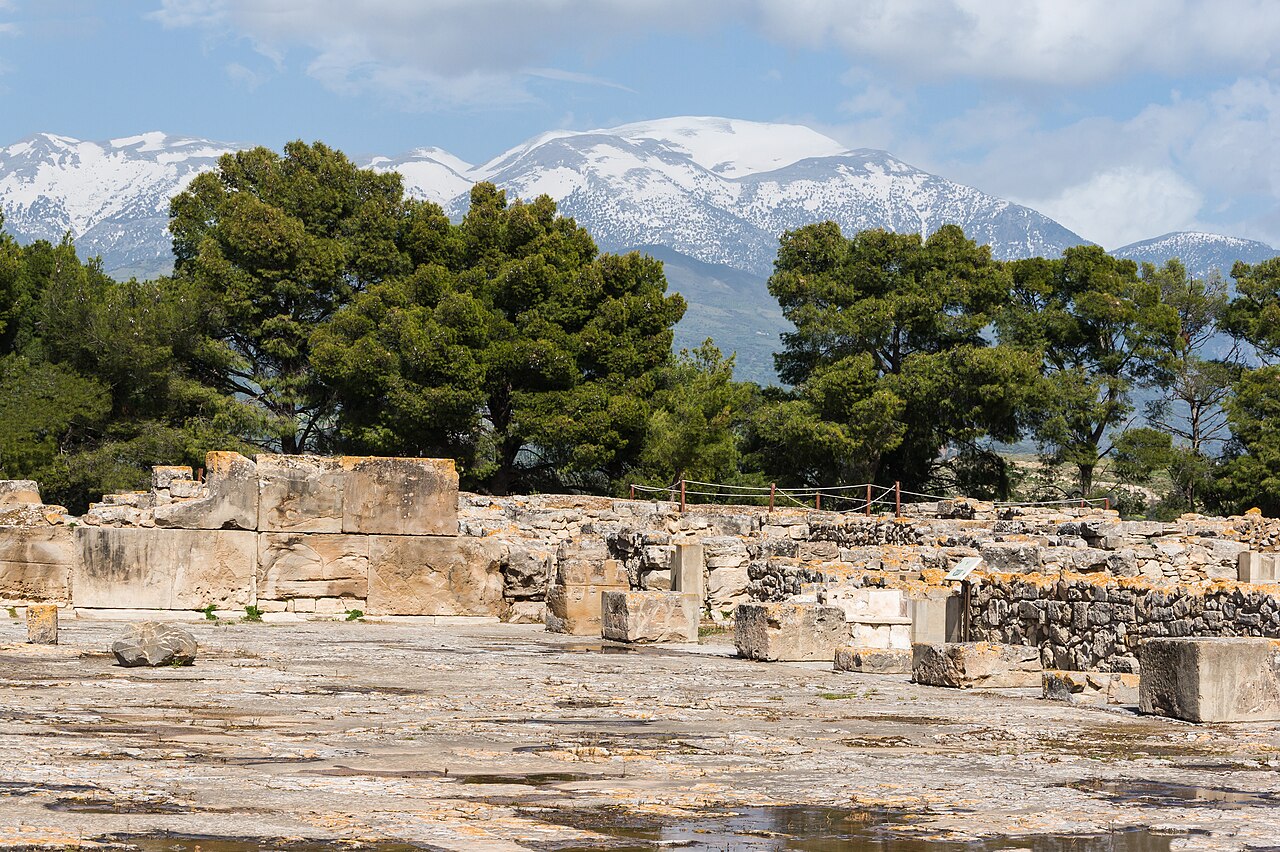
The disc entered modern scholarship through the Italian excavations at Phaistos on 3 July 1908. Giorgia Baldacci’s reassessment of its context gives a more specific account than the usual shorthand that Luigi Pernier “found” it. During fieldwork under Pernier’s direction, local foreman Zakarias Iliakis spotted the object in an evening inspection after the day’s excavation.
Its findspot lay in Room 101 of the North-Eastern Complex beside the palace. The destruction deposit had been disturbed in Hellenistic times, long after the Bronze Age. That disturbance complicates any attempt to date the disc simply by its depth or by everything found around it.
Recent work has also reconsidered Room 101 itself, suggesting that it was used for processing liquids, possibly in connection with textile production. That proposal does not identify the disc’s purpose. It does, however, discourage turning an uncertain findspot into an imagined sanctuary merely because a religious interpretation of the inscription seems appealing. The setting needs its own investigation.
An archaeological context is not a sealed timestamp unless the deposit really is secure. Objects can be moved, old material can survive into a later occupation and later activity can cut into earlier layers. A date assigned by a museum is a considered historical placement, not a year written legibly on the disc.
This is also why the palace should remain in the story. The setting supplies more than an evocative backdrop for an enigma. Other objects from Phaistos offer evidence about local techniques and visual forms. They can help investigate where and when the disc belongs even while its inscription remains unread.
Following the spiral is not translating it
The Scuola Normale Superiore’s Mnamon guide points to partial overlaps between impressions as evidence that stamping proceeded inward from the rim. Material traces can therefore constrain the sequence of production. They are more useful than choosing a reading direction because it produces an attractive sentence.
Short incised strokes beneath certain signs add another problem. Their presence can be recorded without deciding that they are punctuation, grammatical markers or something else. A transcription should preserve them precisely because their function is unresolved.
The 61 groups are often called words. That is a working interpretation of the divisions, not a translation. Even if the divisions separate words, knowing their boundaries would not identify the language or reveal what each word means. A modern reader can see spaces in a sentence from an unfamiliar language and still understand none of it.
The number of distinct signs has encouraged a syllabic interpretation, in which a sign represents a syllable rather than a single letter or a whole idea. Such an inference concerns the probable kind of system. It does not tell us which sound belongs to any individual mark. Forty-five observed types also need not exhaust the repertoire available to the maker.
Recognizing a picture does not recover its sound
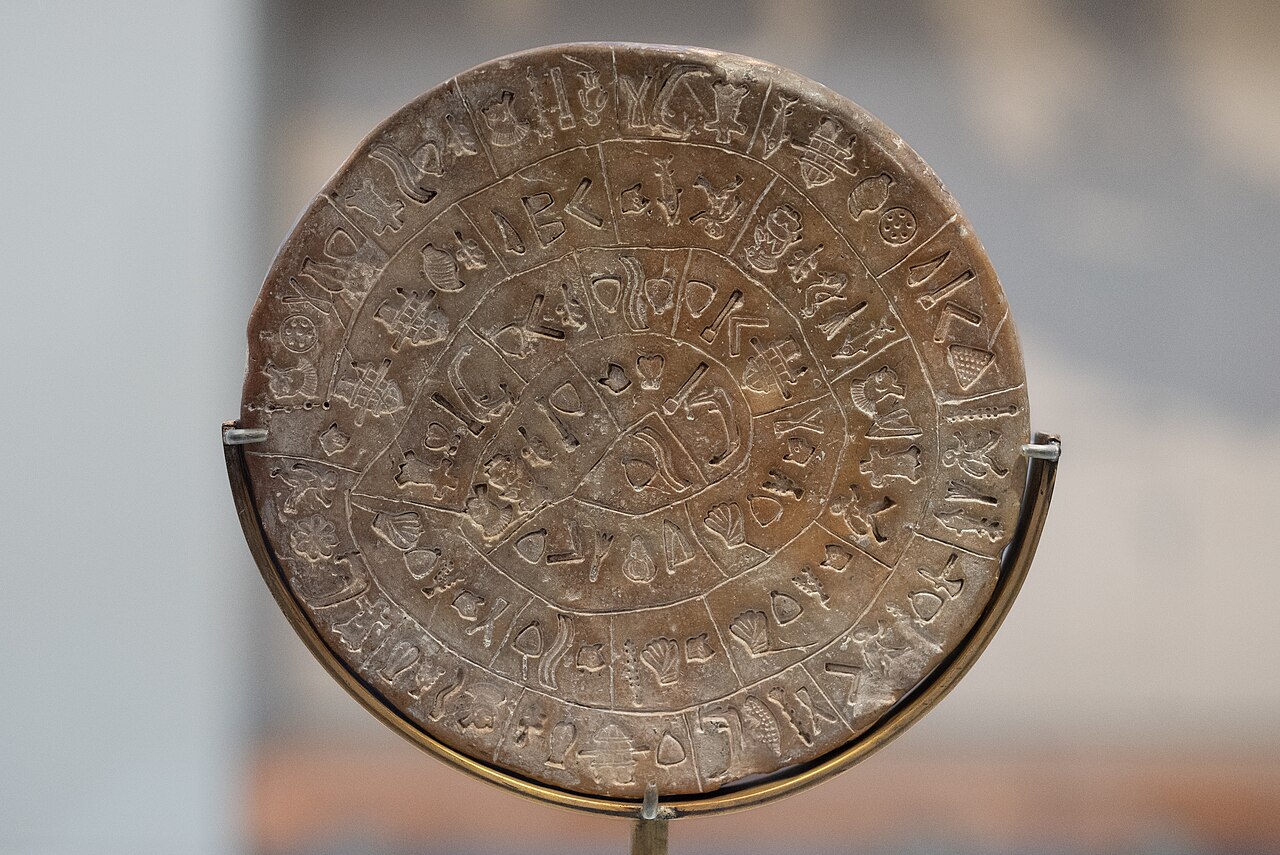
A head in profile can be recognized as a head without telling us whether its sign stood for a person, an action, a name or a sound. The mistake is to slide from visual identification into linguistic meaning without evidence for the connection.
This distinction survives in the modern Unicode chart for the disc’s symbols. A character name provides a convenient way to identify a form in software; it is not the ancient name of the depicted thing. The Unicode specification explicitly treats the repertoire without assuming that its meanings and functions have been recovered.
The same caution applies to resemblances between scripts. Two signs may look alike because they depict a similar object, because one tradition borrowed from another, or for reasons that have not yet been established. Their appearance alone cannot guarantee that they were pronounced alike.
The disc also cannot simply be treated as a sample of Linear A or Linear B with unusually decorative lettering. The relationship to other Aegean systems remains a matter for investigation. Borrowing sound values from a better-understood script is a hypothesis which must earn its usefulness through consistent results, not a shortcut that makes those values certain.
The attraction and limits of “printing”
Prepared stamps are among the disc’s most striking features. Instead of drawing every occurrence from scratch, the maker could press a repeatable form into wet clay. In a photograph, small differences in depth or orientation remind us that repeated forms still resulted from separate physical actions.
This has encouraged descriptions of the disc as the first printed text. The phrase captures the use of reproducible signs, but it can smuggle in a history that the surviving evidence does not establish. One object does not demonstrate an industry producing editions, a wide reading public or a direct line of descent to later printing.
It is useful to ask narrower questions. How many different forms were needed? How were they placed in the available space? What can overlaps or corrections reveal about the work? These are questions about a procedure preserved in clay. They do not require a claim that the maker anticipated the modern book.
The preparation of stamps suggests that the technique involved work beyond the moment of impression. Whether those tools served other objects, and how widely they circulated, cannot be recovered from the disc alone. The absence of a surviving set of companion texts is a limit on our knowledge, not proof that none ever existed.
A copied error can become a false clue
In his 2000 review, Yves Duhoux identified a small but consequential problem in an influential early drawing: the five dots at the start of one face had been reduced to four. A theorist working from that drawing could build an explanation around a feature the object did not possess.
The lesson is practical. Before a proposed reading can be tested, its underlying transcription must be reliable. Changing signs or discarding inconvenient marks to rescue an interpretation reverses the direction of the inquiry. The proposed solution is supposed to explain the evidence, not redesign it.
A neat line drawing can be easier to follow than a photograph, especially where lighting makes the clay’s surface difficult to see. It can also suppress uncertainty by giving an ambiguous trace a clean outline. Photographs, drawings and transcriptions are complementary aids; none should silently stand in for all the others.
Comparison can place the disc without reading it
Research on other Phaistos finds has supplied a more productive kind of comparison. In a study of a potter’s mark on bowl F 4718, Baldacci identified a close parallel to the disc’s comb-like sign. A related form also occurs on a sealing. Their contexts and methods of impression connect the discussion to material from the same site.
The dates of modern discovery matter here. The sealing was recovered in 1955 and the bowl during the 1965 excavations, decades after the disc entered scholarship. Baldacci argues that the resemblance is difficult to reconcile with a supposed 1908 forger drawing on objects that had not yet been excavated. Her argument concerns a complex form and its archaeological parallels, not simply a general resemblance between two everyday pictures.
This evidence weakens the idea that the disc is wholly disconnected from Minoan manufacture and imagery. It supports arguments about authenticity and cultural setting. It does not establish that the isolated mark on a vessel had the same function as a sign inside the disc’s longer sequence.
An image can serve as a workshop mark in one setting and take part in writing in another. Establishing that two forms are related is already useful; forcing that relationship to supply a sound or a complete sentence asks it to do more than the evidence allows.
The distinction also prevents a misleading choice between total certainty and total mystery. An object can become better situated in time and place without becoming readable. Archaeological progress need not arrive in the dramatic form of a translation.
What would make a reading persuasive?
The disc contains repetition, and repeated groups have encouraged religious interpretations, including a hymn or incantation. The museum presents that possibility as an inference. Repetition alone cannot supply the identity of a deity, the circumstances of performance or the words of a prayer. Those would be further claims requiring further evidence.
A convincing proposal would need to account for the whole inscription with rules that remain stable. The same sign cannot acquire a convenient new value every time a difficult passage appears unless there is independent evidence for that variation. A few recognizable words are not enough if the remaining text depends on exceptions.
It would also need tests that the proposed translation did not invent for itself. Another securely excavated inscription could show whether the same signs behave consistently elsewhere. A bilingual text, if one were ever found, might offer external constraints. These are examples of evidence that would help, not predictions about discoveries waiting to happen.
Until then, a fluent English rendering can conceal how many choices its author has made. A reading may select a language, assign sounds, decide word boundaries and choose a genre before producing a sentence that appears persuasive. The polished sentence is the end of that chain of assumptions, not independent proof of it.
The Phaistos Disc remains worth looking at closely. Its maker’s actions survive in repeated impressions and individually cut lines; its archaeological neighbors provide comparisons; the history of its study exposes both good questions and avoidable errors. Saying that its message remains unconfirmed protects those discoveries from being swallowed by a story the clay has not yet authorized.