
WORLD WAR II · PACIFIC THEATER
Okinawa: The Defense in Depth That Prolonged the Battle
The main landings on 1 April 1945 met little resistance. The Japanese army had concentrated inland, where fortified ridges prolonged the campaign and trapped civilians in its path.
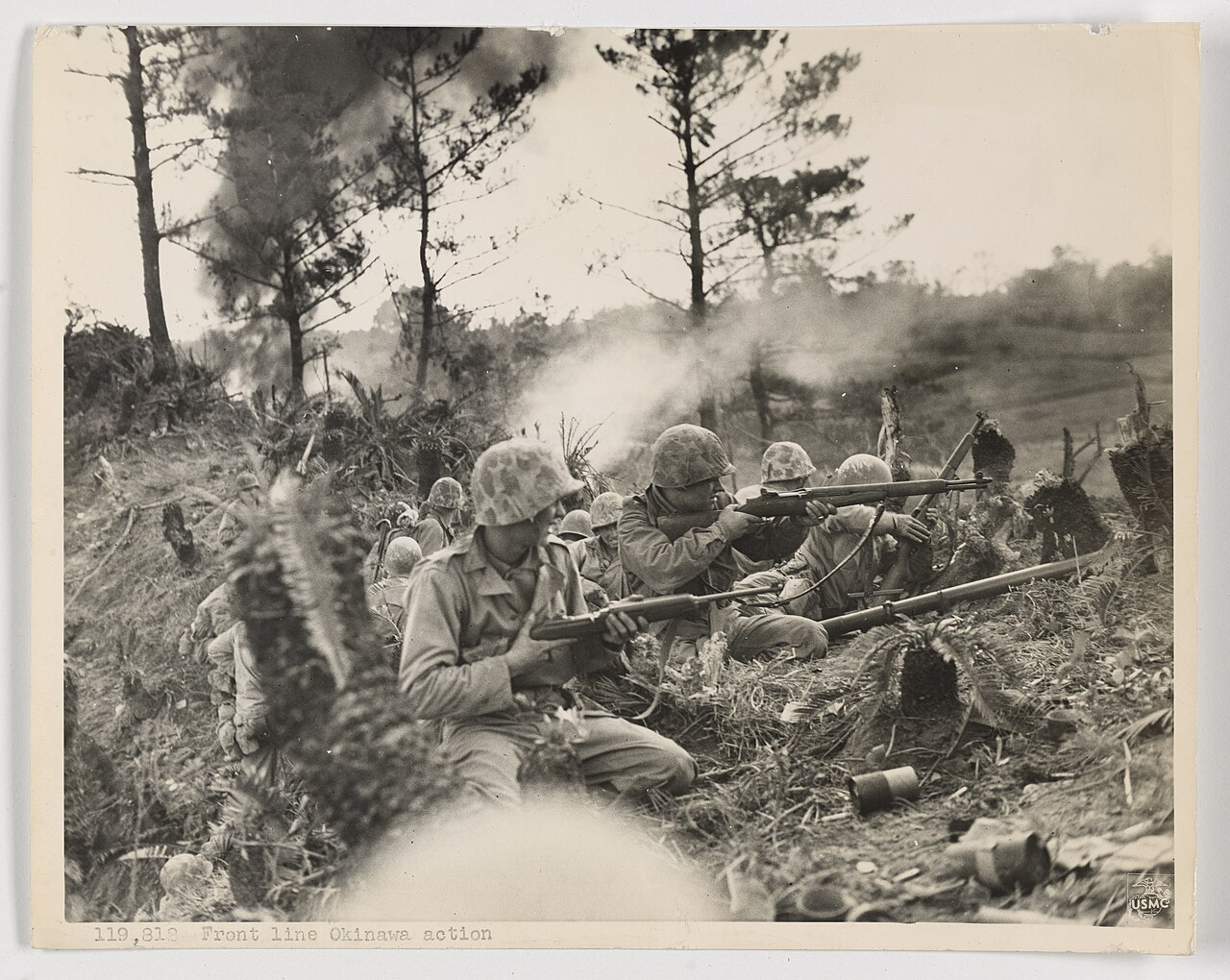
The main American landings on Okinawa on 1 April 1945 moved inland with surprisingly little opposition. Soldiers and Marines crossed the Hagushi beaches, occupied airfields, and soon cut across the island. The bombardment before the assault had been immense. Yet the relative ease of the landing did not mean that it had destroyed the Japanese army.
Most of that army was waiting farther south. Lieutenant General Mitsuru Ushijima’s 32nd Army had concentrated around fortified ridges, caves, and underground positions near Shuri. Its plan exchanged the possibility of defeating the invasion at the water’s edge for a longer battle inland. The resulting delay would also keep the Allied fleet close to Okinawa, where Japanese aircraft could attack it.
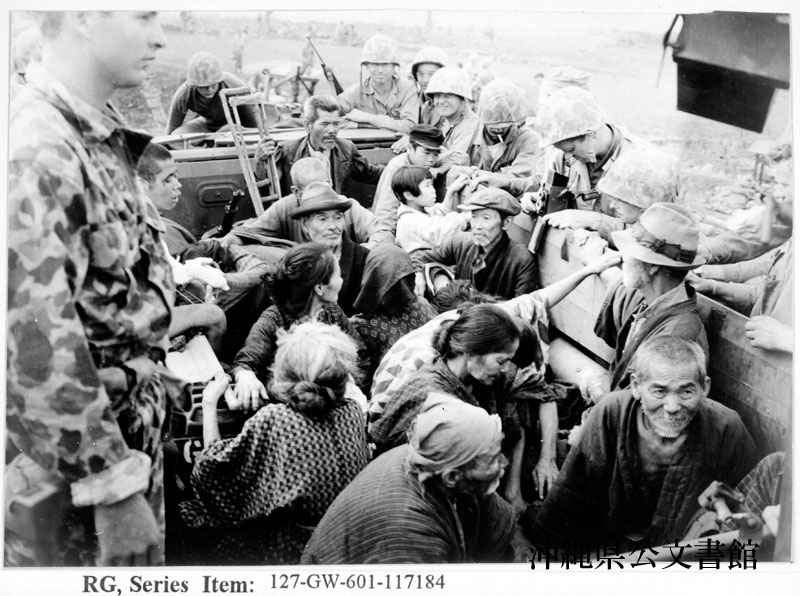
For Okinawan civilians, neither the lightly defended beaches nor the stronger southern positions described a safe place. People had been mobilized for military work, displaced by bombing, or forced to seek shelter. As the ground battle moved south, troops and refugees increasingly occupied the same shrinking area.
.jpg)
Why Okinawa was the objective
Operation Iceberg was intended to secure bases close to the Japanese home islands. Airfields, anchorages, and staging areas on Okinawa would support continued air operations and preparations for a possible invasion of Japan. The island’s capture required an operation much larger than an isolated beach assault: ground forces, naval protection, transport, construction units, and supply organizations all had to remain effective over time.
Arnold G. Fisch Jr.’s U.S. Army campaign history describes the combined command arrangements. Lieutenant General Simon Bolivar Buckner’s Tenth Army included Army and Marine Corps formations, operating within a wider naval command. The initial landings were preceded by operations in the Kerama Islands on 26 March. Okinawa was the central objective within a campaign that extended to neighboring islands and the surrounding sea.
The Japanese command could not match the invasion’s resources. It could, however, try to make those resources work against deeply prepared positions. Building a large fleet and landing a large army solved the problem of reaching Okinawa. They did not remove the need to locate and reduce defensive positions one by one.
The Shuri defenses made terrain do several jobs
Southern Okinawa contained ridges, ravines, limestone caves, and steep slopes. Japanese troops extended natural shelter with tunnels and reinforced firing positions. Guns and infantry could cover approaches to neighboring strongpoints. Some positions lay on reverse slopes, beyond the crest as seen by an approaching force, making them harder to observe or hit directly.
The consequences became clear during the April assaults. Heavy bombardments could drive defenders into shelter without destroying the whole position. When the barrage lifted and American infantry moved forward, surviving troops could return to their weapons. Taking the crest of a ridge did not necessarily silence the caves below it or the guns on the next ridge.
The Army’s detailed account of the 19 April attack follows the difficulties of bringing tanks and infantry through these defenses. Armor provided essential firepower, but mines, restricted movement, and the separation of tanks from supporting troops could turn an attempted breakthrough into a series of isolated engagements. Flamethrowers, explosives, artillery, and small assault groups were then used against positions that had survived the initial preparation.
This was defense in depth in a practical sense. The attacker could lose men reaching a position, lose more making it secure, and then discover another position beyond it. The defenders did not need every outpost to hold indefinitely. They needed each loss of ground to consume time and reduce the strength available for the next attack.
Japanese commanders argued over the use of their reserves
The defense was not a single policy followed without disagreement. Within the 32nd Army staff, Lieutenant General Isamu Chō favored offensive action, while operations officer Colonel Hiromichi Yahara argued for continuing the attritional defense. Ushijima authorized counterattacks in April and a larger offensive in early May.
The 4 May offensive exposed troops and artillery that had previously benefited from protected positions. American firepower inflicted heavy losses, and the attack failed to dislodge the Tenth Army. The campaign history records the resulting depletion of Japanese reserves. Committing men to a counterattack could offer a chance of disruption, but failure also removed troops needed to sustain the longer defensive battle.
That debate is important because it keeps the campaign from looking mechanically predetermined. The Japanese command was choosing between courses with different risks. The Americans likewise had to decide how to rotate exhausted formations, commit reserves, and coordinate attacks across neighboring sectors. The strength of a position did not eliminate the consequences of decisions made around it.
The fleet paid for the time spent ashore
Ships off Okinawa supplied the army, supported it with gunfire, protected transports, and controlled the air approaches. As long as the battle continued, much of this naval force had to remain within reach of the island. Japanese kamikaze attacks exploited that requirement, aiming to damage the invasion’s supporting system as well as individual warships.
The National Park Service’s history of USS Cassin Young explains the particular exposure of radar-picket destroyers. Positioned away from the main force, they detected approaching aircraft and provided warning. Their location also made them early targets. Cassin Young was hit on 12 April and required repairs before returning to duty.
There was consequently pressure to end the land campaign quickly. Yet attacking more rapidly against intact defenses could increase losses without producing a breakthrough. The Army’s account of the May offensive records naval concern over continuing ship losses alongside the ground command’s preparation for another coordinated attack. The two battles were connected, but their immediate demands could pull commanders in different directions.
Rain and the withdrawal from Shuri
Heavy rain in late May damaged roads, bogged down vehicles, and complicated the movement of supplies and casualties. Soldiers still had to carry ammunition and food forward when trucks could not follow. Poor weather also reduced aerial observation, making enemy movements harder to interpret.
Japanese commanders used the period to withdraw from Shuri toward positions farther south. American officers had expected the defenders to make their final stand around the city and were slow to recognize the scale of the movement. The official history’s chapter on Shuri’s fall reconstructs reports of movement, uncertain interpretations, and the gradual discovery that much of the Japanese force had already left.
Marines entered Shuri Castle on 29 May, but occupation of that conspicuous objective did not end resistance around it. Rear guards continued to fight, and supplying the troops inside the newly occupied area remained difficult. Farther south, the Japanese were establishing another line. The subsequent campaign lasted more than three additional weeks.

Civilians were drawn into the military system
Okinawa’s population had already been affected by conscription, labor demands, evacuation, and air raids before the main invasion. The Japanese army requisitioned land and used local labor to prepare defenses. Civilians were not merely spectators who happened to remain near military positions. Military mobilization helped determine where they worked, where they could travel, and what happened when the front reached them.
The Himeyuri Peace Museum’s founding account provides a specific example. In March 1945, 222 students and eighteen teachers from two Okinawan schools were assigned to military medical units. Their work included attending the wounded and carrying food, water, and supplies through dangerous conditions. When the military hospitals withdrew south in late May, the students moved with them. The unit’s sudden dissolution in June left survivors attempting to escape through an active battlefield.
That experience connects the battle’s operational decisions to civilian exposure. A withdrawal could preserve part of an army while moving wounded soldiers, medical workers, and local residents into a smaller area with fewer shelters. The problems were intensified by shortages of food and water and by the difficulty of distinguishing safe routes from areas under fire.
The southern retreat narrowed the space for survival
The Okinawa Prefectural Peace Memorial Museum’s account describes civilians moving among caves as Japanese troops retreated south. Some were killed by Japanese soldiers or forced into collective suicide; others died from starvation or the American bombardment and assaults. These causes should not be collapsed into an undifferentiated claim that all civilian deaths occurred in crossfire.
Nor were caves uniformly military positions. Some sheltered civilians alone, others held troops or supplies, and still others became shared spaces. In his 1946 report on invasion and occupation, U.S. naval medical officer Henry Stanley Bennett acknowledged the enormous destruction and displacement caused by American operations. His report is valuable contemporary evidence, although its paternalistic generalizations about Okinawans reflect the occupying authorities’ outlook rather than the population’s own account.
Reliable casualty totals remain difficult to establish. The National WWII Museum’s discussion notes that estimates of civilian deaths can exceed 100,000, while stressing that the exact number is unknown. Counts differ over geography, time period, military conscripts, and the treatment of people who died from deprivation. A memorial’s list of names and an army’s battlefield casualty report need not measure the same population.
The end of organized resistance and the camps
Organized Japanese resistance collapsed in late June, and the American command announced victory on 22 June. Buckner had been killed on 18 June while observing the fighting. Ushijima and Chō died as their army’s remaining positions disintegrated. Small groups continued to resist or emerge afterward; the official declaration did not make every part of the island immediately safe.
Surviving civilians were gathered into camps under American military government. The Peace Memorial Museum’s testimony collection describes food shortages, limited shelter, wounded people arriving for care, and the early work of rebuilding. Removal from the immediate battle zone could bring food or treatment while also separating families and restricting movement. Military base construction produced further demands on land and labor.
Okinawa City’s guide to battle sites records a further milestone: the formal local surrender ceremony at Morine on 7 September 1945. By then, the principal fighting had been over for weeks, but civilian return and reconstruction were only beginning. The same guide traces temporary camps and repatriation facilities that formed part of the island’s immediate postwar landscape.
Sources and further reading
- Arnold G. Fisch Jr., Ryukyus, U.S. Army Center of Military History, hosted by HyperWar.
- Roy E. Appleman, James M. Burns, Russell A. Gugeler, and John Stevens, Okinawa: The Last Battle, U.S. Army historical series: April assault, May offensive, Shuri withdrawal, and southern defenses.
- National Park Service: Fire from the Sky, USS Cassin Young and the Okinawa Campaign.
- Himeyuri Peace Museum: Foundation of the Museum.
- Okinawa Prefectural Peace Memorial Museum: Permanent Exhibit, Room 3 and survivor-testimony collection.
- Henry Stanley Bennett: The Impact of Invasion and Occupation on the Civilians of Okinawa, Proceedings, February 1946.
- Adam Givens, National WWII Museum: Okinawa, The Costs of Victory in the Last Battle, 2022.
- Okinawa City: A Guide to Battle Sites and Military Bases.
Source note: military histories are used for deployments and operations, while Okinawan institutions and contemporary civilian-administration records supply perspectives on displacement and survival. Their categories and estimates are not interchangeable.