
Penicillin: The Wartime Race to Make Enough
Histovia · World War II
In February 1941, doctors at Oxford gave penicillin to Albert Alexander, a police officer suffering from a severe infection. He began to improve. Then the available supply ran out. The researchers could not produce enough to continue treatment, and he died.
The episode exposed the distance between discovering a promising substance and making a dependable medicine. Penicillin could show striking results and still fail a patient if the next supply did not arrive. Its wartime history was therefore a story of production as much as discovery.
By 1944, Allied medical services had access to quantities that the Oxford team could scarcely have supplied a few years earlier. That expansion required laboratories, agricultural researchers, factories and public agencies to solve different problems together. More mold was not automatically more usable medicine.
From an observation to a treatment
Alexander Fleming observed a mold inhibiting bacterial growth in 1928 and published his findings the following year. The familiar account of an unexpected culture dish captures a genuine discovery. It leaves most of the subsequent work unexplained.
The material was difficult to purify and preserve. A laboratory observation did not tell doctors how to obtain consistent preparations, measure their activity or supply repeated treatment. Those were scientific questions in their own right, not merely the packaging of an already finished drug.
At Oxford, Howard Florey organized a team that included Ernst Chain, Norman Heatley, Edward Abraham and other specialists. Animal experiments in 1940 were followed by early clinical work in 1941. Alexander was an important early Oxford patient; calling him the first person anywhere to receive penicillin would make an unnecessarily broader claim.
Nor had doctors previously possessed no useful antibacterial medicines. Sulfonamides were already in use. Penicillin’s importance lay in what it could do against susceptible infections and in the scale on which it eventually became available, rather than in replacing a completely empty medical cupboard.
The people behind the cultures
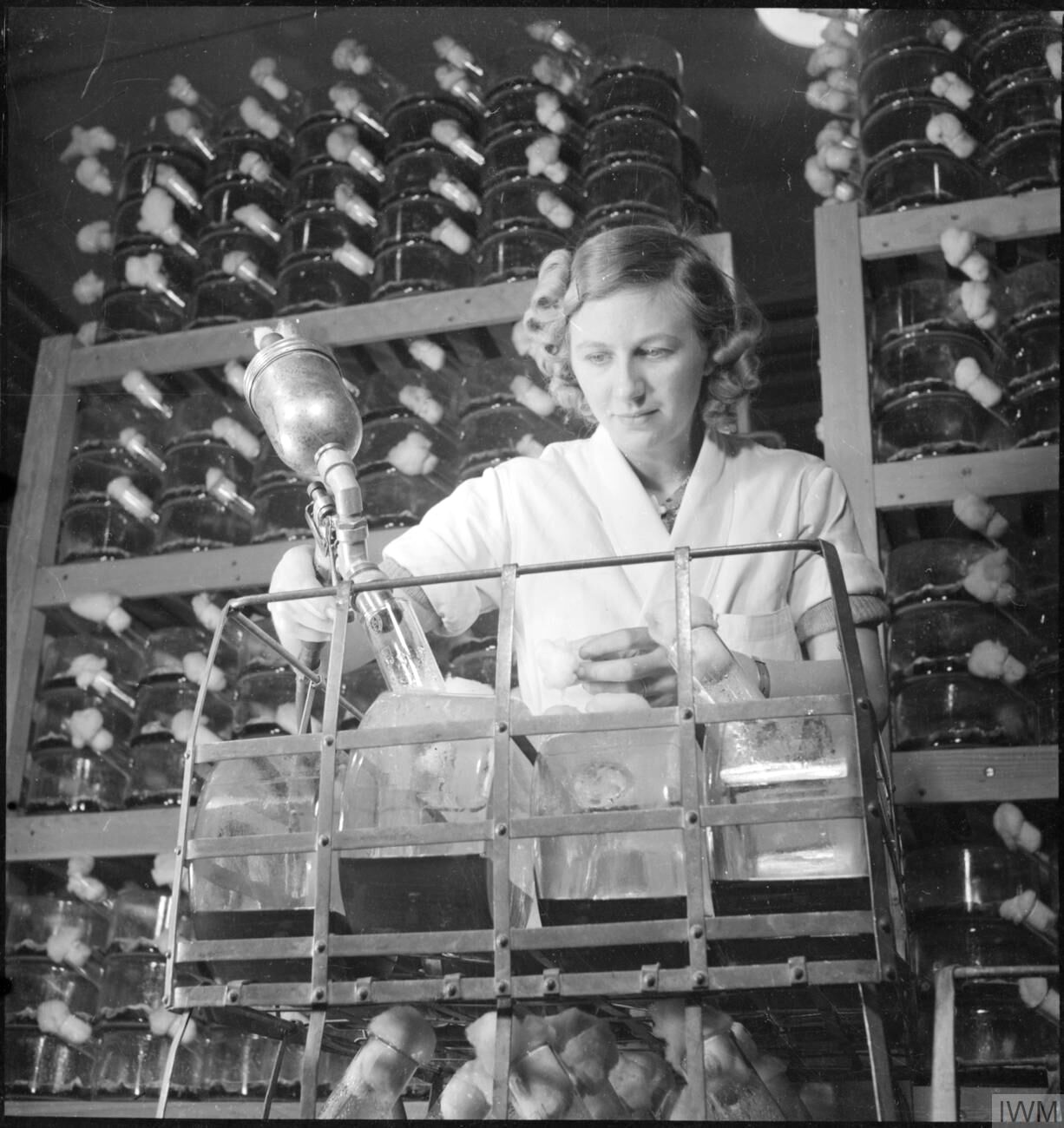
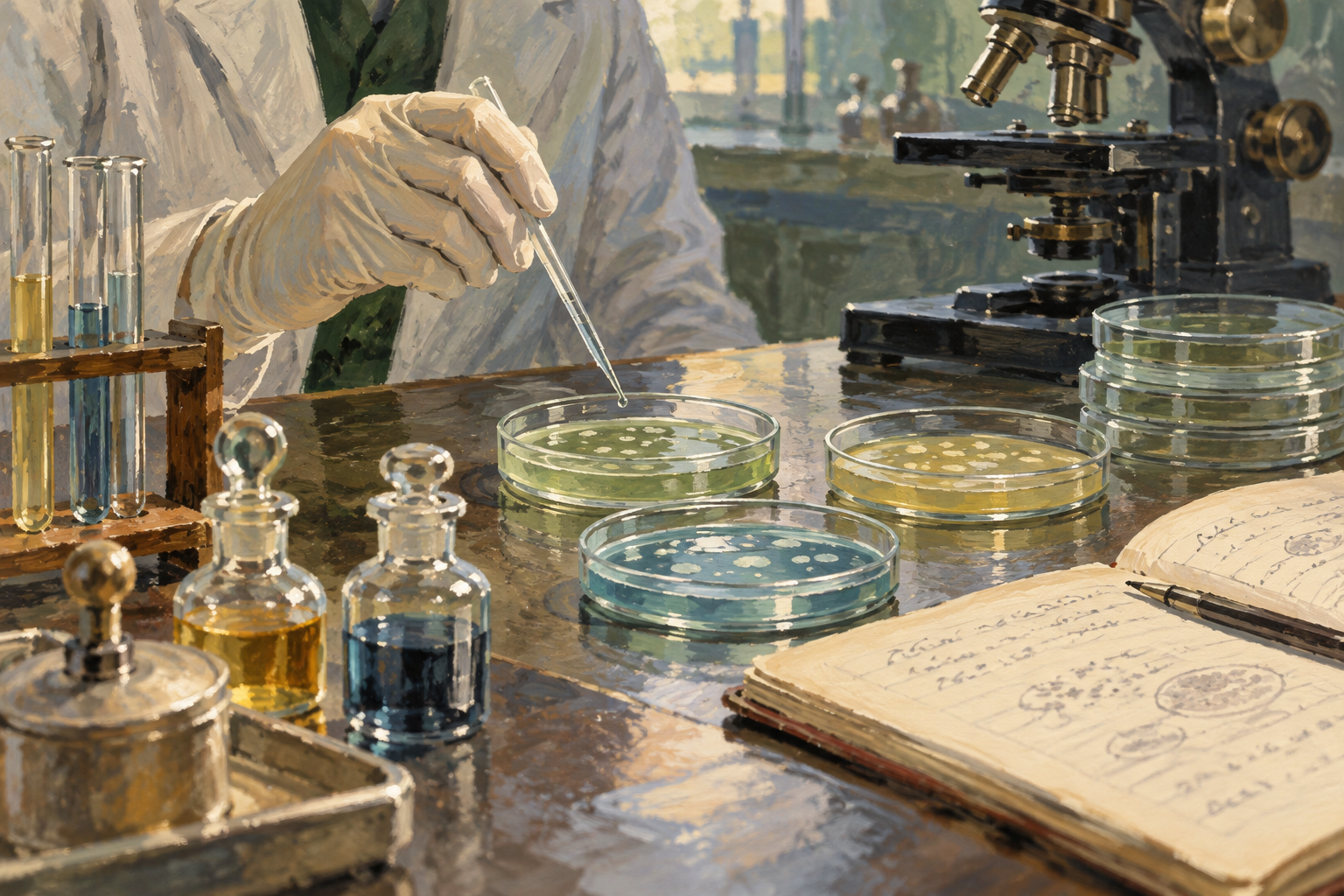
Producing the material for experiments required a daily routine of cultivation, extraction and measurement. Heatley developed practical methods and apparatus that helped turn small amounts of culture fluid into material the team could test. Purpose-designed ceramic vessels were among the equipment used to increase production.
The work extended well beyond the names later attached to the 1945 Nobel Prize. Oxford’s History of Science Museum identifies Margaret Jennings’s toxicity research, Ethel Florey’s supervision of clinical trials and Arthur Gordon Sanders’s operation of extraction equipment. Women cultivating the mold included Ruth Callow, Claire Inayat and Betty Cooke.
The historical nickname “penicillin girls” can make that work sound incidental. It was not. Cultures required repeated handling and careful conditions. Contamination or poor growth could interrupt the supply on which experiments and treatment depended. Clinical research was inseparable from the people making the next batch possible.
Surviving wartime photographs help recover this labor. Shelves of flasks and workers filling containers show production as a workplace rather than a solitary discovery. Their captions still need care: a photograph catalogued as penicillin work in England is not automatically a photograph of the Oxford team.
An agricultural laboratory enters the story
Florey and Heatley traveled to the United States in 1941 to seek help expanding production. The visit took place before the United States entered the war. At the Department of Agriculture’s Northern Regional Research Laboratory in Peoria, Illinois, they found expertise developed for a different purpose.
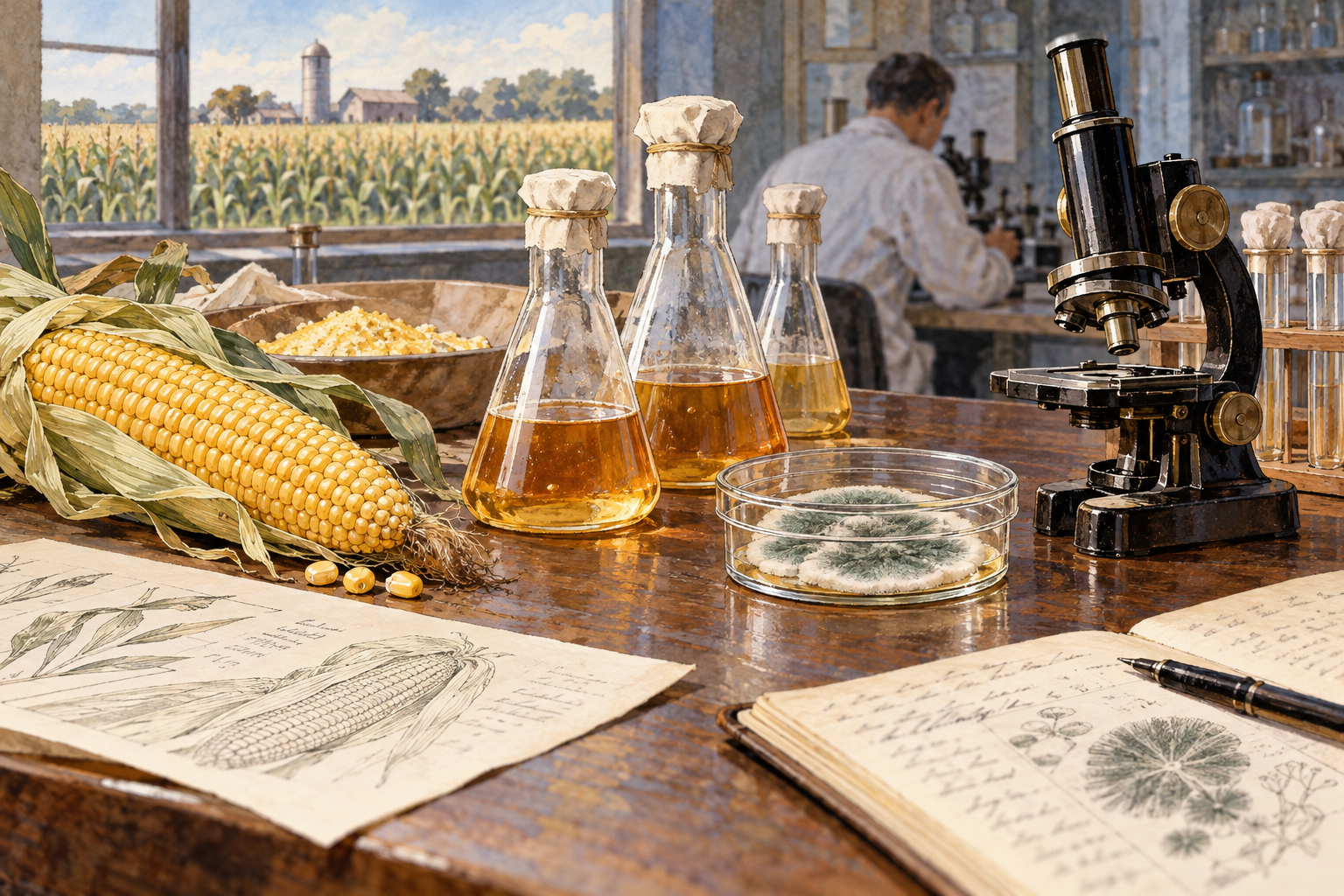
The laboratory studied molds, fermentation and uses for agricultural products. Those skills could be applied to the medical shortage. Researchers examined the conditions in which the organism grew, the nutrients available to it and the quantity of active material that could be recovered.
Andrew Moyer’s work with culture media helped increase yields. Corn-steep liquor, a by-product of processing corn, and lactose became important parts of the effort. Heatley shared the Oxford team’s experience. The collaboration connected medical research with a body of knowledge that had not originally been organized around treating patients.
The search for productive organisms also continued. A mold found on a cantaloupe from a Peoria market became a memorable part of the strain-development story. But a productive strain was another beginning, not an instant solution. It still needed suitable conditions, reliable cultivation and an effective recovery process.
Focusing exclusively on the cantaloupe risks creating a second accidental-discovery legend. The important change was the combination of strain selection and process development, carried forward by many people rather than completed in one fortunate moment.
Why a tank was not just a larger flask
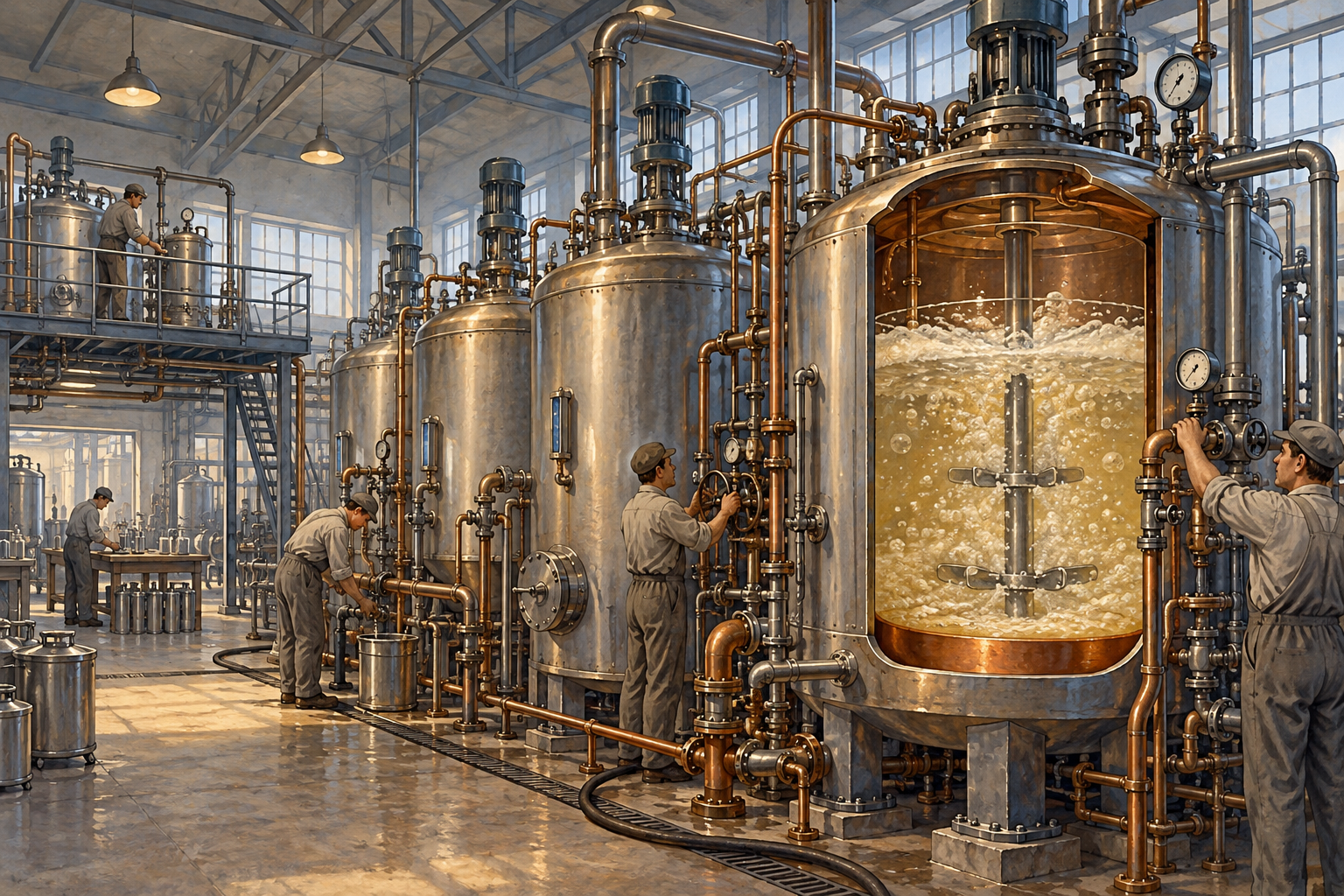
Early production used cultures growing at the surface of liquid in numerous vessels. Increasing output meant more containers, space and handling. Deep-tank fermentation offered the possibility of growing the mold within much larger volumes.
That possibility came with new difficulties. The organism needed oxygen throughout the liquid. Engineers had to manage aeration, mixing, temperature and foaming while excluding contamination. A failed large tank could destroy far more material than a failed flask.
Manufacturers brought existing fermentation experience to the problem. Pfizer’s Brooklyn factory, opened in March 1944, became an important example of deep-tank production. Other companies, including Merck, Squibb, Lederle and Abbott, also belonged to the wider American production program, alongside British work and public laboratories.
The factory did not remove the need for science at smaller scales. Productive cultures had to be prepared and transferred through stages before entering large vessels. Each stage depended on the others. Successful growth in one container did not guarantee success under different conditions in another.
Wartime photographs of flask cultivation and bottling therefore show different parts of one supply chain. They should not be treated as interchangeable pictures of a single process or plant.
Recovering the drug
A tank full of broth was not a tank full of finished penicillin. The active material had to be extracted from a much larger quantity of liquid, purified and prepared in a usable form. Losses during recovery could erase gains made during cultivation.
The distinction changes how production figures should be read. A factory might increase the volume it fermented without increasing usable output by the same proportion. Contamination, instability and processing losses all mattered between growth and delivery.
Robert D. Coghill, who led the Peoria laboratory’s fermentation division, described these difficulties in an April 1944 address. He discussed the trade-offs between familiar smaller equipment and much larger tanks. Large vessels could reduce some handling demands, but placed more material at risk; many smaller vessels required more equipment and labor.
His account is valuable because it was written while expansion was still under way. It restores choices that disappear in retrospective celebration. The factories were not built with certainty that every technical decision would succeed. Equipment, workers and materials had to be committed while the process was still being improved.
Measuring something more useful than volume
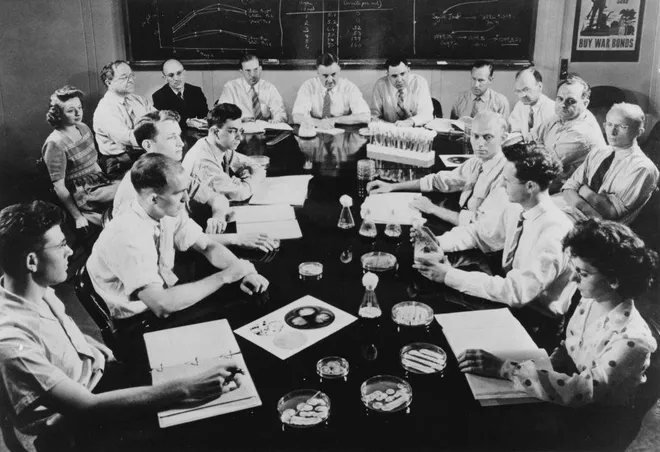
Doctors also needed to know whether preparations from different batches had comparable activity. An assay tested biological potency. Reference standards helped laboratories and manufacturers speak a common language about the material they produced.
This is why output expressed in units cannot simply be translated into a count of bottles, patients or lives saved. Activity, packaging and treatment requirements are different measurements. A striking increase in production establishes an expanded supply, not a precise clinical outcome for every unit.
The work of testing was therefore part of manufacturing rather than an optional final check. Reliable treatment depended on consistent material reaching medical services, not merely on factories reporting that they had produced more liquid.
Coghill’s contemporary account also has limits. It records how a participant understood a program in progress. Its technical and organizational detail is useful historical evidence; its medical language should not be substituted for present-day treatment guidance.
Who coordinated the expansion?
In the United States, Alfred N. Richards and the Committee on Medical Research within the Office of Scientific Research and Development helped connect research and clinical investigation. The War Production Board became involved in expanding capacity and allocating scarce construction resources.
Factories needed equipment, labor and materials in an economy already committed to war. Public coordination helped give penicillin priority, but it did not make institutional differences disappear. Firms invested their own resources and remained concerned about patents, information sharing and future markets.
An economic-history study published by WIPO examines this mixture of cooperation and competition. The wartime system was neither the work of a single company nor a perfectly coordinated public machine. Its achievements depended on negotiations between organizations with different expertise and incentives.
Scarcity also required decisions about access. Chester Keefer helped coordinate civilian clinical allocation while military needs absorbed much of the available supply. Expanding manufacture and deciding who could receive treatment were simultaneous problems.
From scarce material to regular supply
By the Normandy campaign in 1944, penicillin could be used at a scale impossible during the early Oxford trials. It remained one element of medical care, alongside surgery, nursing and other treatments. It did not work against every infection or remove the need for sound clinical judgment.
Civilian availability widened on different schedules. The American Chemical Society’s history records the end of U.S. civilian distribution restrictions in March 1945 and general prescription availability in Britain in June 1946. The transition continued beyond the timetable of wartime victories.
Fleming, Florey and Chain shared the 1945 Nobel Prize. The award recognized major contributions, but could not name everyone who had made supply dependable: laboratory workers, agricultural researchers, engineers, factory staff and clinicians all belonged to the process.
Albert Alexander’s treatment had revealed the consequences of scarcity. The wartime production effort addressed that problem through thousands of repeated operations, measured batches and functioning facilities. Penicillin’s promise became a practical medical resource when the system could keep providing it.
Sources and further reading
- Oxford University’s account of Norman Heatley
- American Chemical Society and Royal Society of Chemistry’s landmark history
- History of Science Museum account of production
- Museum’s “Team Penicillin” exhibition
- USDA’s history of its penicillin work
- ACS history of deep-tank fermentation
- an address delivered in April 1944
- WIPO economic-history working paper on wartime medical innovation