
Science, Invention & Exploration
Louis Braille’s Six Dots: A Writing System Its Readers Could Make
Braille changed more than the shape of a page. Its history turns on writing as well as reading, the choices of schools and printers, and the people who used a code before institutions fully accepted it.
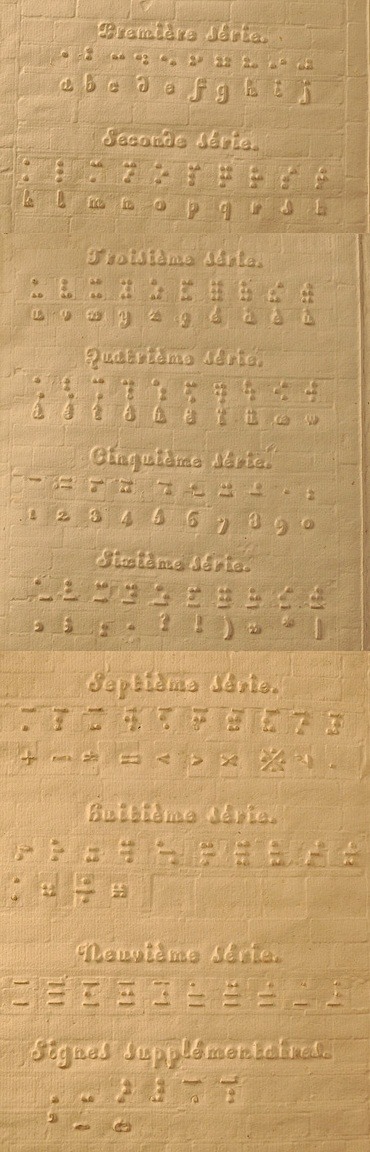
The first published explanation of Louis Braille’s dot system was not printed entirely in the script it introduced. In 1829, the Paris institution where he studied and taught issued his method in embossed letters, accompanied by examples of the new signs. A book proposing a different way to read still had to explain itself through an older one.
That apparent contradiction is a useful starting point. As the National Federation of the Blind’s introduction to the surviving book explains, Braille had not simply invented a private cipher. He was presenting something other people needed to learn, teach, reproduce and use. The material form of the book reveals the world into which the invention had to fit.
Its title promised words, music and plainsong. Its author was a blind teacher, not a sighted benefactor offering a finished solution to passive recipients. The system’s importance lay partly in its compact signs, but also in a crucial relationship between reading and writing: a person could make marks that another blind reader—or the writer later—could recognise by touch.
What the familiar origin story leaves out
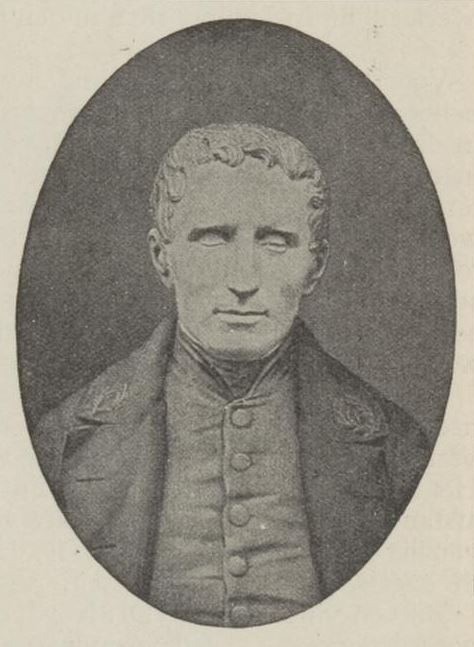
Braille was born in Coupvray, France, in 1809 and lost his sight following a childhood injury. He entered the Paris school for blind young people in 1819. These biographical facts are well established. The much-repeated account of a military officer visiting the classroom to demonstrate a secret code is less secure.
Historian Philippa Campsie’s research, explained in a 2025 Perkins Archives essay, challenges the familiar claim that Charles Barbier devised his tactile system principally for soldiers communicating in darkness. Her reading of Barbier’s writings shows that he explicitly considered blind readers. Braille’s own 1829 preface credited Barbier’s work for blind people while explaining why he proposed a different arrangement.
This is not a dispute about whether Braille owed something to Barbier. He said that he did. It concerns the story attached to that debt. A satisfying chain—military necessity, classroom demonstration, youthful revelation—can survive through repetition even when the documents tell a less theatrical history.
A change small enough for a fingertip
The Library of Congress’s account of Campsie’s archival findings distinguishes the introduction of Barbier’s system to the school from a personal meeting with Braille. In 1821, Barbier corresponded with the director, and the school tried his raised-point method. The documentary evidence places the two inventors’ acquaintance later, in 1833, after Braille had published his own work.
The distinction restores the institution and its students to the story. Ideas could move through letters, equipment and classroom trials without the inventor personally staging a demonstration. Braille encountered a practice already being tested by readers, not merely an abstract puzzle handed down by a visiting officer.
The key spatial unit of the mature code is a cell with two columns of three dots. The National Library Service’s explanation of the cell describes 63 nonblank combinations. The dots are numbered down the left column 1–3 and the right 4–6. Their arrangement, not the outline of a conventional printed letter, identifies the sign.
The change matters because the reading surface is a fingertip rather than a field of vision. A raised version of a familiar ink letter may reassure a sighted teacher while imposing complicated shapes on a tactile reader. A compact set of distinguishable positions begins from a different requirement. It does not merely enlarge or emboss the ordinary alphabet; it changes the form in which the alphabet can be represented.
That was a design decision, not a claim that touch and sight are interchangeable. A code has to work with the way it is encountered. Its users still need instruction, practice and appropriate materials. The elegant cell made those activities possible in a new way; it did not make learning unnecessary.
The right to write back
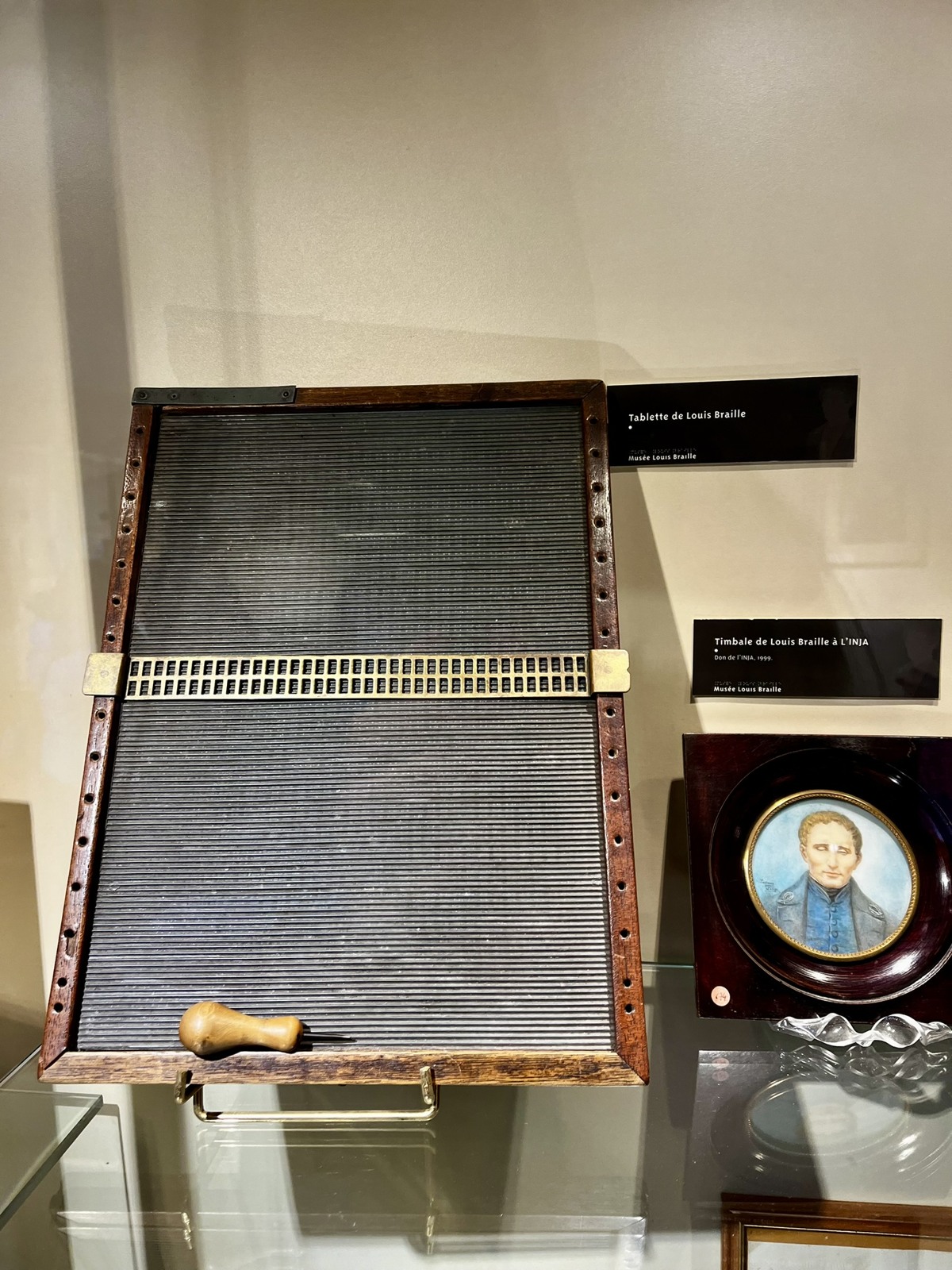
Braille’s 1829 method explains how writing reverses the arrangement seen when the paper is turned over. Pressing a point into one side raises a dot on the other. The writer therefore works in the direction and orientation needed for the finished sheet to be read. The book treats this as a practical skill to learn, not an obstacle that invalidates the method.
A slate and stylus made this a relatively modest piece of equipment rather than an entire printing workshop. The American Printing House’s history of braille writers describes a hinged frame holding paper, with openings guiding the stylus. The user could create a tactile text and subsequently read it. That relationship is easy to overlook if braille is imagined only as a kind of book supplied by an institution.
Reading a prepared page and composing a private note are different forms of access. The second allows decisions about what is worth recording: a reminder, an address, a musical passage, a message to a friend. It also permits correction and revision by the writer. A system that joins those activities gives its users a role in producing the record rather than only receiving it.
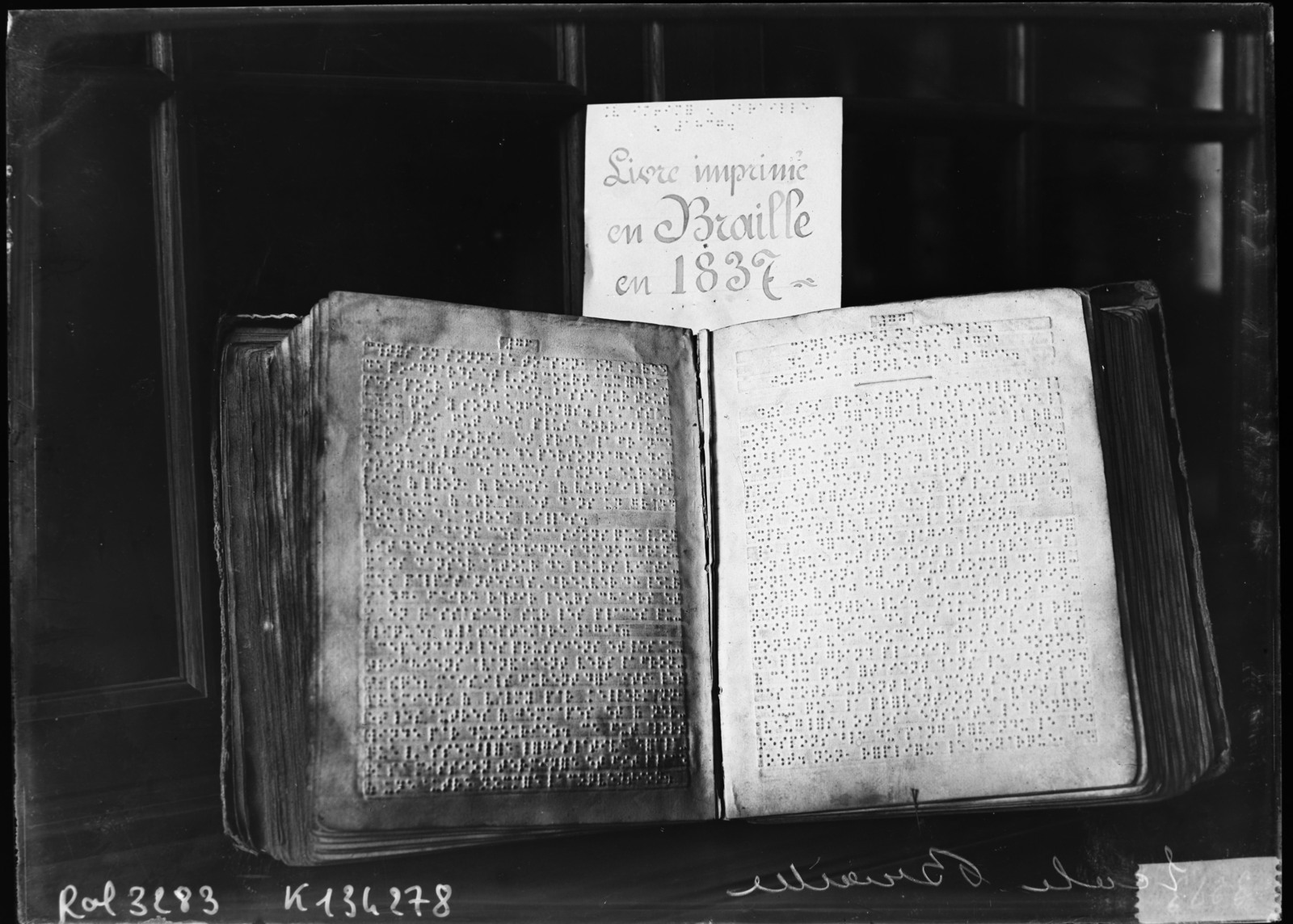
The early method was still developing. The 1829 tables included dashes as well as dots, and the published code underwent revision. The American Foundation for the Blind’s history of the books records the second edition in 1837 and a mathematics publication the following year. It also identifies an 1837 history of France as the first full-length book produced in the dot system.
A published alphabet and a supply of readable books were not the same achievement. Printing required organised production, suitable paper, decisions about spacing and a shared code. The work of readers, teachers and printers therefore continued after the central invention. A promising method could not fill a library by itself.
The competing page
Older systems did not disappear as soon as braille existed. The Folger Shakespeare Library holds an 1871 edition of King Lear in Boston line type: raised Roman letters rather than braille dots. Sarah Hovde’s account of the volume shows the technical effort invested in this alternative, including specialised presses and paper capable of retaining a legible impression.
Those investments help explain why adoption was more complicated than comparing two alphabets and choosing the better one. Schools possessed equipment, books, expertise and habits of instruction. A change could require new production methods and new learning by teachers. The costs of maintaining an existing system and the costs it imposed on readers were not necessarily borne by the same people.
The Perkins historical account is particularly revealing about that mismatch. Students used braille enthusiastically for correspondence and note-taking while Boston line type remained the school’s official printing system until 1908. Braille slates were offered for sale there by 1869. Personal use and institutional policy moved at different speeds.
The same account notes educators’ resistance to a system whose signs sighted teachers would have to learn. This is not evidence that every teacher opposed braille, nor that all raised-letter experiments were worthless. It does show that the convenience of an administrator or instructor could be mistaken for the needs of the person reading by touch.
Not all dots meant the same thing
The alternatives were not limited to raised letters versus braille. Jennifer Arnott’s history for Perkins Archives describes American Braille, developed by the blind teacher Joel W. Smith in 1878. It used the same six-position cell but reassigned signs so that frequently used English letters required fewer dots. For someone writing with a stylus, the number of points to punch was a practical consideration.
Such a change could improve one aspect of use while making texts incompatible with another arrangement. A reader might recognise the physical cell yet need to learn a different meaning for it. The dispute was therefore not simply between enlightened users and stubborn institutions. It also involved competing judgments about speed, space, language and the costs of changing an established practice.
The National Library Service’s historical timeline records the 1932 London agreement on Standard English Braille. Even that settlement retained differences: British practice did not adopt capital letters in the same way. The library began lending books in the new code in 1933. An international agreement became effective through the comparatively unglamorous work of producing and circulating compatible material.
These dates are far removed from the schoolboy inventor of the familiar story. They show why it is useful to distinguish invention from standardisation. A code could be admired, taught and vigorously defended long before readers in different places could assume that their books followed the same conventions.
The history becomes more intelligible when the readers are treated as participants in adoption. Their use of the code could precede formal endorsement. Correspondence and note-taking created practical reasons to learn it; those practices linked people beyond the boundaries of a particular school’s printed collection. Acceptance was built through use as well as decreed from above.
Music was there at the beginning
Music was not a decorative later addition to a system originally concerned only with prose. Braille’s first publication included it in both title and contents. The Library of Congress’s history of early braille music codes traces revisions through the 1830s and the later work of reconciling differences between national versions.
This matters because a reader may need more than ordinary sentences. Musical notation, numbers and punctuation place demands on a code that a simple alphabet chart can conceal. The system’s flexibility depended on conventions that allowed combinations of dots to carry different kinds of structured information.
Music also makes clear why standardisation is not the enemy of creativity. Shared rules let a score travel from its producer to someone who has never met them. Disagreement over notation can make an otherwise useful text harder to exchange. International coordination belongs to the history of the invention’s practical reach, not merely to an administrative footnote.
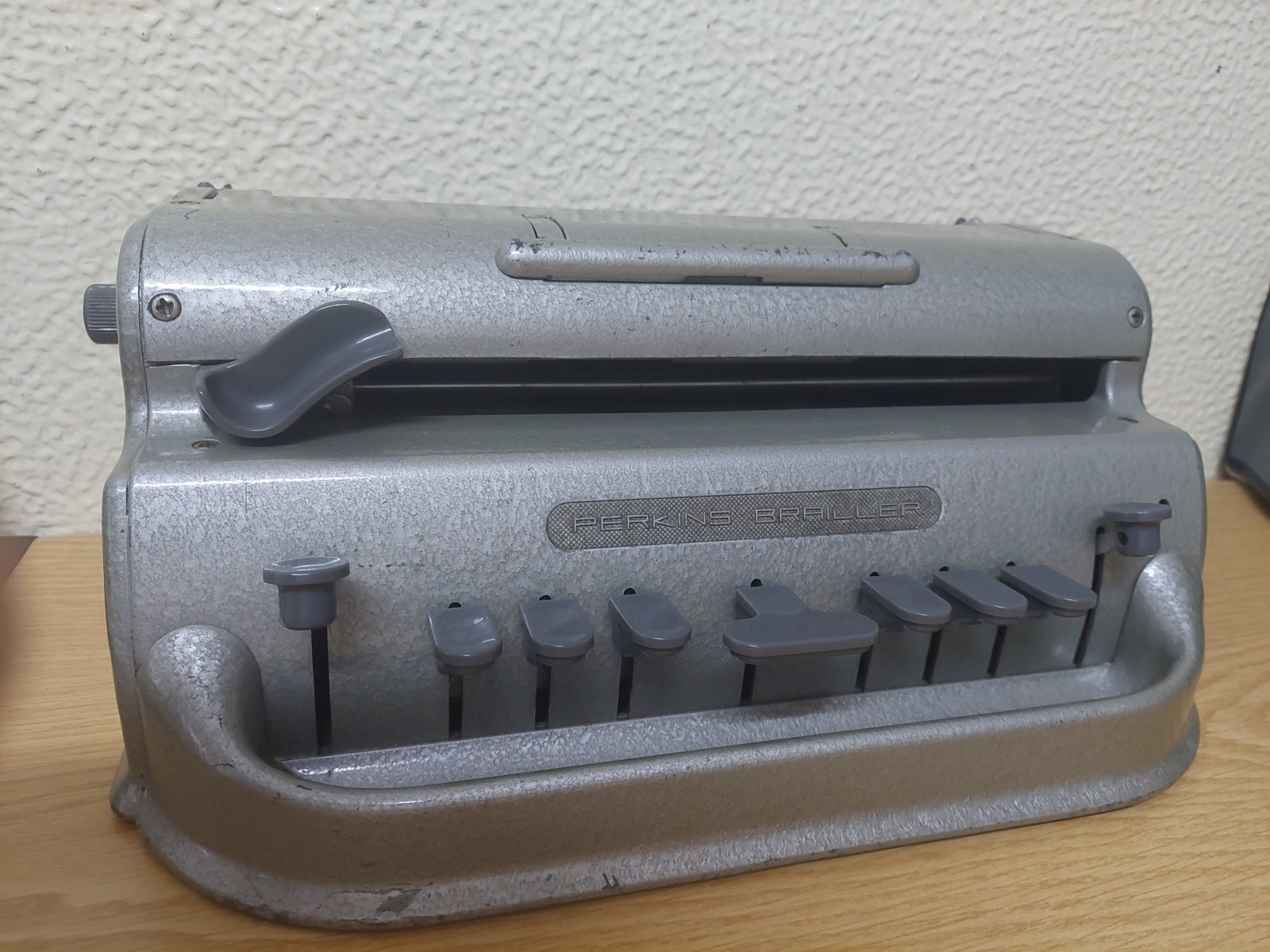
Mechanical writers later changed production again. The American Printing House dates the first sale of the Perkins Brailler to 1951, nearly a century after Louis Braille’s death in 1852. A machine bearing the name of a school in Massachusetts should not be pictured on the desk of the French inventor. The continuity is the tactile code; the equipment belongs to a later phase of its history.
A code did not finish the work of access
RNIB’s history of braille follows its development into more recent technologies and adaptations. The medium can change while tactile reading remains central. Paper is one form of access, not a definition of the entire system.
It would be equally misleading to assume that every blind or partially sighted person reads braille, or that one technology removes every barrier to literacy. Different readers have different needs, opportunities and preferences. The historical achievement is more precise: a compact tactile system enabled forms of reading and writing that could be taught, reproduced and used independently.
The 1829 book preserves the transition in miniature. Raised letters explain dots; a teacher credits an earlier inventor while proposing improvements; music and ordinary writing share the same project. Later schools, printers and users made choices that expanded—or delayed—its reach. Braille’s six dots were an invention. A world in which people could obtain, learn and use them had to be built.