
Know the Present · AI, science & public power
Can Washington Buy an AI Breakthrough?
The Genesis Mission’s new awards and corporate pledges revive an old bargain: public ambition, private capability, and a promise of shared progress. Apollo and the Human Genome Project show why the terms matter.
On 8 October 2026, Washington put another large wager on artificial intelligence. At its science summit, the White House announced an expansion of the Genesis Mission’s resources, including commitments from eleven companies valued at $2.4 billion in scientific tools and computing credits. The Department of Energy separately announced twelve new, larger-stage AI-science projects with awards totaling $159 million.
The announcements are concrete. Their ultimate value remains unsettled. Computing access can help a laboratory examine more possibilities; it cannot, by itself, turn a proposed catalyst into a reliable industrial process or make a simulated fusion device generate commercially useful electricity.
The White House’s own account invokes the Manhattan Project and Apollo as precedents for national scientific missions. That comparison deserves examination rather than applause or dismissal. Apollo helps explain how political rivalry can concentrate money and expertise. The Human Genome Project poses a different question, equally important for AI: after the public has helped pay for a discovery, who gets to use it?
Analysis of the announcements made on 8 October 2026, checked on 10 October. Announced commitments, funded research, and demonstrated results are treated separately. The scenarios below are conditional judgments, not forecasts presented as facts.

What Washington has actually announced
The headline figure needs unpacking. The summit’s wider package was presented as more than $6 billion across government, companies, universities, and philanthropy. The $2.4 billion of industry support sits within that broader announcement. It should not be added to it again, nor treated as a single cash transfer into a federal laboratory. Nextgov/FCW’s same-day reporting confirms that cloud and software credits are central to the pledges.
Companies describe different forms and time horizons. NVIDIA says its $1 billion commitment extends over five years and covers university research, quantum computing, and cloud providers supporting government work. A credit can lower a scientist’s immediate bill. Its public value still depends on the access actually delivered, the price used to value it, and what the laboratory must pay when it expires.
The DOE’s $159 million award announcement is narrower: twelve Phase II projects, alongside six new Phase I selections. It names work on geothermal resources, scientific software, enzymes, microchips, and an AI-enabled digital twin for the SPARC fusion device. These are research programmes with proposed outputs. A digital twin is a model to test and improve decisions; its award is not an announcement that commercial fusion has arrived.
A smaller project makes the intended mechanism easier to see. Caltech and SLAC describe a new seed-funded effort in catalyst discovery. SLAC’s account envisages a loop in which experimental X-ray measurements, existing evidence, and AI-guided hypothesis selection help determine the next experiment. The promise is fewer unproductive trials and faster learning. Its feasibility is precisely what the early funding is meant to investigate.
This is where the race becomes economically meaningful. If a useful method spreads beyond its original laboratory, it can lower the cost of discovering materials or running experiments. If access remains expensive or difficult to reproduce, the same spending may strengthen a narrow group of institutions and suppliers. The machinery alone does not decide which outcome follows.

Apollo: rivalry can organize a mission, but cannot define every mission
On 25 May 1961, John F. Kennedy asked Congress to commit the United States to landing a person on the Moon and returning that person safely before the decade ended. The Soviet Union had already launched Sputnik and sent Yuri Gagarin into space. The lunar target joined a technical programme to a visible contest over national capability. NASA’s historical account traces the commitment through the July 1969 landing.
Apollo’s achievement required much more than a compelling speech. In W. Henry Lambright’s study of its management, NASA’s contracts, research centres, university relationships, and political support formed an interdependent coalition. Administrators had to keep appropriations and engineering work moving across years. Companies built major components, but NASA retained the responsibility for integrating them into a mission that could succeed or fail.
The useful parallel with Genesis is institutional. National competition gives officials a reason to fund work whose rewards are distant or uncertain. Contracts give firms customers; laboratories gain tools; universities gain opportunities to train researchers. Their motives need not be identical for cooperation to work. The difficulty is making their separate incentives serve a result the public can judge.
Apollo also reveals the limits of the comparison. A safe lunar landing by a deadline was an unusually legible objective. Improving scientific productivity across chemistry, biology, energy, and computing has no equivalent finishing line. A faster model might be helpful in one field and misleading in another. A programme can meet a hardware milestone while missing the scientific problem that justified the hardware.
Nor was Apollo’s intensity permanent. NASA’s Inspector General records that the agency’s share of the federal budget peaked at 4.4 percent in 1966. That figure refers to NASA as a whole, not just Apollo. The historical point is about the exceptional scale of political commitment, not a spending ratio that an AI programme ought to imitate.
For Genesis, the implication is practical: its strongest projects will need field-specific tests and institutions able to retain skilled people after the summit has passed. A competition to demonstrate national strength can start a programme. It cannot substitute for the less visible work of keeping experiments, equipment, and research teams functioning.

The genome race: a public benefit had to be designed
The Human Genome Project offers a closer comparison for the treatment of knowledge. Begun in 1990, the international public effort sought a reference sequence of human DNA and the tools needed to produce and use it. Its 2003 milestone was substantial but not a completely gapless genome: NHGRI’s historical summary puts its coverage at about 92 percent. Scientific announcements, then as now, require attention to exactly what was completed.
The project was not insulated from commercial rivalry. At the June 2000 White House announcement, the public consortium’s Francis Collins and Celera’s Craig Venter described their respective progress. The event’s surviving record captures both a shared milestone and the presence of distinct approaches and institutions. A public mission could coexist with a private effort rather than replacing it.
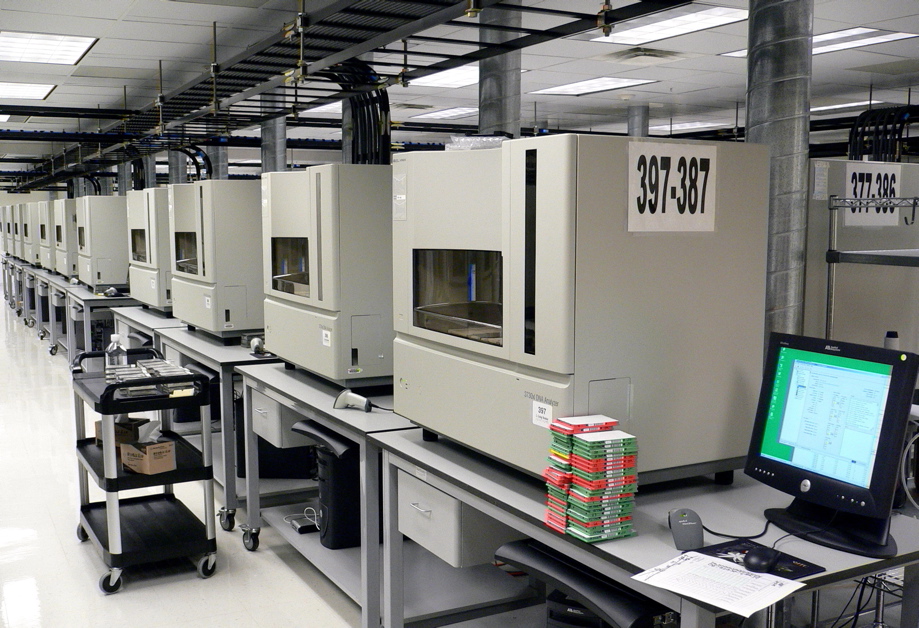
One of the public project’s most consequential decisions concerned access. The Bermuda meetings of 1996 and 1997 established rapid-release principles. In its 1999 statement, the international consortium reaffirmed that assembled stretches of sequence, once they reached the specified threshold, should enter public databases within twenty-four hours. Researchers elsewhere would not have to wait for a journal paper or negotiate a subscription to obtain that sequence.
The subsequent policy record shows rules being adapted as sequencing methods changed. Openness was therefore not simply a generous attitude held by individual scientists. Funding institutions attached expectations to the production and release of a shared resource.
That is a powerful lens for Genesis. Publicly supported AI research could leave behind reusable datasets, tested software, documented methods, and results that other teams can check. Those outputs can make the next discovery cheaper for people who never received an original award. Conversely, a successful demonstration that requires a particular commercial service indefinitely may create a useful product without creating an equally useful public resource.
The analogy has boundaries. A genome reference is not the same thing as a trained AI model. Modern scientific data may contain personal information, commercially sensitive material, or information whose release creates security risks. Model access alone does not reproduce the training process. There is no responsible rule that every output must be released without restriction. The historical lesson is narrower: access conditions shape who benefits, so they belong in the programme’s design rather than in an afterthought about dissemination.
Who pays before the breakthrough arrives?
The immediate beneficiaries are easier to identify than the eventual ones. Awarded laboratories can employ researchers and obtain resources; participating suppliers gain use of their systems and relationships with future customers. None of that proves the arrangement is wasteful. The relevant economic question is whether wider gains exceed costs that the announcement does not settle.
Consider the researcher at a smaller university. Computing credits could make an otherwise unaffordable experiment possible. Yet useful access also requires clean data, technical support, subject expertise, and time to verify results. If allocation systems favour teams already equipped to do those things, a nominally broad programme may widen the gap between well-resourced institutions and everyone else. That is a risk to measure, not an established verdict on the new awards.
Training matters for the same reason. The new Genesis graduate fellowship proposes four-year doctoral pathways combining AI with another scientific discipline, including research experience in a national laboratory and in industry. Its public funding listing describes a $100 million opportunity. This is a proposed training investment, not evidence that a cohort has already graduated or that a shorter doctorate will suit every field.
For workers, faster scientific software and automated experimentation could remove repetitive tasks and create demand for people who maintain instruments, curate data, or test model outputs. They could also reduce demand for particular routine roles. The balance depends on how employers reorganize work and whether people receive paid opportunities to acquire new skills. A claim that national AI leadership automatically guarantees broadly shared employment would go beyond the evidence.
Power supplies introduce another set of costs. The IEA’s updated 2026 outlook estimates that data centres worldwide used 485 terawatt-hours of electricity in 2025 and projects about 950 in 2030. These totals include much more than AI research. They cannot be used as an estimate of Genesis’s own footprint. They do show the crowded infrastructure market into which new computing ambitions are entering.
For a community asked to host additional capacity, the questions are local: who finances the connection and grid upgrades, who bears the risk if expected demand fails to arrive, and how are water use and reliability managed? An apparent national gain can coexist with a badly distributed local bill. Those arrangements must be examined project by project; a global electricity forecast cannot answer them.
The same distinction applies to welfare. A better catalyst or more dependable energy system could bring benefits far beyond a technology company’s balance sheet. But a cheaper discovery process does not automatically produce cheaper medicines, lower household energy bills, or wider access to services. Manufacturing, regulation, market competition, and public purchasing still stand between the laboratory and everyday life.

Three futures to watch
Apollo and the genome project do not supply a timetable for the next AI breakthrough. They identify mechanisms that can be watched. Over the coming years, three broad outcomes are plausible, and different Genesis projects could follow different paths.
1. A shared scientific accelerator
If awards produce independently tested methods, accessible research resources, and tools that work across institutions, public funding could reduce the cost of discovery beyond the original recipients. Private suppliers would still earn revenue, but users would have meaningful alternatives. The signs would be reproducible results, reuse by unaffiliated teams, access for smaller institutions, and lower total cost per successful experiment. More papers or larger models alone would be weaker evidence.
2. Useful science, concentrated control
Real breakthroughs could arrive while laboratories become increasingly dependent on a few suppliers. If workflows, data arrangements, and specialist skills are costly to move, expiring credits could turn into recurring bills with limited bargaining power. This is not an allegation that the announced partners intend such an outcome. It is a foreseeable incentive problem. Watch renewal prices, the practical ability to switch providers, publication rights, and the distribution of access between institutions.
3. A costly start followed by a narrower programme
If computing expands faster than reliable data, experimental validation, or sustained funding, impressive demonstrations may fail to become dependable scientific tools. Governments could then concentrate money on a smaller set of applications. That would not necessarily mean AI had failed; it could mean the initial programme bundled together problems with very different prospects. Warning signs would include delayed validation, unused allocations, rising operating costs, and repeated changes of success criteria. Honest negative findings and timely redesign would be healthier signals than quietly abandoning the original tests.
The bargain after the summit
My assessment is that the October announcements are most promising where they connect AI to a clearly defined experimental bottleneck and an institution capable of checking the answer. Their weakest justification would be the assumption that accumulating computing capacity is itself a sufficient measure of national scientific progress.
Apollo demonstrates that rivalry and public money can organize extraordinary technical effort. The genome project demonstrates that rules about shared knowledge can extend the value of an effort beyond the institutions that perform it. Neither establishes that a new mission will succeed merely because it borrows the language of a race.
Washington can purchase access, support people, and accept risks that individual laboratories cannot carry alone. Whether this week’s commitments become broadly useful breakthroughs will depend on the contracts, tests, infrastructure, and access arrangements that follow. That is where an old question about public power becomes a current question about AI.