
The Fate of the Day: A Revolution Without a Guaranteed Ending
Rick Atkinson’s second Revolution Trilogy volume asks readers to inhabit the years when American independence remained an uncertain military project.
Editorial note: This is a research-based critical guide, informed by authorized excerpts, published criticism, and historical sources. It does not claim a full-book reading. Edition and reception details were checked on October 17, 2026.
A declaration can announce a country in an afternoon. Keeping that country alive takes longer. The years between Saratoga and Charleston expose the distance between a political claim and the difficult work of sustaining it: recruiting soldiers, feeding them, persuading allies, surviving defeat, and convincing people that the next sacrifice might still be worthwhile.
That is the terrain of Rick Atkinson’s The Fate of the Day: The War for America, Fort Ticonderoga to Charleston, 1777–1780. Published by Crown on April 29, 2025, the 880-page hardcover is the second installment of his Revolution Trilogy. Its size signals the bargain it offers: an extended immersion in the war’s middle years rather than a quick tour from the Declaration to Yorktown. The publisher’s edition record establishes the scope and publication details.
Why this history still belongs on the reading list
The book’s prominence is documented, not a claim about today’s sales. The New York Times hardcover nonfiction list dated May 18, 2025, reproduced by Memorial Hall Library, places it at number one. A Kirkus review published on February 1, 2025 commended its narrative history and emphasized its treatment of the Revolution as both a domestic struggle and an international war. These are specific signals of reach and critical reception, not guarantees that the book answers every historical question.
In the United States’ 250th-anniversary year, its subject is especially useful because commemoration tends to compress uncertainty. Once readers know the republic survives, every retreat can start to look like a necessary step toward victory. A history bounded by 1777 and 1780 resists that comfortable shape. It ends before the familiar resolution, forcing attention onto decisions whose consequences were not yet visible.
A war made out of material things
The publisher’s opening excerpt gives a concrete indication of Atkinson’s method. The advance toward Ticonderoga is assembled from vessels, food supplies, military equipment, camp followers, and the different troops moving through the landscape. Individual ambitions sit inside this larger machinery. The effect of the passage is to make an army seem less like an arrow on a map than a traveling community with enormous practical requirements.
That is a genuine strength of the excerpt. A reader can understand a commander’s intention and still miss why the intention fails. Distance, transport, and provisioning interrupt the clean lines of strategic plans. By putting such details beside character sketches, the sample encourages two kinds of attention at once: what people wanted, and what their circumstances allowed. Its risk is the reverse of its strength. An abundance of vivid particulars can absorb attention that a reader might otherwise give to the argument connecting them.
A separate authorized excerpt published by the Museum of the American Revolution sharpens that argument. It presents Washington’s relationship with militia forces as a practical tension, not simply a contest between competence and incompetence. Militia could carry out essential local tasks while a permanent army was needed for other kinds of warfare. Washington also had to maintain political support through correspondence and persuasion. Leadership here involves managing a coalition, not merely displaying bravery.
Saratoga changes the possibilities, not the ending
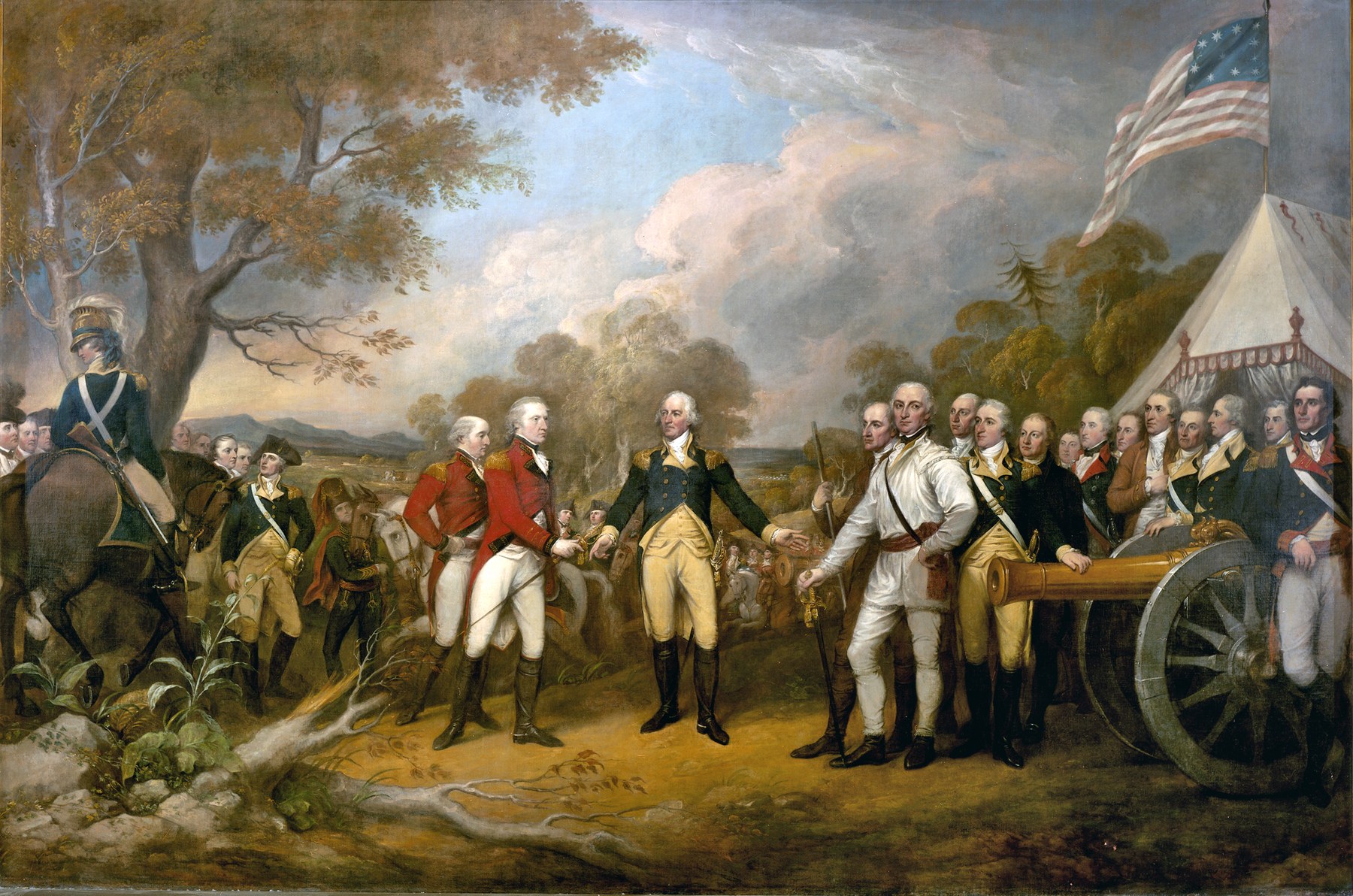
On October 17, 1777, John Burgoyne surrendered his army at Saratoga. The National Park Service’s account of the surrender site explains the event’s international importance: news of the victory strengthened the case for French intervention. This is why the book’s middle-years frame matters. A battlefield result in New York could alter calculations at a European court. For a related perspective, explore Histovia’s article on Saratoga, supply lines, and alliance.
The Office of the Historian’s account of the French alliance supplies an important qualification. France had strategic reasons to weaken Britain; assistance did not arise solely from affection for republican liberty. The treaties signed on February 6, 1778, turned support into a formal relationship, and French supplies, troops, and naval power became crucial. The connection between ideals and interests was complicated from the beginning.
Read against that background, the book’s promise is broader than a succession of battles. It offers a route into a persistent historical question: when does a local conflict become a system of interconnected wars? The answer lies partly in relationships among people who do not share the same ultimate objective. American independence and French geopolitical advantage could reinforce one another without becoming identical causes.
Then comes the corrective to any easy ascent toward success. Charleston fell on May 12, 1780. The National Park Service’s Revolutionary War timeline identifies the capture of a large Patriot army as one of the Americans’ worst defeats. An alliance and a celebrated victory had not made the military situation secure. Ending this volume near that disaster is a reminder that momentum can be real and reversible.
What the format can reveal, and what to read alongside it
The clearest limitation is structural. This is a long middle volume, so it is an awkward choice for someone seeking a single compact explanation of the entire Revolution. A beginner may want a basic chronology beside it. A reader interested primarily in constitutional debate, household life, slavery, or Indigenous sovereignty should not assume that the organizing logic of a military narrative will give those subjects the same space as campaigns and command.
That is a reading recommendation, not a claim to have audited every chapter. Without full-book access, it would be irresponsible to pronounce whole groups absent from Atkinson’s account. The more useful question is what any chosen perspective brings into focus. Following generals helps explain choices within armies. Following an enslaved person seeking freedom or a community defending its land can change what counts as victory in the first place.
For example, the same National Park Service timeline records Lord Dunmore’s 1775 offer of freedom to enslaved people belonging to rebels who reached British lines. It also describes the westward consequences of campaigns in the Ohio country. Those contexts complicate a simple opposition between a freedom-loving side and an oppressive side. Political independence for one population did not automatically deliver freedom or security to everyone.
Evidence, interpretation, and the pleasures of narrative
This is nonfiction, so “fact versus fiction” is not principally a hunt for invented dialogue. The central distinction is between recoverable evidence and the explanatory shape a historian gives it. A dated surrender, a surviving letter, and a commander’s reported remark carry different evidentiary possibilities. Even a beautifully documented narrative must select, arrange, and emphasize.
The accessible samples make that an especially productive way to read Atkinson. Pause when a portrait of character seems to explain an outcome. Ask whether logistics, institutions, or competing information also deserve weight. Conversely, when large forces dominate an explanation, ask where an individual’s decision genuinely changed the available options. Narrative history becomes more rewarding when readers test its connections rather than treating fluent prose as proof.
Who will get the most from it?
The Fate of the Day is a strong candidate for readers who enjoy sustained campaign history, diplomatic context, and the practical business of keeping an army in existence. Book groups could organize discussion around one question: which mattered most at each turning point, leadership, resources, alliances, or chance? Teachers can pair a short excerpt with an independent timeline rather than assigning the volume as a self-contained account of every Revolutionary experience.
The provisional verdict is favorable on the evidence available: the samples demonstrate a persuasive method, and the book’s frame is a valuable challenge to hindsight. Its most interesting invitation is to put the familiar ending temporarily aside. In 1780, independence remained something people were trying to secure, not something history had already promised them.
Edition reference: The Fate of the Day, Crown hardcover on Amazon, ISBN 9780593799185. This link identifies the verified edition; prices, sellers, and availability may change.
Sources and further reading
- Penguin Random House: Crown hardcover
- New York Times list reproduced by Memorial Hall Library
- Kirkus Reviews
- Penguin Random House Higher Education: authorized sample
- Museum of the American Revolution: authorized excerpt
- National Park Service: Saratoga Surrender Site
- Office of the Historian: French Alliance
- National Park Service: Revolution timeline