
Ancient Rome · The long read
Inside the Roman Legion: Soldiers, Tactics, and Imperial Power
How Rome organized, equipped, trained, and supplied its soldiers, and how the legion changed from the Republic to late antiquity.
I. The institution behind an empire
At its greatest extent in the early second century AD, Rome ruled territories stretching from Britain across the Mediterranean to North Africa and western Asia. Its eastern reach changed rapidly: Trajan’s conquests in Mesopotamia were not all retained by his successor Hadrian. A vast empire required more than battlefield victories. It needed soldiers who could be recruited, paid, moved, and supplied year after year.
The legion was central to that system. It combined a recognizable identity with internal divisions, officers, standards, specialists, and established routines. Yet there was no single Roman legion that remained unchanged from the city’s beginnings to the end of the western Empire. The word described different organizations at different dates. A Republican levy fighting in Italy, Caesar’s campaign-hardened troops, and a fourth-century field-army unit should not be placed in the same uniform or organization chart.
Training and discipline mattered, but Rome did not invent either. Greek, Macedonian, Carthaginian, Persian, and other armies possessed their own sophisticated traditions. Roman success came from the interaction of military practice with an unusually extensive recruiting base, alliances, resources, and political commitment. Roman commanders also learned from their opponents, and Roman armies could be badly led or decisively defeated.
For a shorter route through the subject, start with The Roman Legion: How Rome Built a Military Power. This long read separates the major periods before looking closely at the soldier’s work.
From citizen levies to enduring units
Our picture of Rome’s earliest armies is uncertain. Later authors associated military organization with kings and constitutional reforms, but those accounts were written long after the events they describe. Archaeology reveals military equipment and contacts with surrounding cultures; it cannot simply confirm the detailed organization attributed to Romulus or Servius Tullius. The traditional foundation date, 753 BC, is not a securely documented starting date for a fully formed legion.
By the middle Republic, the evidence becomes much richer. The Greek historian Polybius described a legion normally containing about 4,200 infantry, with a larger establishment in emergencies, and 300 Roman cavalry. Heavy infantry were divided into hastati, principes, and triarii, supported by light-armed velites. The maniples of the triarii were smaller than those of the first two heavy-infantry divisions. These figures describe the system in his account, not a permanent establishment across Roman history.
Rome’s Italian allies supplied substantial additional forces. Their contribution was not a decorative addition to a citizen army: it was fundamental to Roman campaigns and to Rome’s capacity to recover after defeat. Later, imperial auxiliary regiments provided infantry, cavalry, archers, and other capabilities alongside the legions. A history of Roman military power that mentions only legionaries leaves out much of the army.
During the late Republic, cohorts became the principal tactical subdivisions of legions. Longer campaigns and repeated service produced experienced formations, even while conscription continued. Augustus eventually consolidated a durable standing army after the civil wars. In late antiquity, further changes produced smaller units and different arrangements for frontier forces and field armies. These developments were cumulative, not a succession of perfectly synchronized reforms.
Inside the legion: an organization explorer
The following is a conventional outline for the early imperial legion, especially the later first and second centuries AD. Establishments changed, and actual strength could fall below the paper total through losses, sickness, leave, and detached duties.
Legio: roughly 5,000 infantry
A legion normally contained ten cohorts. A common reconstruction gives nine cohorts of 480 men and an enlarged first cohort of about 800: 5,120 infantry on paper. A small cavalry element, often given as about 120, was additional. The result is an illustrative establishment: surviving evidence and actual unit strengths vary.
A senatorial legatus legionis usually commanded in much of the early Empire, assisted by tribunes and a camp prefect. Exceptions and later changes matter. The legion also contained clerks, medical personnel, craftsmen, and artillery specialists, many drawn from its own soldiers rather than added as a separate army.
Cohors: the cohort
An ordinary cohort is conventionally reconstructed as six centuries of about 80 men. The enlarged first cohort is commonly described as five double-strength centuries. Its development and precise establishment are subjects of scholarly discussion. Five enlarged centuries and six ordinary centuries produce different cohort totals.
Cohorts offered a useful intermediate scale between a legion and its smaller units. Detachments, called vexillationes, could be assembled for particular missions and did not always correspond to one complete cohort. A legion might have troops scattered across several posts.
Centuria: the century
Despite its name, a century in the familiar imperial model contained about 80 soldiers, not necessarily 100. Its centurion directed training and duties as well as fighting. An optio assisted him, while a signifer carried a standard and had administrative responsibilities.
Centurions formed a hierarchy of their own, with substantial differences in prestige and rewards. The vine staff, or vitis, symbolized their disciplinary authority. A single pay multiplier or a universal twenty-year career does not capture the variety of centurions’ backgrounds and ranks.
Contubernium: the tent group
Eight soldiers are conventionally associated with a tent group, sharing accommodation and routine chores. Ten such groups make the 80-man century of the standard model. Preparing meals, maintaining equipment, and enduring marches together helped establish the relationships on which a unit relied.
Transport animals and servants also supported military life. Claims that every group always had exactly one mule, or that a formal decanus commanded each early imperial tent group, are more certain than the surviving evidence allows.
For the enlarged first cohort, see David Breeze’s “The Organization of the Legion: The First Cohort and the Equites Legionis”. For an accessible explanation of barracks and basic unit sizes, see Arbeia’s museum guide.
II. The making of a legionary
Military service could promise regular income, status, and eventual rewards. It also meant exposure to disease, injury, harsh discipline, and years away from familiar surroundings. Men joined for different reasons: opportunity and family connections could matter, but so could compulsory recruitment. Describing every legionary as a willing professional obscures the variety of Roman practice.
In the early Empire, legions normally recruited Roman citizens. Auxiliary units drew heavily on non-citizens, although the boundaries were never entirely simple and changed over time. Roman citizenship was a legal status, not a modern ethnic label. Legionaries increasingly came from provincial communities, and auxiliary regiments could retain an ethnic name long after their recruiting area had widened.
Recruits underwent scrutiny and training before becoming effective soldiers. Physical fitness and recommendations could be important. Specific ages and height requirements quoted in ancient sources should not be turned into a single, empire-wide recruitment policy for all centuries. The army’s needs and the circumstances of recruitment affected who was accepted.
The oath and the length of service
The military oath, the sacramentum, bound soldiers to obedience and, under the emperors, to the ruler. Its religious force reinforced military law. This was a serious commitment, but the oath was not a timeless contract specifying twenty-five years for every recruit.
Under Augustus, the regular legionary term developed from sixteen years to twenty, with further retention and veteran service complicating the reality. Many men served longer than the nominal term. Twenty-five years is particularly associated with auxiliary service and eligibility for citizenship grants. The distinction matters: a citizen legionary was not ordinarily serving to obtain citizenship he already possessed.
Tacitus’ account of the mutinies in AD 14 preserves soldiers’ complaints about long service, deductions, and mistreatment. His speeches are literary compositions, not verbatim transcripts, but the episode reveals tensions within the military institution. Discipline rested on bargaining and expectations as well as punishment.
Training: ideals and daily practice
Marching, weapons practice, maintaining formation, and camp work were central military skills. Repetition could reduce confusion under pressure and make coordinated movement more reliable. A soldier also had to recognize commands and signals, find his place in a working party, and keep his equipment usable.
The late Roman writer Vegetius is a famous source for training. He describes practice with heavier weapons, exercises against posts, swimming, and burden-carrying. He also gives marching targets of twenty Roman miles at the military step and twenty-four at the faster step, both within five summer hours. That is approximately 30 and 36 kilometres; the second figure is not twice the first. These are training prescriptions in an antiquarian, reform-minded text, not a timetable obeyed by every army.
Vegetius wrote in late antiquity, drawing on earlier material. His recommendations should not be transplanted without qualification into Caesar’s army or Trajan’s. The same caution applies to the often-repeated claim of a universal four-month basic-training course. We know training was important; we cannot reconstruct one standardized curriculum for all legionaries.
Specialists expanded what a legion could do. Surveyors, engineers, medical staff, and skilled craftsmen supported military operations, while ordinary soldiers carried out much of the labor. This does not mean every recruit learned surgery, bridge design, or surveying. An organization’s collective abilities should not be mistaken for the qualifications of every member.
Pay, rewards, and everyday expense
For much of the early imperial period, ordinary legionary pay is conventionally reckoned at 225 denarii a year, rising to 300 under Domitian. Those figures describe basic pay, not take-home income or a stable purchasing power across centuries. Deductions, supplies, gifts from emperors, booty, rank, and local prices all affected a soldier’s position.
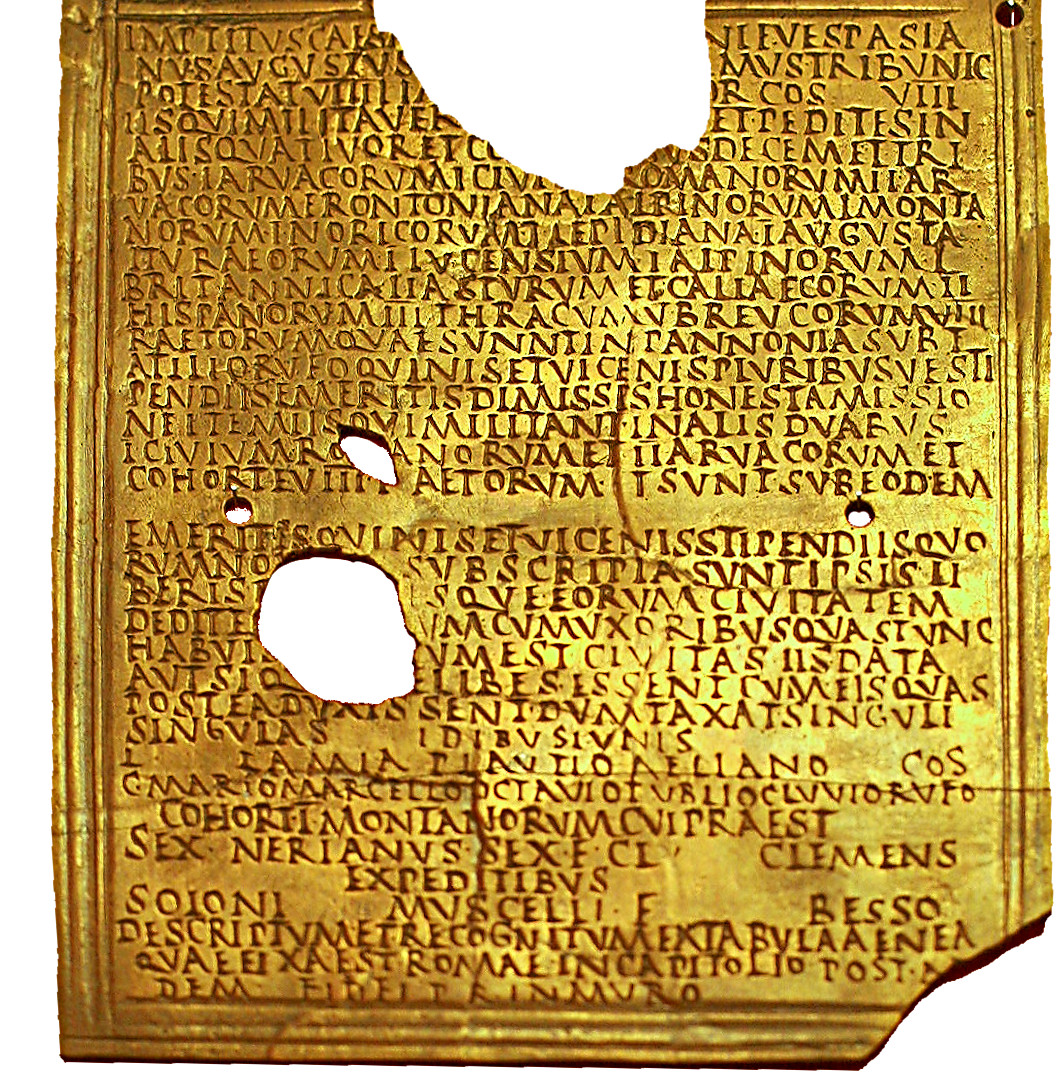
A discharge reward could take the form of land or money. Under the Augustan arrangements, a legionary cash grant of 3,000 denarii became an important benchmark: Cassius Dio records the equivalent 12,000 sesterces after twenty years’ service. It should not be confused with an annual pension paid indefinitely, or assumed to apply unchanged throughout Roman history. Survival, eligibility, administrative decisions, and political upheaval could all affect retirement.
Army life also involved ordinary shortages and requests from home. Letters and writing tablets show soldiers seeking clothing, food, recommendations, and assistance. These small transactions make a useful corrective to the image of an entirely self-contained military machine. Even a paid standing army depended on personal networks.

Weapons and armour: practical, varied, and changing
The familiar combination of rectangular shield, short sword, javelin, helmet, and segmented armour belongs broadly to parts of the early imperial army. It is not suitable for every Roman century. Different weapons and armour overlapped in use, and archaeological finds often reveal greater variation than modern films suggest.
Pilum: the heavy javelin
The pilum combined a wooden shaft with a long iron shank and a penetrating point. It could injure an opponent or lodge in his shield, making protection awkward. Caesar describes shields encumbered by Roman javelins, while other ancient writers discuss changes intended to make a weapon difficult to reuse.
There was no single universal weight, throwing distance, or construction. Nor can we assume that every legionary in every period carried exactly two. The idea that all pila were deliberately soft and always bent on impact simplifies a more complicated history of materials and design. Their immediate purpose was to strike the enemy, not merely to become unusable.
Gladius: more than a thrusting weapon
The gladius was a short, double-edged sword, with dimensions and blade shapes that changed over time. It suited close fighting but could cut as well as thrust. Roman authors’ praise of the thrust does not mean legionaries never slashed, or that other ancient soldiers were incapable of controlled swordsmanship.
A shield and sword had to be used together in a shifting fight. The image of an unbroken wall of permanently overlapping shields leaves too little room for actual weapon handling. Longer swords, usually called spathae, became increasingly important to Roman infantry in the later Empire; the short sword was not eternal.
Scutum: a large shield with a history
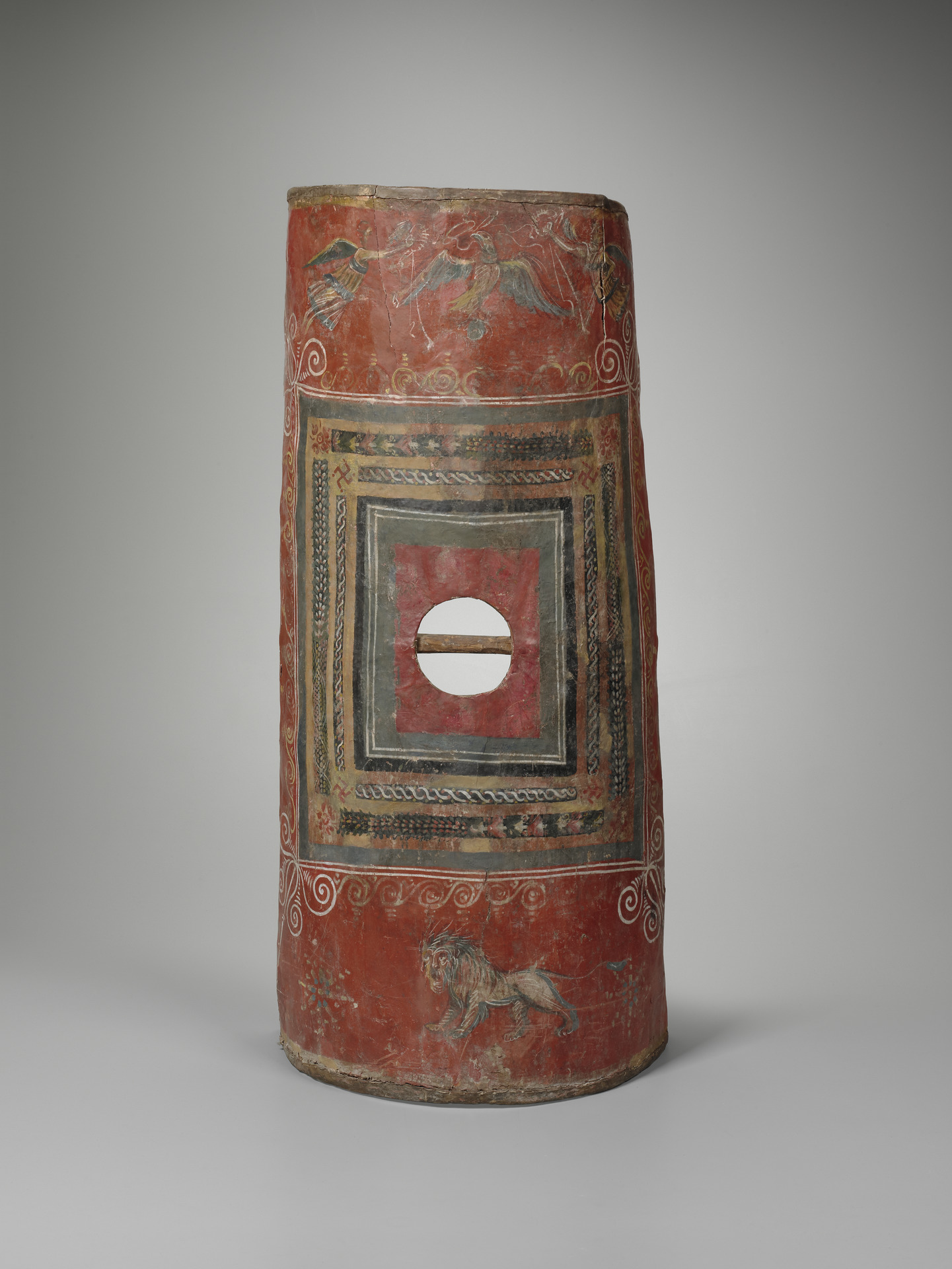
Roman shields included oval, rectangular, and other forms. The strongly curved rectangular scutum is especially associated with the early imperial legionary. Thin wooden layers, coverings, a handgrip, and a central boss created protection that combined strength with manageable weight.
Surviving examples and fragments differ, and their condition makes exact original dimensions or weights difficult to generalize. The third-century shield from Dura-Europos is exceptionally valuable because organic materials rarely survive so well. It is evidence for a real object in a particular place and period, not a template for every Roman shield.
Helmet: protection without a uniform silhouette
Helmets evolved through many forms in bronze and iron. Cheekpieces, brow reinforcements, and neck guards offered protection while leaving soldiers able to see, hear, and breathe. The cheekpieces did not normally close into a complete face-covering helmet.
Crests appear in artistic and archaeological evidence, but their use varied with date, rank, and occasion. The transverse crest is associated with centurions in familiar reconstructions; it should not be presented as an unfailing identification system worn by every centurion in every battle.
Body armour: mail, scale, and segmented plate
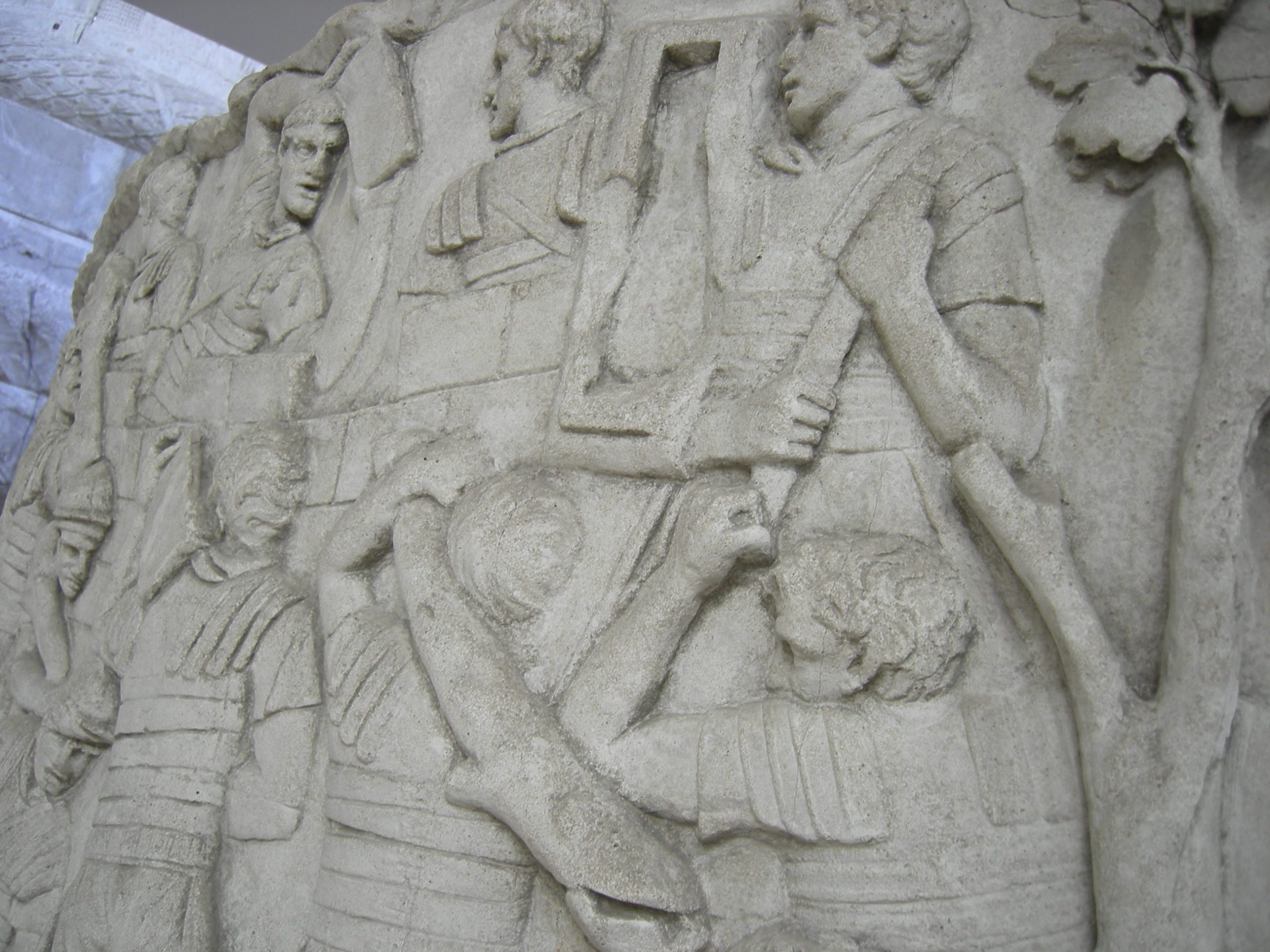
Mail and scale armour coexisted with the articulated iron strips conventionally called lorica segmentata. That last expression is a modern scholarly name, not the securely known Roman term. Segmented armour appears in early imperial evidence and famously on Trajan’s Column, but it never replaced all other body protection.
Protection, flexibility, weight, manufacture, fit, and repair involved trade-offs. A sweeping claim that segmented armour was twice as effective at half the weight of mail is not supportable. Surviving pieces, such as this neckpiece in London Museum, reveal the hinges, straps, and fittings on which the system depended.
Footwear: caligae, shoes, and boots
Hobnailed military footwear was vital for movement, and the openwork caliga became one of the best-known Roman designs. Soldiers also wore other shoes and enclosed boots. Climate, date, and the availability of replacements affected what appeared on their feet.
It is fanciful to claim that caligae prevented blisters or made long marches comfortable. Ancient letters complain about footwear and request socks or replacements. Caligula’s nickname, conventionally translated “Little Boots,” recalls the small military footwear associated with his childhood among soldiers, not an unchanging uniform for the entire army.


III. On the march: a working community
A campaigning army was far larger and more complicated than a line of infantry. Officers, cavalry, pack animals, drivers, servants, and supplies moved with or around its combat units. The column could stretch over a considerable distance. Moving it safely required reconnaissance, route planning, guards, and attention to crossings and bottlenecks.
Soldiers carried burdens that included weapons, protective equipment, personal belongings, and some provisions. Estimates often place a heavily loaded legionary in the range of several tens of kilograms, but no single figure describes every march. What counted as “kit” also matters: armour worn on the body, a carried shield, a pack, shared tools, and baggage transported by animals are not interchangeable categories.
Roman commanders sometimes moved troops rapidly to surprise an enemy or reinforce a threatened position. Such marches could impose severe costs in fatigue, stragglers, animals, and supplies. Weather, roads, terrain, the length of the column, and enemy activity governed the real pace. Vegetius’ exercise targets are not evidence that every legion routinely covered the same distance every day.
The camp: security through routine
A fortified camp offered a defended base for rest, baggage, command, and regrouping. Ditches and ramparts could delay attack, while guards controlled access. Allocating space to units made a crowded temporary settlement more manageable. The practical advantage was not that every camp was identical, but that soldiers and officers knew a shared set of procedures.
Polybius’ account of the Republican camp is unusually detailed. Later evidence, including archaeology, shows both continuity and adaptation. Ground conditions, the force assembled, available time, and tactical risk affected shape and layout. A marching camp, a seasonal base, and a permanent legionary fortress were different things.
Claims that the layout never changed, that every camp had stone-style granaries beside its headquarters, or that a complete fortress rose on every night’s march confuse these categories. The important point is that the army treated protection and organization as recurring tasks rather than hoping that a tired force would remain safe.
Supply was a strategic limit
Grain, water, fodder, fuel, and replacement equipment were indispensable. Soldiers might buy food, receive organized deliveries, or take supplies from the countryside. Each method depended on conditions and imposed different demands on local people. An army could exhaust an area’s resources quickly, particularly when large numbers of horses and pack animals needed fodder.
Roads helped troops and messengers move, while sea and river transport were crucial for heavy loads. Depots, ports, barges, carts, and animals formed overlapping supply networks. The polished image of straight stone-paved highways should not conceal the variety of Roman roads, many of which used gravel or other surfaces. There was no single construction standard applied identically across the empire.
Roman military engineering worked because skills were combined with organized labor and access to materials. It did not free commanders from geography. Destroyed bridges, a hostile population, bad harvests, or an enemy controlling a supply route could undermine an army that remained formidable in close combat.

How the legion fought: choices rather than formulas
Ancient battle accounts are selective. Authors seldom explain every movement in enough detail for an exact modern diagram, and they may emphasize a commander’s foresight or an opponent’s mistake. The formations below are useful concepts, but their names should not imply a universal drill book followed unchanged for centuries.
Triplex acies: a battle line in depth
A three-line deployment could provide depth and reserves. In the middle Republic, the familiar lines were associated with hastati, principes, and triarii. In Caesar’s wars, cohorts could be arranged in several lines. The popular four-three-three diagram is a schematic possibility, not a rule for every Roman battlefield.
Reserves gave a commander choices: reinforce a threatened point, exploit an opening, or respond to a flanking movement. How troops passed through or around one another remains debated. At Pharsalus in 48 BC, Caesar describes creating an additional line of cohorts to meet Pompey’s cavalry. The lesson is adaptation, not the mechanical operation of an invincible formation.
Testudo: protection under missiles
In a testudo, soldiers combined their shields to provide shelter, notably during assaults on defended positions. Ancient reliefs and texts attest the idea, though artistic depictions simplify bodies and spacing. The formation required coordination and restricted movement and visibility.
It was not a standard posture for all sword fighting, nor an airtight shell proof against every projectile. Heavy missiles, disruption, difficult ground, and close attack could create dangers. Its value was situational: bringing protection to a particular task, rather than transforming infantry into an invulnerable vehicle.
Cuneus: concentrating an attack
The word cuneus can refer to a wedge or a compact attacking body, but literary descriptions do not always establish a precise triangular arrangement. Concentrating troops against a selected point could be useful when the enemy’s order was vulnerable.
Success depended on momentum, cohesion, support, and what happened on the flanks. A modern arrow-shaped diagram can explain the principle, but it should not be mistaken for archaeological proof of exact files and ranks. Roman and non-Roman forces alike could use concentrated attacks.
Orbis: defense when surrounded
Ancient accounts describe troops drawing into an orbis when threatened from several directions. This is best understood as an all-round defensive arrangement; the word does not prove that every formation was a geometrically perfect circle.
Such a posture could help prevent an exposed rear, but it also signaled a dangerous loss of freedom to maneuver. Caesar’s narrative of the disaster involving Sabinus and Cotta shows that forming an orbis did not guarantee rescue or survival. It was an emergency response, not a winning tactic by itself.
Legionaries also needed cooperation with other troops. Cavalry could scout, protect flanks, pursue, or counter enemy horsemen. Archers and other missile troops contributed different ranges and effects. Auxiliary infantry were capable fighting units in their own right. Sieges required artillery, digging, timber, protection, and supplies, often over long periods.
Roman artillery changed over time. Torsion-powered bolt-shooters and stone-throwers belong in the story, but the familiar onager is especially associated with later evidence. It should not be inserted automatically into every early imperial legion’s equipment list or identified indiscriminately in reliefs of earlier machines.
IV. Military change and the struggle for power
The late Republic placed extraordinary demands on Roman society. Wars lasted for years and ranged far beyond Italy. Successful commanders accumulated prestige, wealth, and relationships with troops. Soldiers expected pay, rewards, and an acceptable future after discharge. These conditions helped tie military affairs to political competition.
The traditional story puts Gaius Marius at the center of a sudden revolution in 107 BC: he supposedly abolished property qualifications, invented the cohort, standardized all equipment, and created a permanent professional army. The evidence is much less tidy. Sallust records Marius recruiting volunteers, largely from the poorest citizens, for the Jugurthine War. That episode does not establish the whole package of changes commonly attached to his name.
Recruitment, unit organization, equipment supply, and patterns of service developed over a longer period. Conscription did not disappear. Soldiers could be experienced without belonging to a modern-style volunteer career army. Recent scholarship has challenged the idea of one comprehensive “Marian reform,” while still recognizing Marius as an important commander and political figure.
Personal loyalty could be powerful, but it was neither automatic nor exclusive. Troops might follow commanders because of shared campaigns, expected rewards, political allegiance, fear, or the alternatives available. They could also resist orders, bargain, mutiny, or desert. The Republic’s crisis involved institutions, elite competition, violence, and disputes over citizenship and resources as well as army organization.
Sulla’s march on Rome in 88 BC and Caesar’s crossing of the Rubicon in 49 BC exposed the danger of using military force in domestic politics. Augustus’ eventual settlement reduced the number of competing armies and placed enduring forces under imperial control. It did not remove military politics: later armies repeatedly supported rivals for the throne.
Defeat tested the system
At Cannae in 216 BC, Hannibal’s army enveloped a much larger Roman force. Polybius emphasizes the role of cavalry and attacks on the Roman flanks and rear. Heavy infantry strength became difficult to use once the troops were compressed and surrounded. Ancient casualty totals differ, but the scale of the disaster is clear.
Rome continued the war, drawing on further mobilization and the loyalty of many allies even as others defected. Its eventual victory depended on years of campaigning in several theaters, not a simple battlefield correction. Cannae shows both the vulnerability of a Roman army and the resilience of the wider system that supported it.
A timeline of transformation
- Early RomeItalian and Greek influences shaped equipment and warfare. Later foundation stories cannot provide a securely dated organization chart.
- Third–second centuries BCThe manipular army fought Rome’s Mediterranean wars. Polybius supplies a detailed account, while Italian allied manpower remained essential.
- 107 BC and the late RepublicMarius recruited poor volunteers, but the army’s transformation cannot be reduced to a single reform decree. Cohorts and long campaigning became increasingly prominent.
- Augustus, 27 BC–AD 14A permanent imperial army emerged from the civil wars. Pay, service, and discharge arrangements developed during his reign rather than appearing complete in 27 BC.
- AD 9The disaster associated with Varus destroyed three legions in Germany. Rome did not reissue their numbers, but Roman armies did campaign across the Rhine afterward, including Germanicus’ campaigns of AD 14–16.
- Late third–fourth centuries ADDiocletian, Constantine, and their successors reshaped the army. Frontier forces and field armies developed over time; unit size and terminology varied.
- Fifth century and beyondWestern imperial military structures fragmented as revenues and territories were lost. The deposition of Romulus Augustulus in AD 476 did not end Roman armies in the eastern Empire.
V. Engineers, neighbors, and occupiers
Outside battle, legionaries carried out construction, repair, guard duty, escort work, administration, and policing. A major fortress could support workshops, storage, medical facilities, baths, and a civilian settlement nearby. These activities help explain why Roman military sites left such a substantial archaeological footprint.
Hadrian’s Wall is a vivid example. Construction began in AD 122, and the frontier ran for about 80 Roman miles, roughly 118 kilometres. Legionary forces from Britain’s Second, Sixth, and Twentieth Legions played major roles, with assistance from other military personnel. Auxiliary troops were central to its garrisons. The wall was a changing system of installations and movement controls, not simply a solid barrier staffed by legionaries.
Its design was altered, and work continued through additions and rebuilding. Its changing widths, installations, and building phases show construction responding to new decisions and local conditions. The surviving remains reveal both technical skill and practical adjustment. English Heritage’s history explains how the frontier evolved.
Soldiers helped create demand for food, leather, metalwork, pottery, and transport. Traders and families lived near military bases, and veterans sometimes settled in the regions where they had served. Such relationships could produce exchange and opportunity. They could also bring requisitions, unequal power, violence, and resentment.
The infrastructure of the Roman world was not all built by soldiers. Cities, private patrons, contractors, enslaved workers, and civilian laborers were indispensable. Nor did legionaries introduce settlement into empty landscapes. Many regions had long-established farms, towns, routes, and political communities before Roman conquest.
“Peacekeeper” is therefore an incomplete description. The army could maintain order while enforcing an occupation that local people had not chosen. Campaigns involved destruction, enslavement, and displacement as well as roads and fortresses. The material achievements of Roman military organization should be understood alongside those consequences.
VI. What survived, and what changed
The legion did not disappear in a single moment. Roman military institutions changed with the resources and demands of the state. In late antiquity, the relationship between frontier garrisons, mobile forces, cavalry, and infantry differed from that of the early Empire. Older legion names might survive even when the size or role of a unit had changed.
It is misleading to describe all late western troops as Germanic foederati wearing Roman names. Regular soldiers, allied forces, different recruiting backgrounds, and multiple arrangements coexisted. “Roman” could describe service and political identity rather than ancestry. The eastern Roman state retained armies and an extensive military tradition long after AD 476.
Roman texts, buildings, roads, and military vocabulary influenced later societies. Vegetius was read in medieval and early modern Europe, and commanders sometimes looked to antiquity for models. Yet resemblance is not proof of direct descent. Modern national armies were shaped by many traditions and technologies, not copied wholesale from Marius’ legions.
The same caution applies to military medicine and logistics. Roman forts provide evidence for organized treatment and storage, but Rome did not invent caring for wounded soldiers or planning supplies. Hospitals, depots, and professional roles developed in particular circumstances. Their significance is clearer when studied precisely rather than described as the first example of everything familiar today.
What makes the legion worth studying is the connection between ordinary work and large political outcomes. A repaired shoe, a ration delivery, a trained replacement, or a defensible campsite could matter as much as a dramatic charge. Institutions made those recurring tasks possible, but institutions also depended on people and could fail them.
Rome’s military history includes remarkable endurance, devastating defeats, coercion, innovation, and civil war. The legion expresses all of those contradictions. It helped rulers extend power across great distances, and it helped soldiers build identities and expectations of their own. Its history is richer than a tale of an unbeatable machine.
Test your understanding
Was a century always made up of 100 soldiers?
No. In the familiar early imperial model it contained about 80, and organization varied over time. The name alone is not an establishment return.
Did Marius create the professional army in one reform?
No single comprehensive reform program is securely attested. Marius’ recruitment in 107 BC was one episode in a longer transformation, and Augustus’ standing army belongs to a later political settlement.
Did every Roman soldier wear segmented plate armour?
No. Mail, scale, and segmented armour overlapped in use. Equipment depended on date, unit, role, and availability.
Why does the distinction between legionaries and auxiliaries matter?
They had different organizations and, especially in the early Empire, different relationships to citizenship and discharge privileges. Both were essential to Roman military power.
Power sustained by everyday work
The legion’s importance lay in bringing men, skills, resources, and authority into an enduring organization. It could build and destroy, defend and occupy, obey and rebel. Its effectiveness was substantial, but always conditional on the wider society that maintained it.
For the key ideas at a glance, return to the illustrated Roman legion overview.
Sources and further reading
Ancient authors offer arguments and selective narratives, not neutral technical manuals. Archaeology, inscriptions, and personal documents help test and complicate their accounts. The following sources underpin the distinctions made here.
- Polybius, Histories 6.19–42: middle Republican recruitment, weapons, organization, and camps.
- Sallust, Jugurthine War 86: Marius’ levy of volunteers in 107 BC.
- François Gauthier, “The Changing Composition of the Roman Army in the Late Republic and the So-Called ‘Marian-Reforms’”, Ancient History Bulletin 30 (2016): scrutiny of the traditional reform story.
- David Breeze, “The Organization of the Legion: The First Cohort and the Equites Legionis”, Journal of Roman Studies 59 (1969), 50–55: evidence for the enlarged first cohort.
- Tacitus, Annals 1.16–30: grievances over military service and discipline in AD 14.
- Suetonius, Domitian 7.3: the additional installment of military pay.
- Vegetius, De re militari, especially Books I–III: training and military ideals, read as a late antique compilation rather than a universal description.
- Caesar, Gallic War 1.25: javelins and shields; Gallic War 5.33–37 describes the surrounded force of Sabinus and Cotta.
- Caesar, Civil War 3.88–94: his account of the deployment and fighting at Pharsalus.
- Tacitus, Annals 2.5–26: Germanicus’ campaign beyond the Rhine in AD 16.
- British Museum, Introduction to Legion: life in the Roman army, and the exhibition guide: soldiers’ experiences, surviving letters, clothing, and discharge rewards.
- Yale University Art Gallery, Scutum (Shield), 1933.715: material evidence from Dura-Europos.
- English Heritage, History of Hadrian’s Wall: construction, garrisons, and subsequent changes.
- The Cambridge History of Greek and Roman Warfare, Volume II: studies spanning the late Republic to the sixth-century eastern Empire.
BC and AD are used throughout. All illustrations show surviving objects or, where stated, a modern cast of an ancient relief. Image creators, dates, and reuse terms are provided in the captions.