
Salem, 1692: When Accusation Became a Death Warrant
Through warrants, examinations and prison petitions, follow how the Salem accusations became a judicial system that punished denial and multiplied its own evidence.
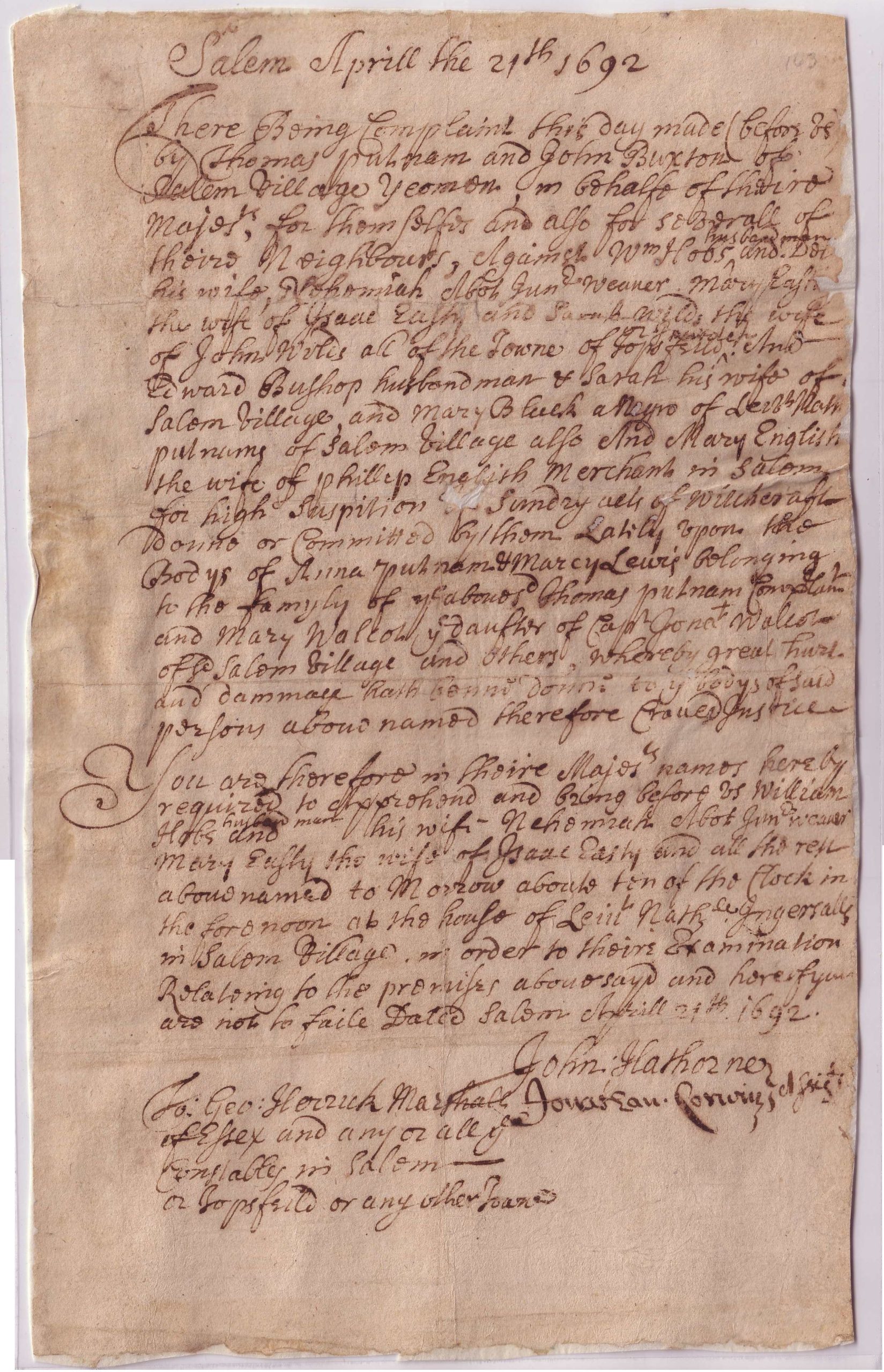
The warrant was precise about the hour. On February 29, 1692, the Salem magistrates ordered the constable to bring Sarah Osborne and Tituba before them, if possible, by ten the following morning. The women were suspected of witchcraft. Four local men had made the complaint; several girls were named as the injured parties. Beneath the warrant, the constable recorded that he had arrested the women and searched for suspicious objects. He had found none.
In the examination that followed, questions carried their own verdicts. Tituba was asked why she hurt the children before the court had established that she had hurt them at all. After initial denials, she confessed and named Sarah Good and Osborne. Her testimony supplied additional figures, animals, threats and a book bearing marks. A limited accusation had acquired the outline of a conspiracy.
Here, in a few sheets of paper, the Salem crisis becomes visible as a sequence of human acts: someone complained, someone issued an order, someone arrested a neighbor, and someone decided what an answer meant.

A province already under strain
The trouble began in a community accustomed to reading public calamity and private misfortune together. During the preceding decades, war had displaced families from northern settlements; refugees carried losses into Essex County. Renewed fighting after 1688 brought further insecurity and expense. None of this proves why any particular person accused a neighbor. It explains why danger was already a familiar subject before the first witchcraft warrants appeared.
Salem Village also had a history of disagreement over its ministers and their support. Samuel Parris entered an office burdened by earlier quarrels. Arguments over salary were arguments over authority: who could demand payment, who spoke for the congregation, and whose understanding of its future would prevail. The village’s troubled chronology places the accusations within that longer instability.
Early in 1692, Parris’s daughter and niece displayed alarming symptoms; other young people followed. Their sufferings were interpreted as bewitchment. The surviving evidence cannot supply a single retrospective diagnosis for everyone involved. It can show how an explanation accepted in households became a charge that magistrates were willing to investigate.
A court for the emergency
Massachusetts was also rebuilding its government. Its old charter had been revoked; a new one reached the province with Governor William Phips in May 1692. The transition created uncertainty over the legal arrangements under which the accumulating prisoners should be tried. Phips established a special Court of Oyer and Terminer, a name meaning to hear and determine.
Witchcraft already belonged to the law’s vocabulary. The novelty was not the existence of a punishable offense, but the scale of prosecution and the evidence allowed to sustain it. English legal discussion demanded convincing proof, while the relation between English statutes and Massachusetts practice remained troublesome. The court’s commission invoked both without resolving every difficulty.
The Massachusetts Trial Court Law Libraries’ account identifies the dangerous incentive that developed: an accused person could hope to escape execution by confessing, repenting and implicating others. A denial offered the prosecution no new suspects. A confession appeared to confirm the emergency and gave it somewhere else to go. Each admission could become the beginning of another case.
The accused had to explain the accusation
Sarah Good’s examination shows how little protection physical distance could provide. The children accused her face to face, suffered fits, and then said that she had tormented them during the encounter. The record acknowledges that she had been kept apart from them. Distance became compatible with guilt because the alleged assault took place through an apparition.
Pressed to identify the cause, Good named Osborne, who was then absent from the room. The children subsequently attributed their affliction to both women. Thus an answer made under accusation could widen the accusation without settling the original question.
Other notes preserve Good’s explanation for not attending worship: she lacked clothing. Asked about her muttering, she described a psalm or commandment. Such details matter because they restore the ordinary life beneath the official category. Poverty, speech and religious observance could all be examined for hostile meaning. The case papers preserve denials alongside the statements used against her, but preservation was no guarantee of equal weight. The record accumulated; the balance within it remained the magistrates’ to determine.
The special court gave these inquiries a route toward execution. Presided over by Lieutenant Governor William Stoughton, it began trying cases in June. Bridget Bishop was the first defendant tried. Accusations that had circulated through households and preliminary examinations now entered proceedings with jurors, indictments and sentences.
Spectral evidence was testimony that a person’s shape or apparition had appeared and inflicted harm. Its difficulty went beyond invisibility. If an accuser alone could recognize the attacking figure, another witness could observe the distress without independently identifying its cause. The suffering and the identification could nevertheless be treated as parts of one demonstration.
The Massachusetts Archives’ exhibition also displays records of bodily searches and other alleged signs of witchcraft. The cases were not all identical, nor did every allegation depend on a specter. Different kinds of accusation reinforced one another. A body was inspected, an old incident recalled, a witness described an apparition; assembled in a prosecution, these fragments could acquire a coherence they had not possessed separately. The machinery worked through accumulation as well as repetition.
The verdict that changed
Rebecca Nurse’s case exposed how fragile an acquittal could be. Her jury initially returned a verdict of not guilty. The court objected, drawing attention to something she had said about two confessing witnesses who had formerly been among her company. Did she mean the company of prisoners, or a company of witches?
Juror Thomas Fisk later explained that the court’s dissatisfaction led jurors to reconsider. Nurse did not clarify her words when the matter was raised in court; Fisk treated that silence as important evidence against her. The revised verdict was guilty.
In her subsequent appeal, Nurse supplied the missing explanation. She meant fellow prisoners. She also said that she was hard of hearing and overwhelmed by grief, and had not understood the interpretation being placed on her statement. Her silence had been made to answer a question she said she had not heard properly.
The clerk’s papers carry another warning for the historian: some spoken evidence was never written down. What survives is substantial, but it is not a complete courtroom transcript. Even within that incomplete record, the reversal is unmistakable.
Letters from the prisoners
On July 23, John Proctor addressed a petition from prison to several ministers. He described defendants who believed that judges and jurors had condemned them before trial, and asked for proceedings in Boston or for different magistrates. If that could not be arranged, he wanted ministers present at the trials. He sought people who might interrupt the existing relations between accusation and judgment.
The petition also alleged physical coercion. Proctor said that young men, including his son William, had been bound neck and heels to obtain confessions. These are allegations preserved in a prisoner’s appeal, not a neutral investigation of each incident. They nonetheless reveal what defendants were asking outsiders to examine: the means by which supposedly confirming testimony had been produced.
Proctor pointed to accusations whose chronology he considered impossible, including claims about prisoners attending a diabolical gathering while confined. He argued from dates, custody and bodily treatment. His petition did not require the ministers to abandon their belief in the Devil. It asked them to recognize that the Devil’s deception might lie in the prosecution’s account of events.
Mary Easty’s petition was still more direct about procedure. Previously released and then arrested again, she could measure the instability of accusation through her own experience. Her innocence, she argued, gave her reason to doubt the charges against others who were following her toward death.
She did not ask only for mercy. She asked that the afflicted be questioned closely and kept apart for a time. She asked that confessing suspects be tested, because some might have accused themselves and other people falsely. The petition’s practical proposals attacked the system at its points of reinforcement: witnesses influencing one another, and confessions being treated as their own validation.
Easty allowed that the judges intended to discover witches and avoid innocent blood. That concession made her charge more exact. Good intentions could coexist with a method that killed the innocent. She wrote from within the religious language shared by the court, invoking divine knowledge of her heart while disputing the court’s knowledge of her actions. Her proposed safeguards did not save her. They survive as instructions for an inquiry that the authorities had not conducted.
The last executions
Bridget Bishop had been hanged on June 10. Further executions followed in July and August; on September 22, eight people, including Easty, were hanged. Three days earlier, Giles Corey had died under stones after refusing to enter a plea. The pressing was intended to force that plea, and must be distinguished from a conviction followed by hanging.
The usual total of twenty people put to death comprises nineteen hanged and Corey. Deaths in confinement were additional. The Peabody Essex Museum counts twenty-five deaths overall, including the prison dead. Those categories should remain separate: the jail, as well as the execution ground, formed part of the calamity.
Tituba survived. The grand jury eventually rejected the charges against her, but release required payment of jail debts, and she passed into another person’s ownership. The documents do not reveal the rest of her life. Her survival therefore cannot be written as a simple recovery of freedom. The proceedings had depended on the words of an enslaved woman while leaving her future largely outside the record.
Doubt inside the believing world
By October, criticism had become increasingly explicit. In his letter of October 8, Thomas Brattle proceeded carefully, professing respect for lawful authority before attacking the proceedings. The caution belongs to the argument: he wanted readers to understand that questioning a prosecution did not require hostility to government itself.
Brattle challenged the use of the afflicted as interpreters of an invisible world and objected to the way examinations and confessions were handled. He also described inconsistencies in the treatment of suspects. Reputation and influence could affect whose accusation became imprisonment and whose did not. The supposed emergency operated through an unequal society.
His letter is evidence of contemporary opposition, not proof that opposition was universal or immediately effective. It does establish that objections were available in 1692. Belief in supernatural evil did not compel one conclusion about the trustworthiness of a witness, the meaning of a fit, or the safety of a confession. Those were disputed judgments within the society conducting the trials.
Phips’s letters show the official retreat, accompanied by official self-defense. In October he reported that the Devil had assumed the shapes of people he considered innocent. He described restraints on further commitments and proceedings. In his fuller account the following February, he blamed the court’s methods and emphasized his own absence on military business.
The governor’s explanation should be read with his interests in view. He was reporting to England and defending his administration. Yet the altered course is clear: the special court ended, and a new court heard remaining cases in 1693 with much less weight attached to the evidence that had driven the earlier convictions. Phips stopped further executions.
The change did not depend on declaring witchcraft impossible. It depended on reconsidering whether these proceedings had proved it. In Phips’s telling, recognition that the Devil could impersonate innocent people broke the link between a reported apparition and a death sentence. The same religious universe could now support restraint where it had previously been invoked to support prosecution.
What remained on paper
The work of acknowledgment extended beyond the release of prisoners. Samuel Sewall publicly expressed repentance in 1697. Ann Putnam Jr., one of the accusers, made her acknowledgment before the Salem Village congregation in 1706. In 1711, the provincial government provided compensation and relief to a number of victims and families. These measures came through separate acts and petitions, over years.
The surviving aftermath records belong beside the examinations. They register changed judgments, damaged households and efforts to obtain material redress. An accusation could travel swiftly from a complaint to a warrant; reversing its consequences required survivors to return to authority and ask again.
Mary Easty’s petition remained after her death. Its requested steps were modest enough to be performed in any room where witnesses were questioned: separate them, examine them carefully, test what confessors had said. By the time the proceedings changed, she could receive no benefit from that scrutiny. The paper preserved both her proposal and the fact that the court had proceeded without it.
For a later chapter in the history of courts and the limits of their judgments, read Putting Aggressive War on Trial: What Nuremberg Actually Decided.
Sources and further reading
1. Tituba: warrant and examinations, February–March 1692.
2. Salem Witch Museum: Chronology Prior to Salem Trials.
3. Massachusetts Trial Court Law Libraries: Witchcraft law up to 1692.
4. Sarah Good: examinations and testimony.
5. Massachusetts Archives: The Trials.
6. Rebecca Nurse: case papers, juror declaration and appeal.
7. John Proctor: petition from prison, July 23, 1692.
8. Mary Esty: examinations and petitions.
9. Peabody Essex Museum: The Salem Witch Trials of 1692.
10. Thomas Brattle: Letter of October 8, 1692.
11. Governor William Phips: letters of October 1692 and February 1693.