
WORLD WAR II · OKINAWA, 1945
Okinawa: Why an Easy Landing Became a Long Battle
The Americans reached the airfields on the first day. The army they had come to defeat was waiting among the ridges farther south.
On 1 April 1945, American soldiers and Marines landed on Okinawa expecting to fight their way off the beaches. Instead, much of the assault force walked inland with little opposition. By evening, more than 60,000 men were ashore. The airfields at Kadena and Yontan had fallen into American hands.
The Japanese army had not disappeared. Its commander, Lieutenant General Mitsuru Ushijima, had placed most of his strength farther south, around the old royal capital of Shuri. There, hills and caves offered protection that an exposed beach could not.
Over the next twelve weeks, the invasion would become a struggle to take those hills, keep the supporting fleet alive, and survive on an island where civilians had fewer places left to go. The quiet landing was the beginning of that struggle.
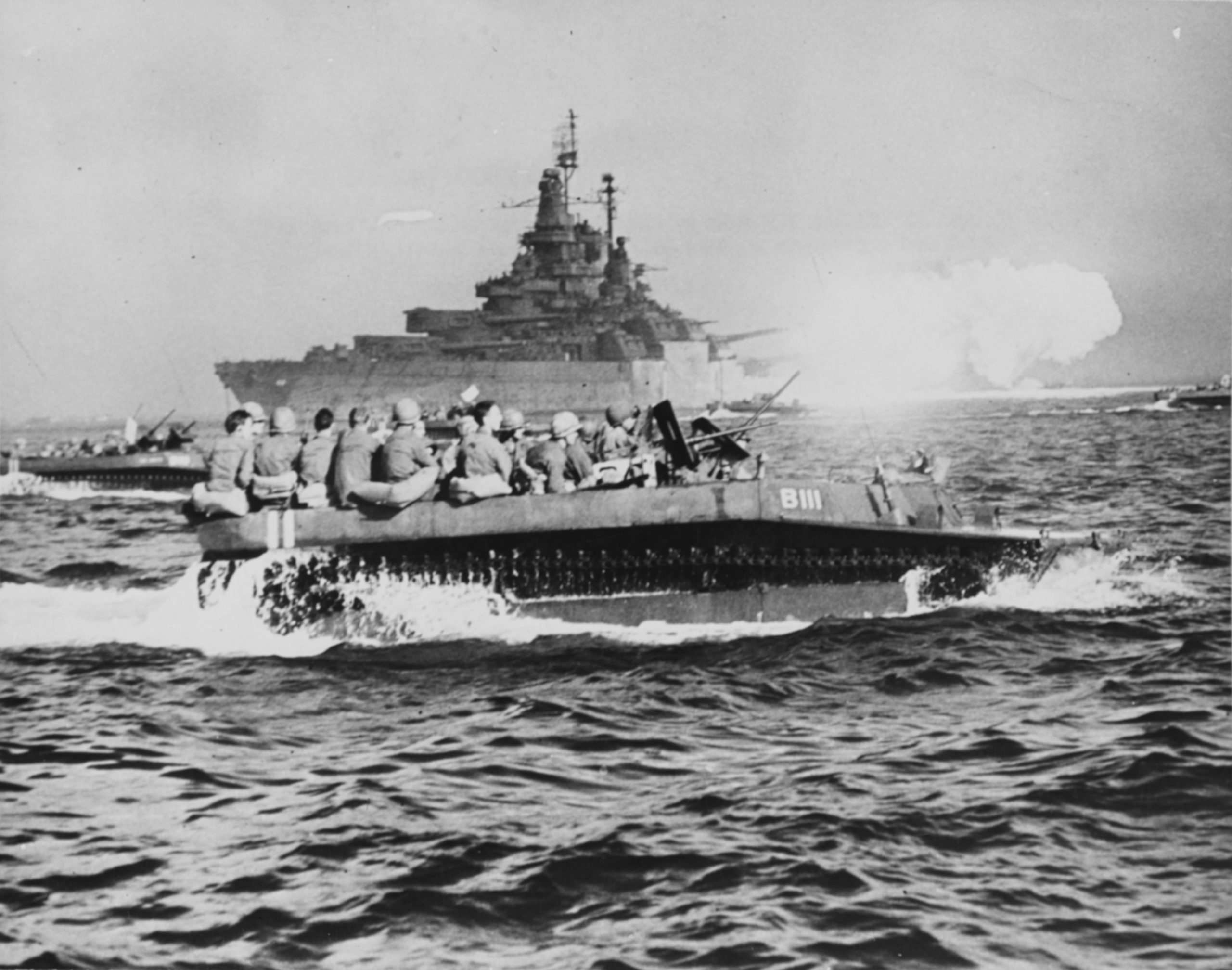
The army was waiting inland
Okinawa lay close enough to Japan for its airfields and anchorages to support the next stage of the Allied war. American planners wanted bases for air attacks and, if necessary, an invasion of the Japanese home islands. Operation Iceberg brought together an enormous fleet and Lieutenant General Simon Bolivar Buckner’s Tenth Army, which included both Army and Marine divisions.
Ushijima’s 32nd Army could not defeat that force in an open contest. It could make the Americans spend time and men taking ground. Japanese troops had enlarged caves, dug tunnels, prepared gun positions, and linked strongpoints across southern Okinawa. Local people had been conscripted for military service and labor as the island was turned into a battlefield.
The landings at Hagushi, on the west coast, initially bypassed the strongest defenses. American troops soon crossed to the east coast, cutting the island in two. Marines moved north, where the fighting on the Motobu Peninsula would prove difficult. Army units turned south toward Shuri.
By the first week of April, the southern advance had met the resistance missing from the beaches. At one ridge after another, the same problem appeared: the defenders could survive a bombardment underground and return to their weapons when the infantry approached.
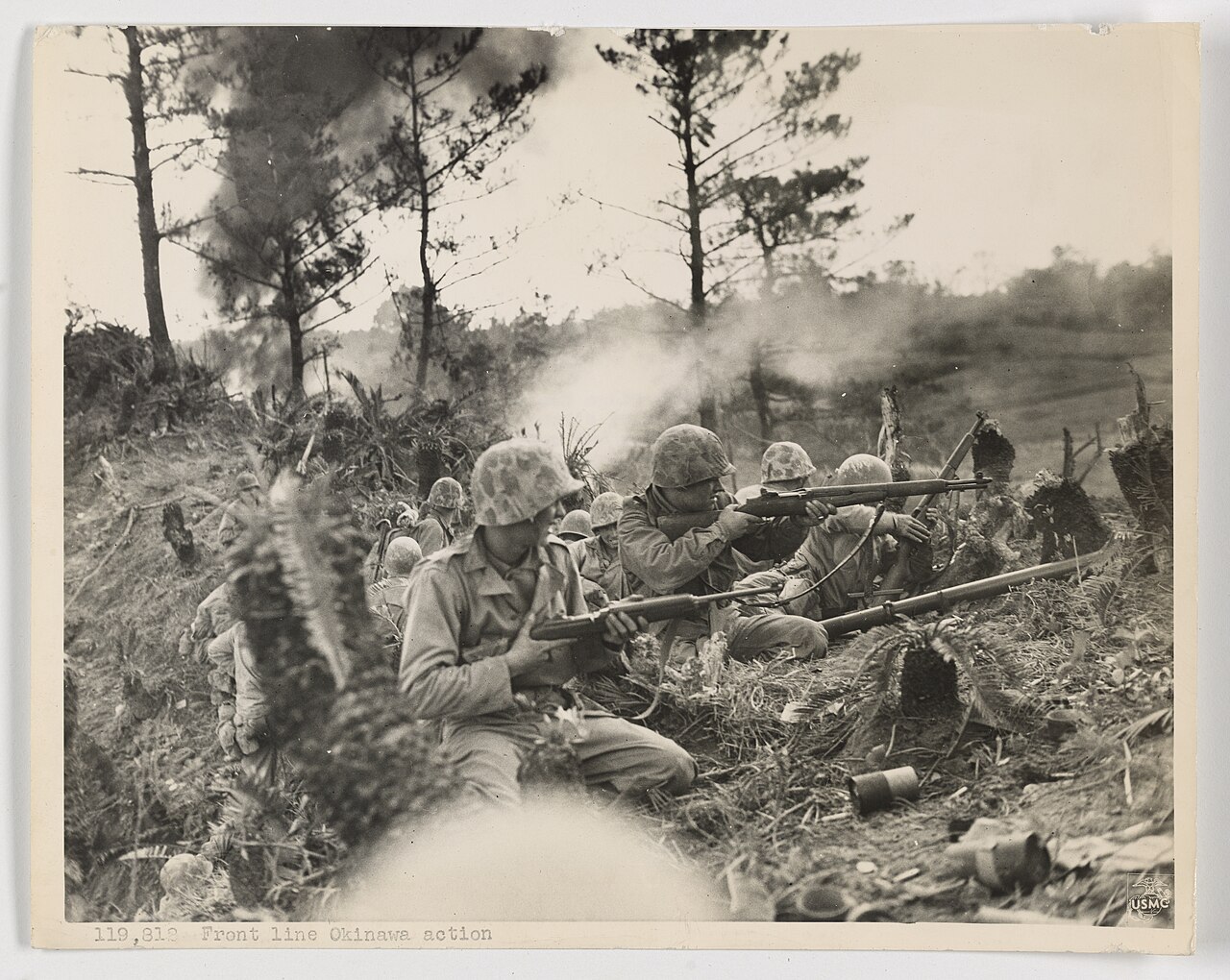
A ridge could fight from both sides
From a distance, a hill looked like a single objective. Close up, it might contain caves below the crest, trenches along its sides, and gun positions covered by a neighboring hill. Japanese troops often dug into the reverse slope, the side facing away from the approaching Americans. Shells hitting the visible face could leave those positions intact.
On 19 April, the Americans tried to break through with a massive coordinated assault. Artillery, warships, and aircraft struck the defenses before three Army divisions attacked. Near Kakazu Ridge, tanks pushed ahead without enough infantry support. Mines, anti-tank guns, and close attacks disabled vehicles; twenty-two tanks were lost in the attempt. The hoped-for breakthrough failed.
The official Army history of the attack makes the difficulty clear. Getting men or tanks past one position did not clear a safe route for everyone behind them. Nor did reaching a crest remove the defenders underneath it.
Progress increasingly depended on smaller, closely supported attacks. Infantry located an opening; tanks and guns covered the approach; assault teams used explosives or flamethrowers against the position. Then the troops had to hold what they had taken against fire from elsewhere. This was the practical meaning of defense in depth: each success led into another fight.
The defenders made a costly gamble
Japanese commanders disagreed about how long to remain on the defensive. Colonel Hiromichi Yahara, the army’s senior operations officer, favored continuing the slow, grinding battle. Chief of staff Lieutenant General Isamu Chō pressed for attacks that might disrupt the invasion.
Ushijima approved several counterattacks, including a major offensive on 4 May. Troops moved out of the positions that had protected them, and artillery was brought into more exposed sites to support them. American fire inflicted heavy losses. The offensive failed and consumed reserves that the Japanese army could ill afford to lose.
The Americans were also running short of rested infantry. Exhausted formations needed replacements and time away from the front. Buckner could rotate divisions, but a fresh unit still had to learn the ground and face defenses that were difficult to see. The failed Japanese offensive helped the attackers; it did not make the remaining hills easy to take.
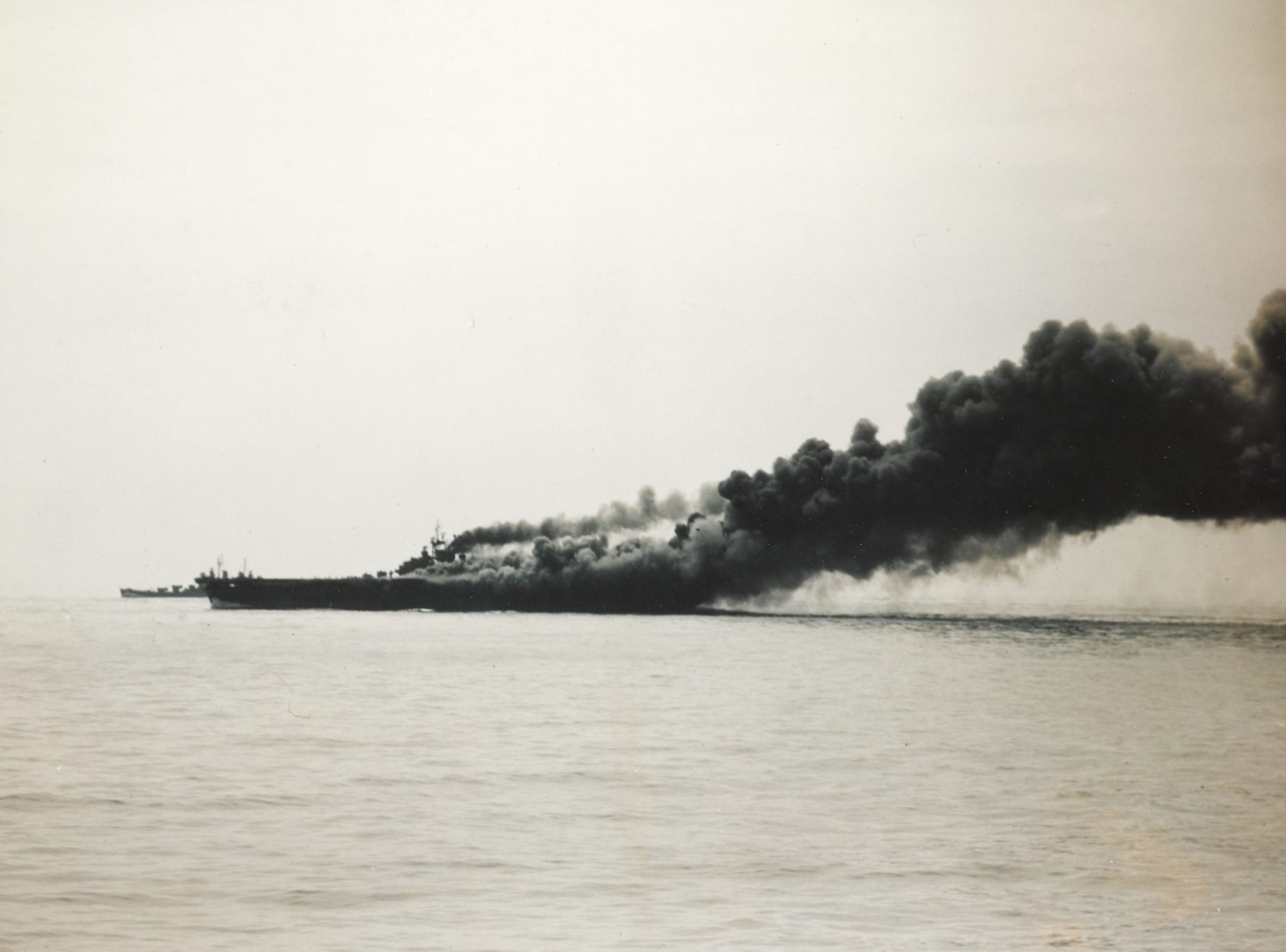
Every extra day ashore exposed the fleet
The ships off Okinawa could not simply leave while the land battle continued. They carried supplies, fired on Japanese positions, protected transports, and supported aircraft. Japanese suicide pilots attacked that dependence, crashing aircraft into Allied vessels in repeated waves.
Radar-picket ships were especially exposed. These destroyers and smaller vessels waited away from the main force to detect incoming aircraft and guide defending fighters. Their early-warning position also made them conspicuous targets.
USS Cassin Young was hit on 12 April. The National Park Service’s account of the destroyer describes the cost of a job whose success depended on remaining in danger. Other ships suffered far worse. On 11 May, two kamikazes struck the carrier Bunker Hill, causing devastating fires.
Naval commanders wanted the ground campaign finished quickly. Buckner’s men faced the opposite pressure: rushing another assault could produce casualties without opening the road south. The official history records this tension as preparations began for the May attacks. The same delay that preserved an infantry unit for a better-planned attack could mean another day of danger for the ships supporting it.
Shuri fell, but the battle moved south
In May, fighting tightened around Shuri. Sugar Loaf, a small hill on the western side of the defenses, became one of the campaign’s most costly positions. Its strength came partly from the nearby Horseshoe and Half Moon hills, whose weapons could fire on troops trying to hold its crest.
Marines repeatedly reached parts of Sugar Loaf and were driven back. Only after attacks weakened the surrounding positions could a coordinated assault secure it on 18 May. The Army history’s account follows that sequence closely: the capture of the hill depended on hard fighting around it over several days.
Then heavy rain turned roads into mud. Vehicles bogged down; ammunition, food, and wounded men had to be moved by whatever means remained possible. Bad visibility also made Japanese movements harder to detect.
Under those conditions, Ushijima withdrew much of his surviving army from Shuri. American commanders were slow to recognize the scale of the retreat. Marines entered Shuri Castle on 29 May, but Japanese rear guards still held positions nearby, while the main body was establishing new defenses farther south. Taking the castle did not end the campaign. It moved the fighting into the last crowded portion of the island.
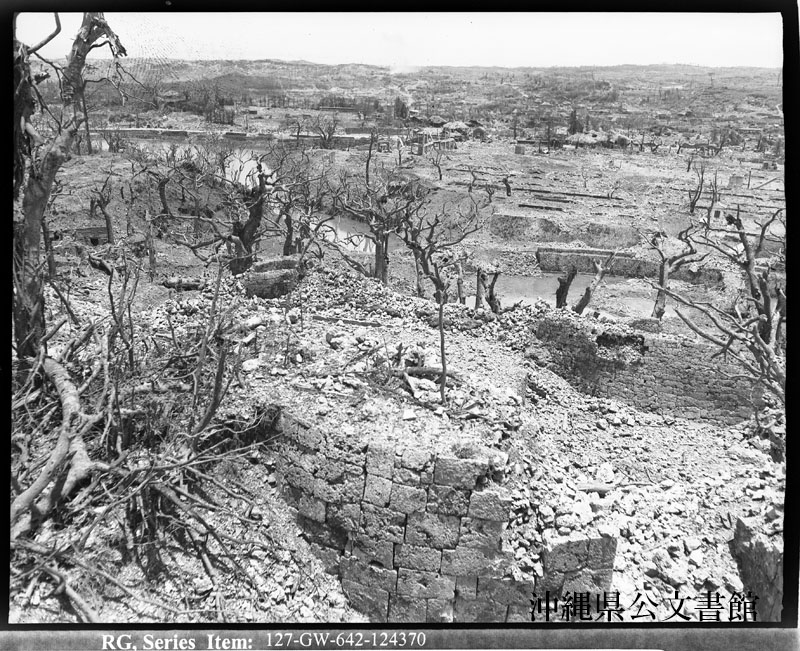
For civilians, retreat meant fewer places to hide
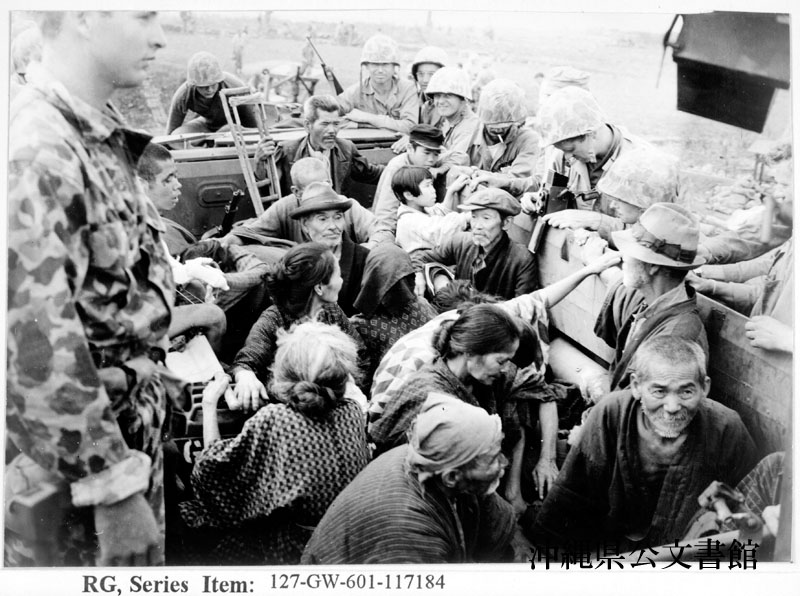
Okinawans had already endured air raids, evacuation, forced labor, and military conscription. During the invasion, families sought shelter in caves or moved in search of food and safety. The retreat from Shuri brought more soldiers and civilians into the same shrinking area.
The Himeyuri students show how directly the military had drawn young people into the battle. On 23 March, 222 students and eighteen teachers from two schools were ordered to join medical units at Haebaru. They cared for wounded men and carried supplies between hospital caves. When the hospitals withdrew in late May, the students went south with them.
The Himeyuri Peace Museum, founded by survivors, describes what followed. As the army disintegrated, the student units were disbanded amid the fighting. Young people who had been serving in military hospitals were left to find their own way through the battlefield. Many were killed.
The danger came from several directions. American bombardment and assaults killed civilians as well as soldiers. Japanese troops took shelters and supplies, killed some civilians, and in some places forced people into collective suicide. Others died of hunger. The Okinawa Prefectural Peace Memorial Museum records these different causes. Describing all the deaths simply as people caught between two armies would conceal part of what happened.
The end of the fighting was not a return home
Organized Japanese resistance collapsed in late June. Buckner was killed on 18 June while observing the fighting. Ushijima and Chō died as their remaining positions were overrun. The American command announced victory on 22 June, although scattered resistance continued afterward.
The human cost cannot be reduced to one tidy number. Estimates of Okinawan civilian deaths reach or exceed 100,000, but records are incomplete and totals do not always count the same groups. Conscription further complicates the boundary between civilian and military losses. The National WWII Museum’s assessment emphasizes the uncertainty rather than presenting an exact civilian total.
For survivors, American military-government camps could provide food and medical treatment while also restricting movement and separating people from their homes. Many homes no longer existed. The prefectural museum’s survivor testimonies carry the story into the work of finding relatives, securing shelter, and beginning again.
The Japanese defense had prolonged the campaign and inflicted severe losses. It had not saved Okinawa from occupation. The Americans gained the bases they had sought, on an island whose roads, farms, towns, and families had been devastated during the attempt to capture them.
Sources and further reading
- Arnold G. Fisch Jr., Ryukyus, U.S. Army Center of Military History, hosted by HyperWar.
- Roy E. Appleman, James M. Burns, Russell A. Gugeler, and John Stevens, Okinawa: The Last Battle, U.S. Army historical series: April assault, May offensive, Shuri withdrawal, and southern defenses.
- Naval History and Heritage Command: H-Gram 048, The Naval Battle of Okinawa.
- National Park Service: Fire from the Sky, USS Cassin Young and the Okinawa Campaign.
- Himeyuri Peace Museum: Foundation of the Museum.
- Okinawa Prefectural Peace Memorial Museum: Permanent Exhibit, Room 3 and survivor-testimony collection.
- Henry Stanley Bennett: The Impact of Invasion and Occupation on the Civilians of Okinawa, Proceedings, February 1946.
- Adam Givens, National WWII Museum: Okinawa, The Costs of Victory in the Last Battle, 2022.
- Okinawa City: A Guide to Battle Sites and Military Bases.
Source note: military histories are used for deployments and operations, while Okinawan institutions and contemporary civilian-administration records supply perspectives on displacement and survival. Their categories and estimates are not interchangeable.