
WORLD WAR II · UNITED STATES · READING PHOTOGRAPHS
A baseball game does not prove freedom
What happens when we read Ansel Adams’s Manzanar photographs alongside the orders, testimony, and legal decisions outside their frame?
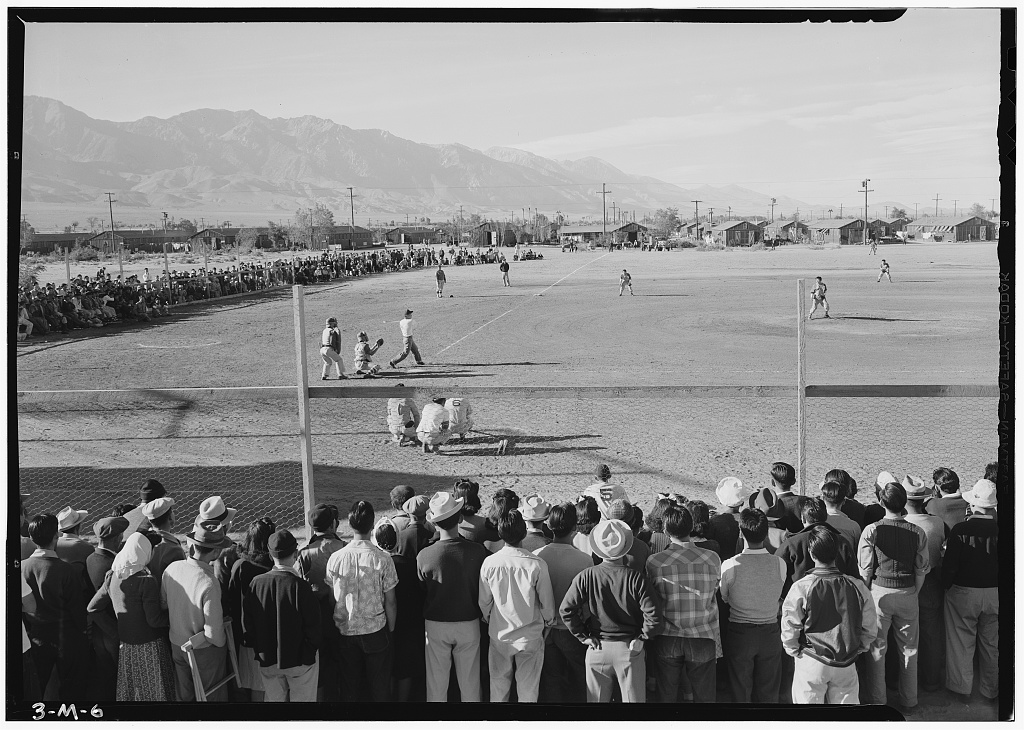
In Ansel Adams’s photograph of a Manzanar baseball game, spectators crowd the sideline while a batter stands at home plate. Beyond the diamond stand barracks and mountains. The game is real. So is the incarceration. The historical problem begins when viewers make one fact cancel the other.
Manzanar photographs preserve what Japanese Americans built and sustained after the United States forced them from their homes during World War II. They also reveal how much a photograph leaves unresolved. A street can show traffic without establishing freedom of movement. A portrait can record dignity without explaining the power exercised over its subject. Read alongside orders, testimony, and court decisions, these pictures become evidence of lives shaped by confinement, rather than illustrations of a single story about suffering or perseverance.
The distinction between proclaimed principles and actual rights also appears in Histovia’s study of the Atlantic Charter’s contested promises. Manzanar requires its own close examination of the institutions that exercised power.
The machinery outside the frame
President Franklin D. Roosevelt signed Executive Order 9066 on February 19, 1942. Its text did not name Japanese Americans or simply announce a network of camps. It authorized military commanders to designate military areas, exclude people from them, and regulate entry, residence, and departure. That delegation of power enabled subsequent military orders targeting people of Japanese ancestry.
Congress added criminal penalties for violating military restrictions through Public Law 503. A separate presidential order, Executive Order 9102, established the War Relocation Authority, or WRA. Military exclusion and removal, followed by confinement under this administrative system, displaced more than 110,000 people from the West Coast. Most were American citizens; immigrant parents had been barred by discriminatory law from naturalizing. The sequence matters: an apparently general grant of emergency authority became a racial policy through its implementation. National Archives records document both the policy and the removals.
Exclusion and detention were connected but distinct. Exclusion prohibited someone from remaining in a designated region. Detention restricted where that person could go afterward. Manzanar, in California’s Owens Valley, was one of ten WRA camps. A picture taken inside it cannot establish the legal pathway that brought someone there, or the conditions under which they might leave.
Terminology can either clarify or conceal that pathway. This article uses incarceration, following Densho’s distinction between mass confinement and the separate wartime internment system administered by the Army and Justice Department. Official names such as “relocation center” remain useful for locating records, but they should not supply the historian’s explanation.
A street with traffic is not evidence of freedom
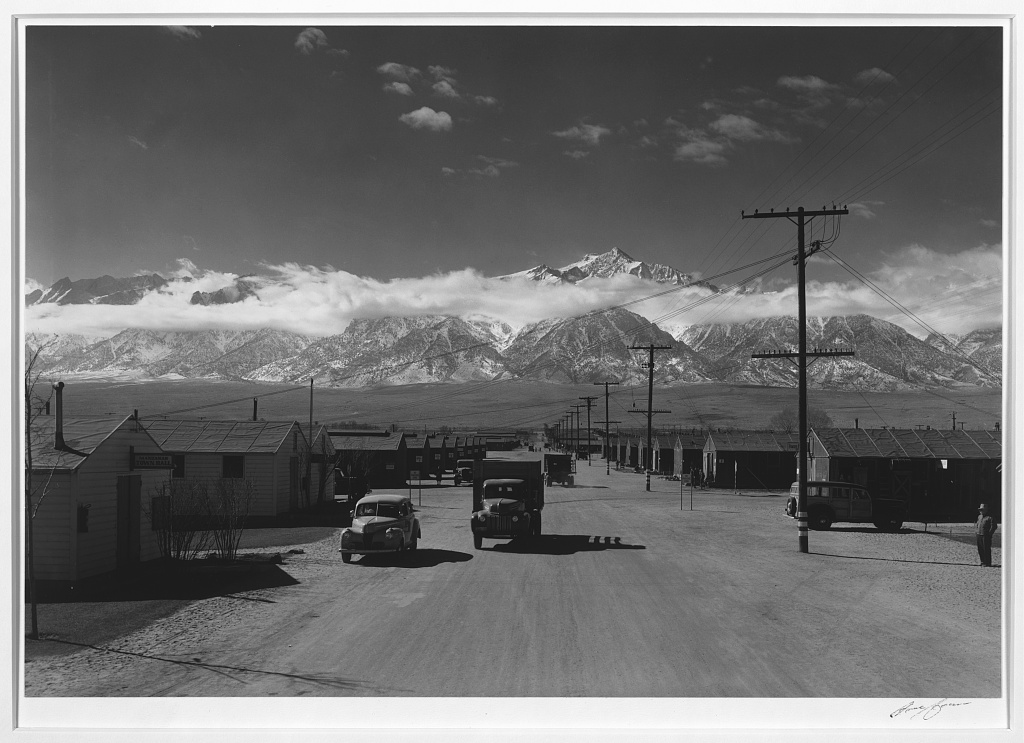
The street photograph invites an initial reading of ordinary settlement. Vehicles share a broad road. Utility poles recede toward a mountain backdrop. Repeated rooflines make the camp appear organized and permanent enough to have acquired routines. Adams’s viewpoint brings infrastructure and landscape into the same carefully ordered composition.
Notice what this description can support. Vehicles were present; buildings lined the road; the photographer could occupy this particular vantage point. The image does not identify every driver, explain anyone’s travel authorization, or show whether a resident could return to a prewar home. Treating visible circulation as freedom would turn a claim about space into an unsupported claim about rights.
The buildings also become more legible when compared with testimony. The National Park Service’s account of Manzanar describes crowded rooms, inadequate privacy, communal meals, and the difficulty of keeping wind and dust outside. Those experiences are poorly registered by an exterior view. A roof proves that shelter existed; it cannot measure whether that shelter permitted privacy or ordinary family life.
Archie Miyatake’s oral-history account supplies a telling counterpoint to the orderly street. He remembered arriving amid blowing dust, receiving a sack to fill with hay for a mattress, and sharing a room with six other people. He also recalled making partitions and furniture in a carpentry class. These details distinguish the accommodations initially provided from improvements residents made themselves. The finished appearance of a place can conceal the labor required to make it habitable.
The mountains deserve similar care. Their beauty belongs to the photograph, but remoteness also shaped confinement. Neither reading requires us to decide that Adams’s image is deceptive. The problem lies in asking an aesthetically persuasive view to answer questions it was never equipped to settle.
What a baseball game can establish
In the baseball photograph, the crowd is as important as the players. Spectators fill the foreground and extend along the left edge. The diamond has become a place where many people can direct their attention toward a shared event. That is substantial evidence of social life, organization, and the preservation of familiar pleasures.
It would be a mistake to treat the scene as proof that incarceration was tolerable or justified. People create meaningful lives under constraints they did not choose. Their success at doing so tells us about their work and relationships. It does not transfer moral credit to the institution that confined them.
Nor should interpretation make the players merely symbolic. Baseball need not have meant the same thing to everyone watching. Competition, friendship, boredom, pride, and a desire for distraction are possibilities; the photograph alone cannot assign motives. Even its foreground barrier needs disciplined description: the visible fencing belongs to the ballfield setting, and should not automatically be labelled the camp’s perimeter.
The camp’s documented history supplies context: incarcerated people organized recreational activities, tended gardens, staffed services, and altered their surroundings. Their agency was exercised within unequal conditions. A useful reading preserves both facts without demanding that every moment of enjoyment conceal despair, or that every sign of competence become evidence of consent.
Three photographers occupied different positions
Adams visited Manzanar in 1943 and 1944 through his friendship with director Ralph Merritt. He opposed the injustice and published Born Free and Equal in 1944. His access nevertheless had limits: the National Park Service notes that he was told not to photograph guard towers. Permission to make pictures was itself part of the camp’s distribution of power.
Selection mattered as much as access. Adams emphasized individuals, work, family life, and recreation. In explaining his project to the Library of Congress in 1965, he stressed how people had built a community despite injustice and loss. The Library’s collection description also highlights differences between his negatives and finished prints, including cropping. A surviving photograph is therefore the result of several decisions: where to stand, when to expose, what to print, and what to publish.
For readers, the distinction between a negative and a print is practical. The street image reproduced here comes from a finished print; the baseball image comes from a negative. Their surviving borders make those different objects visible. Before comparing compositions, one should establish which version is being examined. A later website crop may introduce another selection that the photographer never made. The digital image is a route to an archival object, not a transparent substitute for its history.
Dorothea Lange photographed removal and early confinement for the WRA in 1942. Her pictures address a different moment, when displacement and arrival were immediate events. Differences between her work and Adams’s cannot be reduced to pessimism versus optimism: chronology, assignment, and subject all shaped the available evidence. The National Archives also corrects a persistent myth: much of Lange’s WRA work was withheld during the war, but public access was available after the collection’s 1946 transfer. It was not concealed until a supposed discovery in 2006.
Toyo Miyatake occupied another position entirely. A Los Angeles photographer incarcerated at Manzanar, he assembled a camera from parts brought into camp despite restrictions on residents possessing cameras. His work extended community portrait-making into confinement. Densho’s account, incorporating his son Archie’s testimony, describes the obstacles he faced in taking photographs.
Miyatake’s presence prevents a history of Manzanar photography from becoming solely a history of outsiders looking in. It also cautions against assuming that an insider’s camera must produce only images of protest. Family and social photographs could preserve relationships and self-representation. The crucial questions are who could make an image, for whom, and under what conditions.
The missing event does not disappear
A calm image from 1943 cannot summarize Manzanar’s entire history. On December 6, 1942, military police fired into a crowd during unrest following the arrest of Harry Ueno. James Ito and Jim Kanegawa were fatally shot. The National Park Service timeline records the deaths and the conflicts surrounding them. Those events belong to the history of the streets and buildings even when no trace appears in a later photograph.
This is a limit of the photographic instant. The camera records a slice of time; viewers often supply an imaginary duration around it. A moment of order becomes “camp life,” while a moment of distress can become an equally totalizing picture of the people. Neither shortcut adequately represents a community whose members argued, adapted, resisted, and made different choices.
Reading a series helps, but additional photographs alone cannot recover everything. Testimony can explain experiences outside the camera’s range. Administrative records can reveal the permissions, punishments, and classifications that structured the visible scene.
Why Endo and Korematsu answer different questions
The distinction between exclusion and detention became central in two Supreme Court decisions issued on December 18, 1944. In Korematsu v. United States, the majority upheld Fred Korematsu’s conviction for violating an exclusion order. It expressly separated that issue from the legality of detention. Saying simply that the Court approved the camps obscures the question it chose to decide and the questions it avoided.
In Ex parte Endo, the Court held that the WRA lacked authority to detain Mitsuye Endo, whose loyalty the government conceded. The majority resolved the case by interpreting the agency’s authority rather than issuing a sweeping constitutional judgment against the entire incarceration program. Endo’s victory was consequential, but its legal basis was narrower than an uncomplicated national recognition of wrongdoing.
These cases also expose a danger in using photographs of industrious, patriotic people as the main argument against confinement. Such images could challenge racist assumptions, yet freedom should not depend on producing an exemplary portrait. The state’s authority required scrutiny regardless of whether a person looked cheerful, worked efficiently, played an American sport, or suited a sympathetic photographer’s narrative.
Accountability requires evidence beyond appearance
Later investigations challenged the government’s wartime claims. In a 2011 acknowledgment, Acting Solicitor General Neal Katyal described how the government had failed to disclose intelligence undermining its rationale and allegations discredited by the FBI and FCC. Courts vacated wartime convictions in the 1980s; that should not be confused with a contemporaneous Supreme Court reversal of its wartime reasoning. The redress movement similarly depended on recovering records and public testimony. A congressional commission rejected military necessity as the explanation and identified racism, wartime hysteria, and failed political leadership. The Civil Liberties Act of 1988 provided an apology and $20,000 payments to eligible survivors.
These developments change how the photographs should be used. A viewer does not need to discover misery in every face to establish injustice. Nor does the presence of injustice exhaust what each life contained. The strongest reading begins with precise observation, checks the maker and date, and then seeks the rules and testimony beyond the frame.
A useful exercise is to write two captions for either image. The first should describe only what is visible. The second should add the documented place, date, authorship, and circumstances of confinement. Comparing them makes the evidentiary gap explicit. It also reveals how a caption can quietly determine an image’s meaning before viewers have considered it. Words such as “residents,” “evacuees,” and “prisoners” direct attention toward different aspects of the same scene.
Manzanar’s photographs let us encounter people making a world under imposed conditions. They cannot, by themselves, explain the authority that imposed those conditions. Keeping that distinction visible is how we honor both the lives the images preserve and the rights the government denied.
Sources and image records
- National Archives: Executive Order 9066: Resulting in Japanese-American Incarceration (1942)
- National Archives: Japanese-American Incarceration During World War II
- Densho: Terminology
- National Park Service: Manzanar: A Site of Conscience
- National Park Service: Atsufumi Archie Miyatake
- National Park Service: Ansel Adams Gallery
- Library of Congress: About this Collection: Ansel Adams’s Photographs of Japanese-American Internment at Manzanar
- Library of Congress: Background and Scope of the Collection
- National Archives: Correcting the Record on Dorothea Lange’s Japanese Internment Photos
- Densho: Campu Episode Four: Cameras
- National Park Service: Timeline: Manzanar 1942–1945
- U.S. Supreme Court, reproduced by Justia: Korematsu v. United States, 323 U.S. 214 (1944)
- U.S. Supreme Court, reproduced by Justia: Ex parte Endo, 323 U.S. 283 (1944)
- U.S. Department of Justice: Confession of Error: The Solicitor General’s Mistakes During the Japanese-American Internment Cases
- National Archives: World War II Japanese American Incarceration: Federal Courts
- National Archives: The Importance of Records: Japanese American Incarceration During World War II
- National Archives: National Archives Commemorates the 25th Anniversary of the Civil Liberties Act
- Library of Congress: Manzanar street scene, spring, Manzanar Relocation Center
- Library of Congress: Baseball game, Manzanar Relocation Center, Calif.
- Library of Congress: Ansel Adams’ Manzanar War Relocation Center Photographs: Rights and Restrictions