
WORLD WAR II · SOUTH AND SOUTHEAST ASIA
When encirclement stopped being a death sentence
At Imphal and Kohima in 1944, Japanese troops cut roads and surrounded their opponents. The decisive question was whether being surrounded still meant being starved.
A roadblock can be a tactical success and a strategic failure. In the spring of 1944, Japanese forces crossed into northeastern India and interrupted the roads feeding the Allied positions around Imphal and Kohima. Earlier in the war, similar movements through jungle and behind exposed flanks had helped unravel British defenses. Commanders who feared losing their supplies retreated, sometimes abandoning the very stores their pursuers needed. This time, the defenders did not collapse on schedule.
The difference was not that geography had become easy or that Japanese infantry had ceased to be formidable. The hills were still steep, the roads scarce, and the monsoon dangerous. What changed was the relationship between the soldiers holding the ground and the transport system behind them. Allied aircraft could bring in supplies and reinforcements while removing wounded men. An army could lose its road connection without immediately losing the means to fight.
That possibility altered the meaning of an encirclement. It also exposed the central gamble in Japan’s offensive: troops operating on fragile supply lines expected to seize enough enemy stores to keep moving. If the defenders remained in position and protected those stores, the attacking army would have to survive the delay. The campaign became a contest between two different answers to the same question: how does an army keep eating, shooting, and treating its wounded when the road is cut?
A campaign connected to China, Burma, and India
Imphal and Kohima were not isolated jungle battles. They belonged to a wider struggle over Burma, British India, and the communications sustaining China’s war against Japan. Japan’s conquest of Burma in 1942 had severed the overland Burma Road. Allied planning consequently linked operations on the ground with air transport across the mountains and attempts to restore a land route. Histovia’s account of China’s long war before 1939 provides the earlier context: China was already fighting a major continental war before the conflict expanded across the Pacific.
In March 1944, Lieutenant General Renya Mutaguchi’s Fifteenth Army launched Operation U-Go. Its objectives included the supply bases on the Imphal Plain and the road connecting Imphal with Dimapur through Kohima. The National Army Museum’s campaign account identifies the offensive as an effort to forestall an Allied advance into Burma. Seizing the bases would also threaten the communications supporting the wider Allied position in Asia.
The map therefore matters more than the familiar image of two armies fighting across a tennis court. Dimapur was a rail-linked supply center. Kohima stood on the route south toward Imphal. Holding an individual ridge mattered because it controlled movement through a larger transport network. Capturing territory was useful only if the attacker could exploit the interruption faster than the defender could repair or bypass it.
Learning to hold a defensive perimeter
The Fourteenth Army under William Slim had emerged from earlier defeats with an institutional problem as much as a tactical one. Troops needed to believe that infiltration behind them did not automatically require flight. Training, leadership, and the organization of mutually supporting defenses helped create that confidence. The National Army Museum’s study of Slim emphasizes defensive “boxes” that could continue fighting while supplied from the air.
The box was not an impregnable fortress. Its value depended on disciplined infantry, artillery support, communications, and a functioning link to resources outside the perimeter. If the airlift failed, the confidence that made the defense possible could become a trap. The important development was a practical promise: commanders could ask troops to stay because there was a credible way to sustain them.
The RAF Museum’s account of the 1944 offensive places Imphal and Kohima alongside the earlier fighting in the Arakan. There, too, encircled units held their ground while aircraft supplied them. Lessons traveled between operations. By spring, the system was more than an emergency improvisation for one garrison.
Air supply was an organization, not simply an aircraft
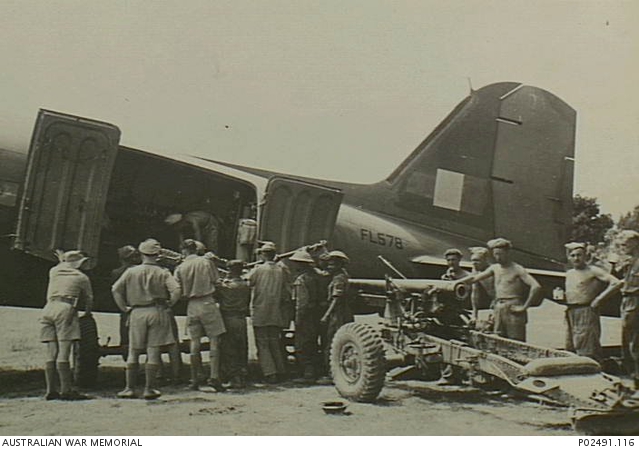
A Dakota overhead is the visible end of a much longer chain. Fuel must reach the departure airfield. Loads must be collected, weighed, packed, and handled. Mechanics must keep aircraft serviceable. Crews need usable weather information and destinations that can receive their cargo. On the ground, someone must unload or recover the supplies and carry them to the units that need them. None of this disappears because the last stage happens in the air.
The photograph above is valuable precisely because it shows loading rather than flight. A field gun could not simply be wished into an aircraft. Moving heavy equipment required preparation and work by men whose contribution rarely dominates battlefield narratives. The Australian War Memorial identifies the aircraft as RAF Dakota FL578 and the loaders as Indian troops. It is a small, concrete record of a multinational transport operation.
Reinforcements were part of the same problem. Elements of the 5th Indian Division were flown from the Arakan toward the threatened sector. Such movement shifted combat power faster than the region’s roads could have allowed. Evacuating casualties also mattered: the aircraft that brought resources forward could help carry the wounded out, reducing pressure on medical facilities within the defended area. Logistics affected not only how long a formation could survive, but what its commanders could attempt.
Published summaries give different totals for aircraft loads, troops moved, and casualties evacuated. Some count a particular air force or period; others aggregate wider operations. Those totals should not be merged into a single impressive number. The stronger conclusion is the one supported across the institutional accounts: sustained air transport made prolonged resistance possible, while the route on the ground remained contested.
Kohima: holding the ground still mattered
Air transport did not win the battle by itself. Someone had to defend landing grounds, protect positions, and keep the enemy from overrunning the perimeter. At Kohima, fighting compressed into a small area around Garrison Hill and the Deputy Commissioner’s bungalow. The tennis court became famous because it made the proximity of the opponents almost unbearably easy to imagine.
But the episode should not conceal the larger battle for ridges, roadblocks, artillery positions, and water. The U.S. Army’s Spring 2019 Army History study describes the loss of much of the garrison’s water access and the resulting rationing. It also explains how artillery outside the perimeter supported men inside it. Encircled did not mean wholly disconnected; the difference between those conditions was crucial.
The relief of the initial garrison on 18 April was not the end of fighting at Kohima. Clearing Japanese positions and opening the route toward Imphal took much longer. On 22 June, forces advancing from the north linked with IV Corps. A compact anniversary narrative can turn these stages into one moment of rescue. Separating them reveals the sustained effort required to convert local survival into a restored line of communication.
The attacker’s clock ran out
Mutaguchi’s plan depended on a rapid success that would make captured Allied stores available. That assumption linked operational ambition to the enemy’s behavior. It would work best if the defenders withdrew, abandoned supplies, or could be overwhelmed quickly. Holding on denied the Japanese not only a battlefield objective but part of the material basis of their offensive.
The National Army Museum’s discussion of Japanese forces in Burma explains that shortages forced troops to rely on local resources or captured supplies. Such dependence became increasingly destructive when combat continued and the monsoon worsened movement. Hunger, disease, exhaustion, and combat losses reinforced one another. A hungry formation had less strength to capture the food it needed; carrying wounded men further reduced what could be moved forward.
Command disputes cannot be separated from that material deterioration. The offensive did not fail because one side possessed courage and the other lacked it. Japanese soldiers endured appalling conditions. The question is what their endurance was being asked to accomplish after the assumptions behind the plan had broken down. Persistence can sustain a defense, but it can also magnify disaster when commanders refuse to reconsider an unattainable objective.
A multinational victory in an inhabited landscape
Calling this simply a British victory narrows the human story. Indian formations were central at Imphal; British and Indian units fought at Kohima, and Gurkhas formed an important part of the wider campaign. Allied air operations likewise crossed national boundaries. Opposing them were Japanese forces and troops of the Indian National Army, whose struggle against British rule complicates any simple alignment of nationality with one side.
The hills were also people’s homes. In her 1947 account, preserved in Cambridge University Library’s Naga collection, Mildred Archer described a recovering Kohima, damaged buildings, and a landscape of graves. She recorded Naga assistance to the wounded and the movement of a memorial stone. This is evidence of how a British visitor remembered the aftermath, not a complete account of Naga wartime experience. Its colonial perspective needs to remain visible.
That distinction changes how the battlefield is read. A road was a military artery, but also a route through communities. A ridge was a defensive position, but also land on which people lived and worked. Military histories reveal how armies moved; they do not automatically preserve the experiences of everyone whose world those movements destroyed.
What the turning point actually changed
The defeat of the Japanese offensive helped create the conditions for the Allied advance into Burma in 1945. It did not end the war in Asia, resolve India’s political future, or erase the costs borne by soldiers and civilians. What it demonstrated was more specific: a defense supplied through the air could withstand the sort of encirclement that had previously helped force retreat.
The comparison with the Atlantic convoy war is useful without making the two campaigns identical. In each, an outcome sometimes explained through a single weapon depended on a network of training, information, transport, maintenance, and organization. At Imphal and Kohima, that network did not remove the need for desperate ground fighting. It gave that fighting time to matter.
Sources and further reading
- National Army Museum: Battles of Imphal and Kohima
- National Army Museum: William Slim
- RAF Museum: Onto the Offensive, 1944
- U.S. Army Center of Military History: Army History, Spring 2019, Kohima study
- National Army Museum: Japanese forces and supply in Burma
- Mildred Archer, Journey to Nagaland, entry for 25 August 1947
- Australian War Memorial photographs P02491.116 and P02491.205
Source note: broad casualty and airlift totals vary with the force, period, and category counted. This article avoids combining incompatible totals. Archer’s retrospective account is used for the aftermath, not as the sole authority for battle dates.