
Hampi Beyond the Ruins: Reading the Landscape of an Imperial City
The stone chariot gets the photographs. Hampi’s streets, waterworks and living shrines tell the bigger story.
Hampi rewards a different kind of sightseeing. Instead of asking which monument comes next, ask what once connected the monuments: a route carrying grain, a channel carrying water, a street filling with people during a festival. That small change turns an impressive collection of ruins into something much more interesting: the remains of a working city.
These are the remains of Vijayanagara, the imperial capital beside the Tungabhadra River in present-day Karnataka. Its most celebrated buildings belong to the period between the fourteenth and sixteenth centuries. But the historical landscape is neither a single royal building project nor a city whose story stopped neatly after a battle. It contains sacred places, agricultural ground, domestic traces, later alterations and continuing worship. Start with those connections, and the famous silhouettes become less mysterious without becoming less remarkable.
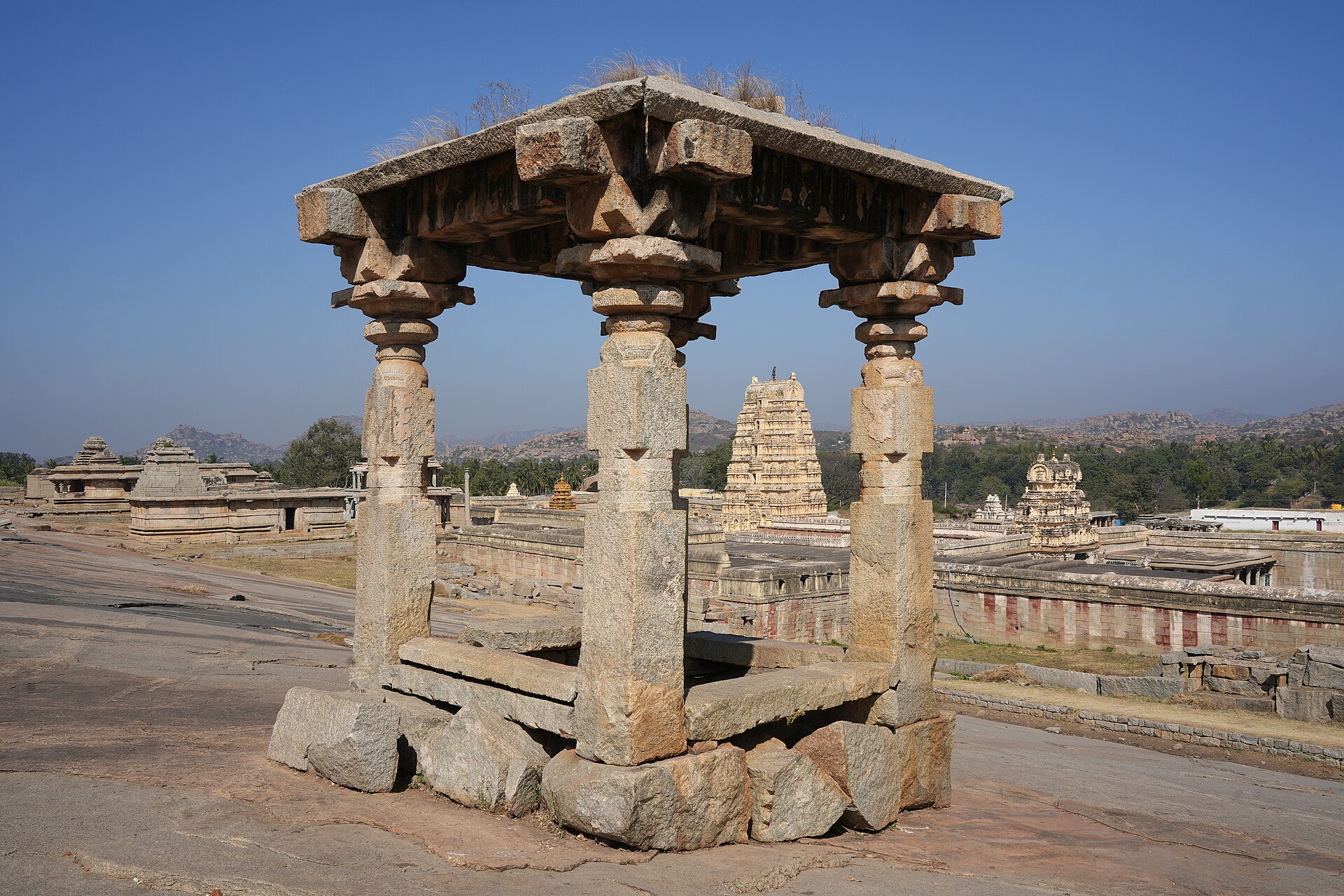
First, look at what the rocks make possible
The boulder hills are not just a spectacular background. They shape approaches, divide spaces and help explain why fortifications do not resemble one tidy wall drawn around a compact European-style city. The capital extended through a landscape of defended passages, cultivated areas and clusters of settlement. Its relationship with the river mattered as much as the view.
UNESCO describes a cultural landscape containing more than 1,600 surviving remains, from temples and gateways to water structures. That variety is a useful corrective to the usual photograph album. The site was not simply a royal court with some shrines attached. A large urban population had to eat, work, move and obtain water. Looking across a seemingly empty stretch between monuments, the better question is not “Why did they leave a gap?” but “What activities no longer leave an obvious stone outline?”
The distinction matters at many historic sites. At Great Zimbabwe, too, masonry can dominate our attention so completely that the wider settlement and exchange networks become harder to see. Surviving stone is evidence, not a complete census of the past.
Water belongs at the centre of the story
A stepped tank is easy to admire as geometry. The repeating stairs create exactly the sort of image that looks designed for a camera. Yet the more revealing feature may be a modest channel nearby. Water had to reach particular places, at usable levels, and in sufficient quantities. A beautiful reservoir was also part of an arrangement of labour, maintenance and authority.
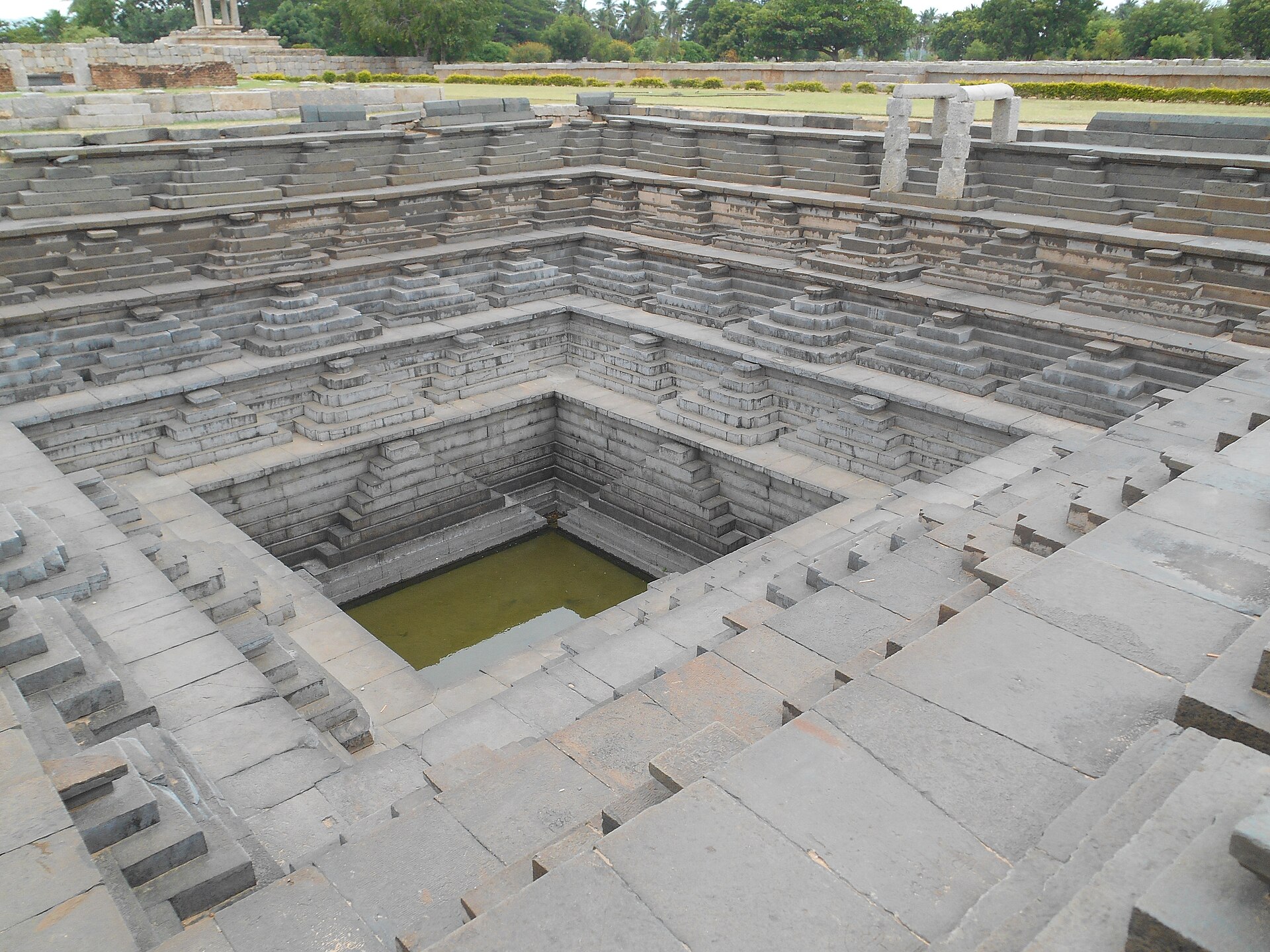
Domingos Paes, the Portuguese visitor whose account survives in Robert Sewell’s 1900 collection, noticed water repeatedly. He described gardens and cultivated ground between defensive lines, conduits and reservoirs, and a major tank under construction. His account connects royal ambition to irrigation rather than treating hydraulic work as a footnote to palace life. A city could stage impressive ceremonies only because people elsewhere were growing, carrying and distributing what it consumed.
Paes is especially valuable when read with caution. His measurements and enormous headcounts are observations and estimates, not modern survey results. He also interpreted unfamiliar practices through his own religious and cultural assumptions. The English text comes through a much later translation. None of that makes it useless. It means we should ask what he could see, what he was told, and where an admiring outsider might exaggerate.
One rewarding exercise is to compare the visitor’s attention to fields and water with the monuments most often reproduced today. The contrast reveals how our preferred version of Hampi can become more exclusively ceremonial than the city he described.
A temple street was more than an approach road
At Virupaksha, the relationship between gateway, street and surrounding settlement matters as much as the tower itself. This is a living temple, not an abandoned prop in an archaeological panorama. Religious activity continued through changes in political authority, and later work forms part of the building’s history.
That continuity makes the phrase “lost city” particularly awkward. It can describe the disappearance of imperial functions, but it can also erase people who never stopped knowing, using and valuing the place. Sewell’s title, A Forgotten Empire, tells us something about the historical interests of his own readership. It does not prove that local memory had vanished until European scholarship arrived.
Rows of pillared structures and broad ceremonial approaches encourage another useful question: who occupied the edges of sacred space? Temples drew together devotion, patronage, performance and exchange. Streets were not neutral corridors between the important buildings. They were places where the city’s public life became visible. Reading a historic city through movement is often more revealing than reading it through a list of monuments.
The stone chariot, properly placed
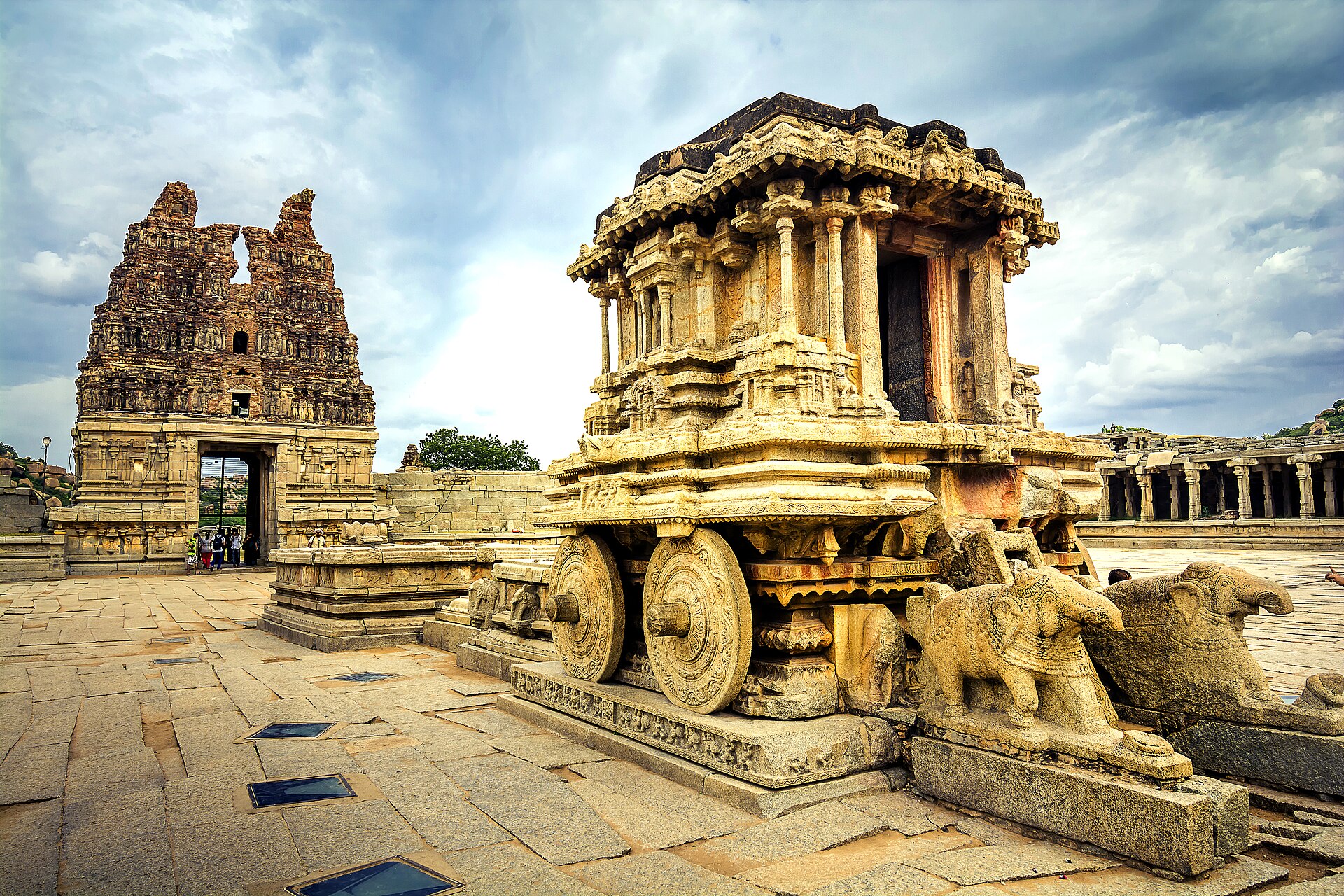
The famous stone chariot at the Vittala complex represents a shrine associated with Garuda, the mount of Vishnu. It is not best understood as a giant vehicle waiting to be hauled through the streets. Its architectural language refers to a chariot while its setting places it within a temple ensemble.
Look beyond the wheels. How does the shrine relate to the halls, gateways and open court? Which direction does a visitor approach from? What changes when the iconic object is understood as one component of a larger composition? These questions restore scale and purpose to a monument that is often cropped free of its surroundings.
The same principle applies to sculpted detail. A photograph can isolate an extraordinary piece of carving; the building tells us how that carving participated in a sequence. We do not need to identify every figure to recognise that image, approach and ritual space were arranged together.
Royal spaces: useful names, uncertain functions
The royal enclosure and nearby structures bring a different interpretive problem. Labels such as “Queen’s Bath” or “Lotus Mahal” make sites memorable, but familiar names should not automatically be treated as documentary proof of who used a building and exactly how. Architecture supplies clues; a modern label can suggest more certainty than those clues justify.
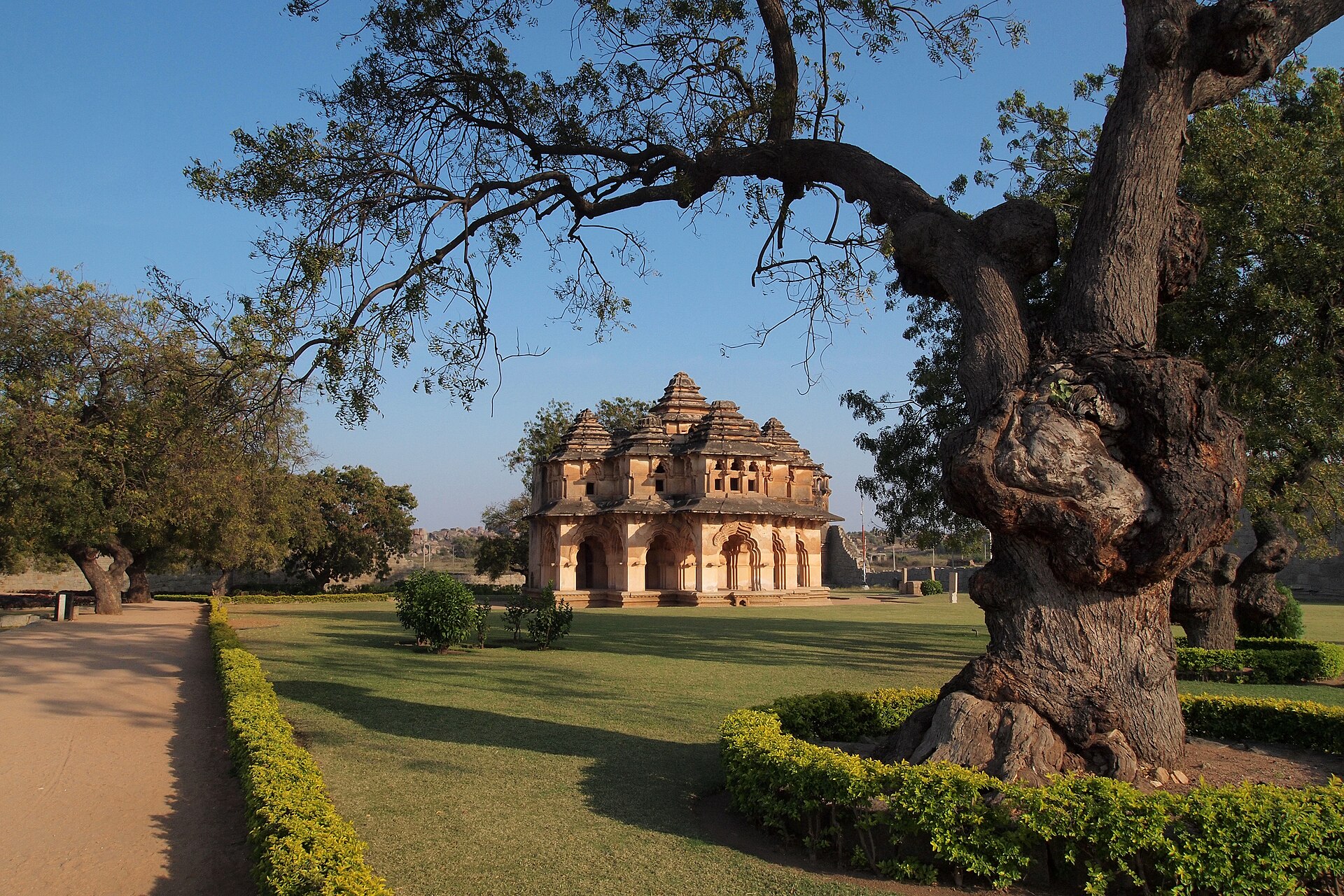
At the Lotus Mahal, arches, openings and the relationship between upper and lower levels invite careful looking. Hampi’s courtly architecture also complicates a simple opposition between supposedly sealed Hindu and Islamic worlds. Forms and building practices could circulate across political boundaries even when rulers fought one another. Rivalry did not prevent borrowing, employment or exchange.
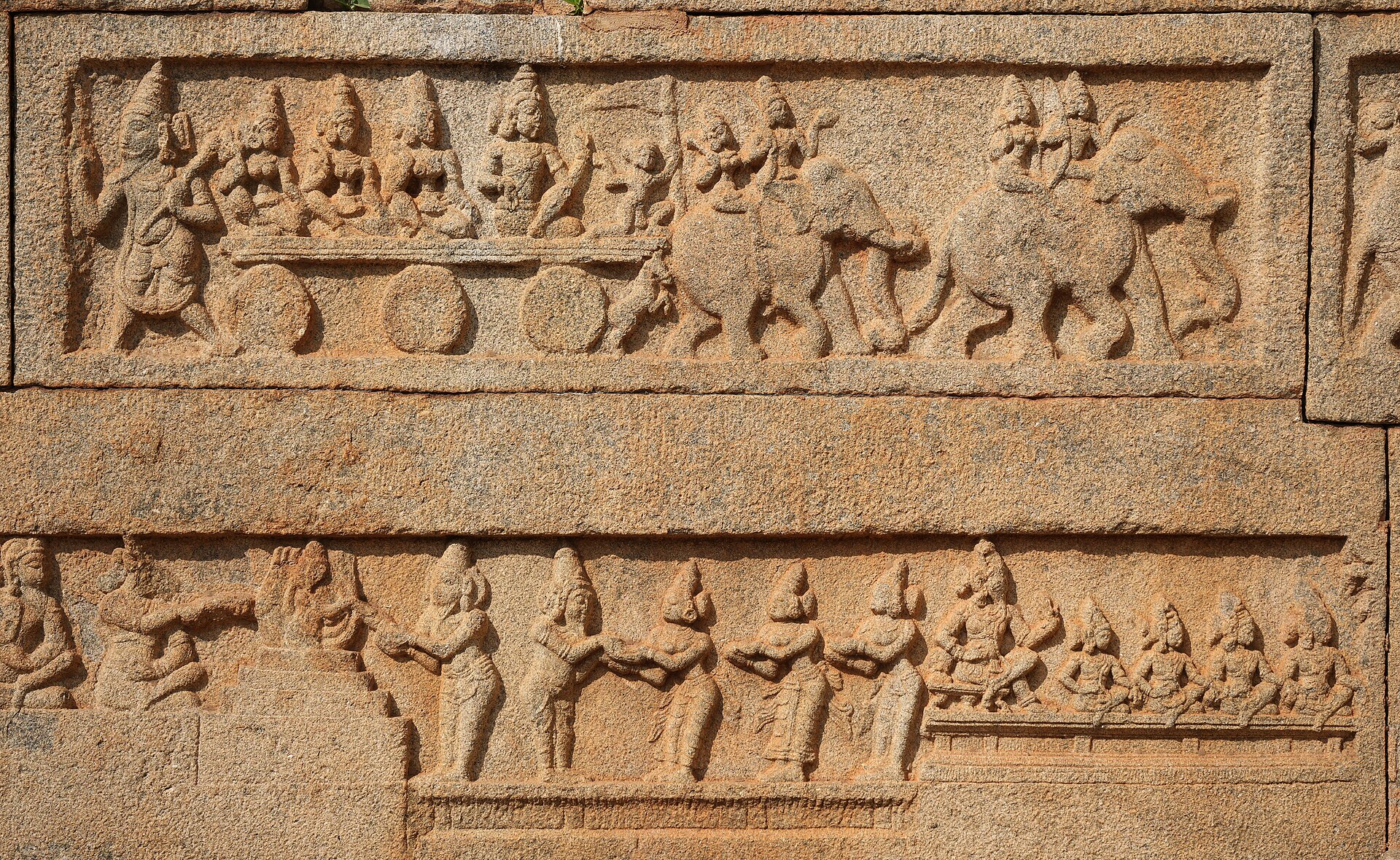
The Archaeological Survey of India’s account places the Mahanavami Dibba within royal festival culture and draws attention to the Ramayana reliefs at the Hazara Rama temple. Here, public spectacle and sacred narrative came close to the representation of kingship. Rather than imagining an undocumented ceremony in detail, compare the scale of the platform, the sequences of figures and the spaces available to an audience. The remains allow strong questions even when they do not supply a complete performance script.
1565 was a rupture, not an explanation for everything
The defeat of Vijayanagara’s forces at Talikota in 1565 and the subsequent destruction of the capital were a major turning point. They help explain the end of its imperial role. They do not, by themselves, explain the date and condition of every surviving wall, or the whole later history of the region.
There is a temptation to compress a complicated city into two images: fabulous prosperity, then instant silence. Hampi resists that neat ending. Continued worship at Virupaksha alone should make us pause. Political collapse, damage, abandonment, reuse and the survival of sacred institutions are different processes. Some can occur together without producing the same result everywhere.
This is also why an exclusively religious explanation of the conflict is insufficient. The capital belonged to a world of shifting regional powers, armies and alliances. The architectural evidence of cultural exchange is a reminder not to turn later ruins into proof that the earlier world contained only impermeable civilisational camps.
A way to visit without flattening the past
For a historically attentive visit, choose a few relationships rather than trying to exhaust a checklist: river and settlement; tank and channel; temple and street; palace platform and carved narrative. Allow time for the apparently ordinary remains. Do not climb on fragile structures or treat a working shrine as an empty photographic set.
This is not a timetable or an access guide: local arrangements and conservation restrictions need checking before travel. It is a way of looking. Hampi’s greatest surprise is that the gaps can become as interesting as the monuments. Once water, movement and continuing life enter the picture, the landscape stops being merely the aftermath of an empire. It becomes evidence of how a city worked, and of how selectively its history survives.