
Everyday Life & Culture
Medieval Watermills: The Work, Rights and Rivers Behind the Wheel
From an Irish tidal mill to English manorial accounts, water-powered grinding joined skilled work, engineered rivers and contested rights to a share of the harvest.
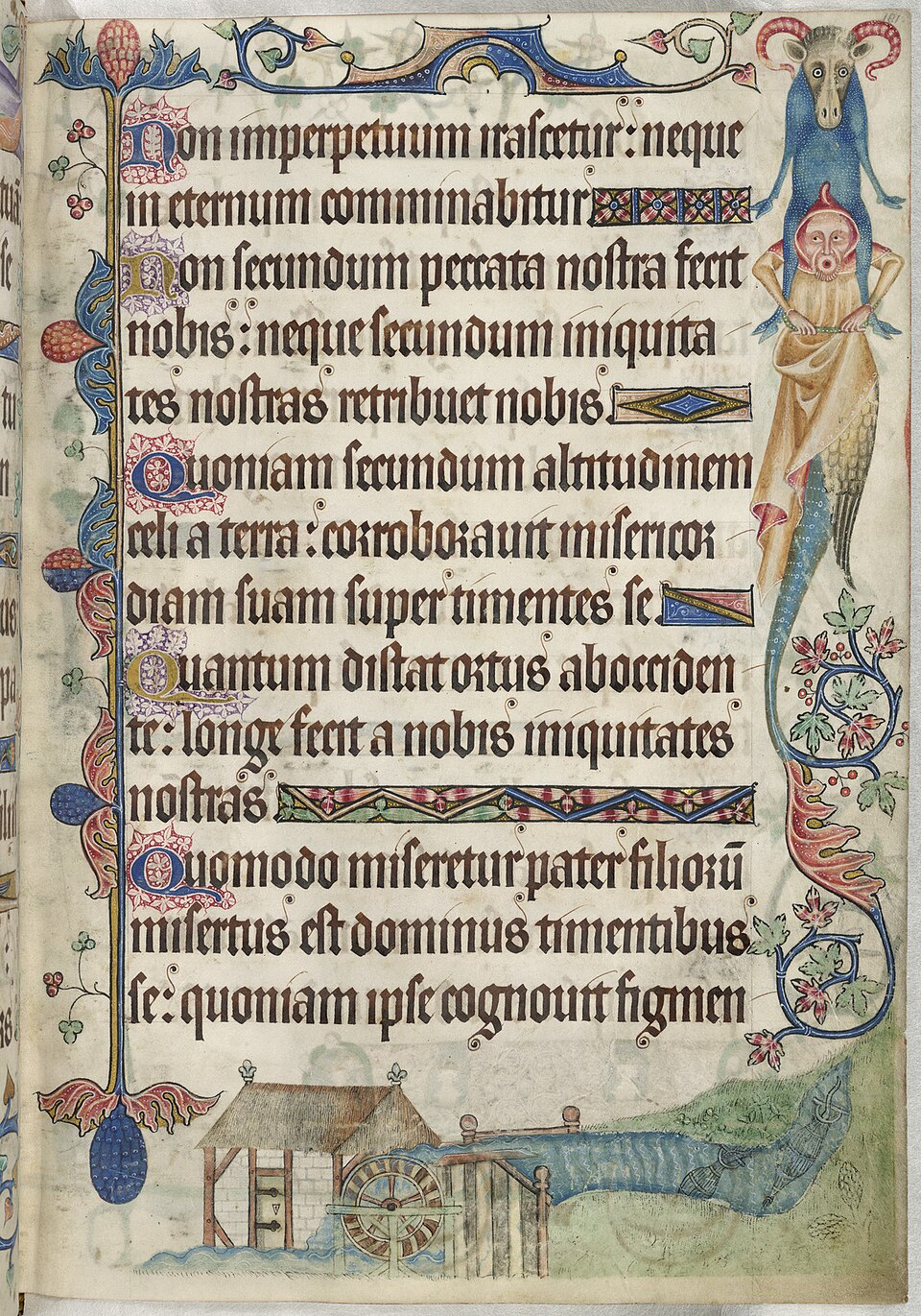
Look closely at the lower margin of a fourteenth-century English prayer book and you’ll find a waterwheel beside a timber-framed mill. A barrier funnels the river towards it. Beneath the water, the artist has included fishing equipment. Someone has put this stretch of river to work.
The book is the Luttrell Psalter, now in the British Library. The mill is small beside the decorated text and fantastical creature above it. But it points to a very practical problem. Between harvesting grain and eating bread stood another operation: somebody had to grind. Water could perform much of the repetitive muscular work, but harnessing it required construction, maintenance and arrangements over payment and access.
Across medieval Britain and Ireland, mills connected agricultural production to religious houses, landed estates, households and markets. There’s more to this story than the arrival of a useful machine. A wheel that saved labour could also collect a lord’s income; a sophisticated mill could operate beside a household still grinding by hand. The surviving evidence shows several such arrangements, rather than one universal medieval system.
What the wheel actually did
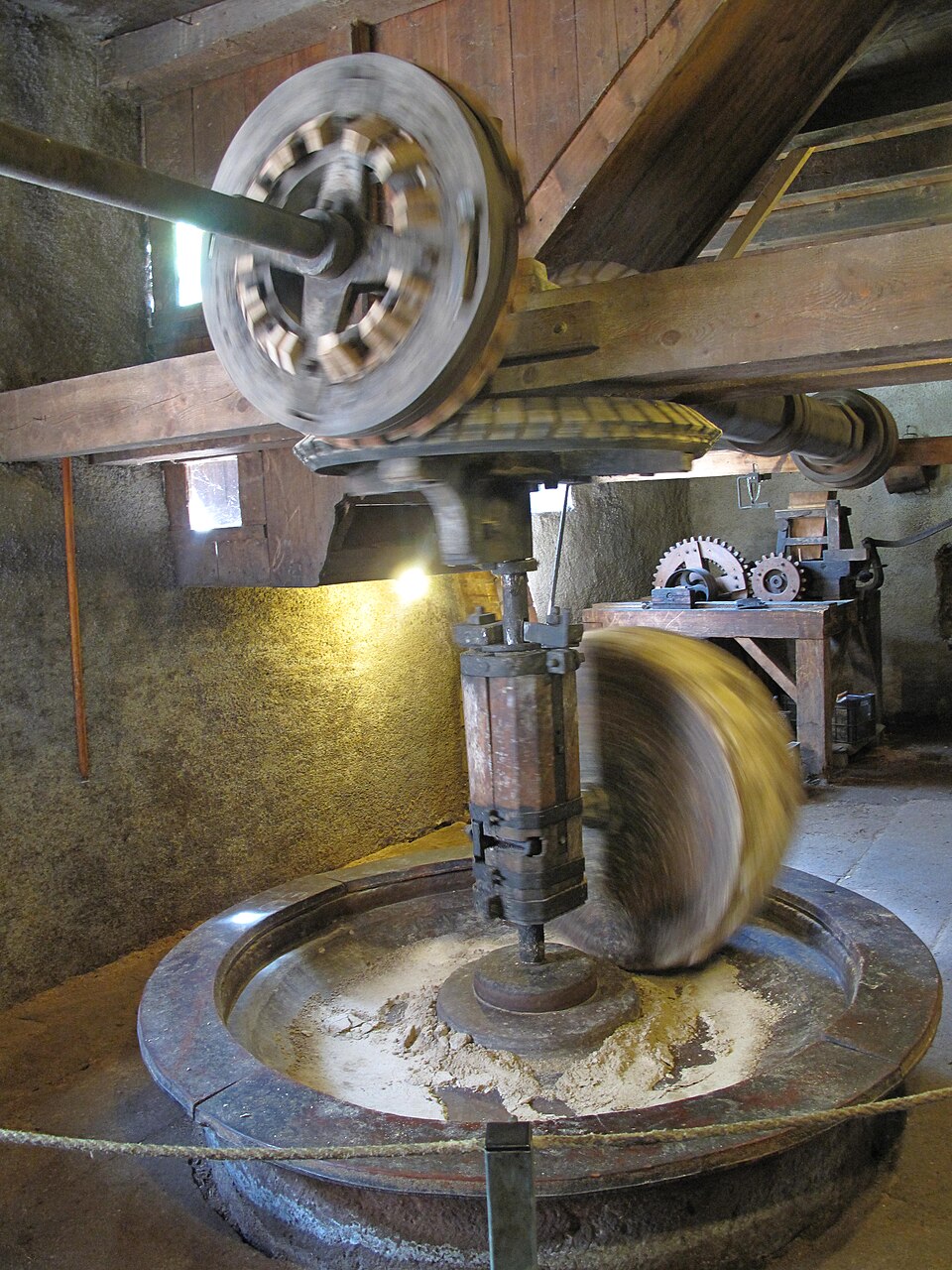
At its simplest, a grain mill used moving water to turn a stone. In the familiar paired arrangement, the lower bedstone stayed still while an upper runner rotated above it. Grain entered the central opening and was worked between the stones before the meal emerged around their edges. The result depended on the grinding surfaces and their adjustment, not merely on how rapidly a wheel could spin. The Mount Vernon gristmill glossary, describing later machinery, usefully identifies these basic components without making that later installation a model for every medieval mill.
Two different wheel arrangements matter. A horizontal wheel turned on a vertical shaft and could drive the stone directly. A vertical wheel turned a horizontal axle; gearing changed the direction of rotation to drive a millstone above. Knowing the wheel’s direction, though, doesn’t tell us how old, large or sophisticated a mill was. A seemingly simple arrangement might be exceptionally well adapted to its water supply.
Vertical wheels didn’t all work in the same way either. Water could pass beneath a wheel or be delivered higher onto it, depending on the available fall and the structures built to control it. The necessary landscape extended beyond the building: a channel brought water in, a race carried it past the wheel, and a tailrace returned it downstream. Historic England’s archaeological guide to mills treats these water-management features as part of the installation, not incidental scenery.
A tidal machine in seventh-century Ireland
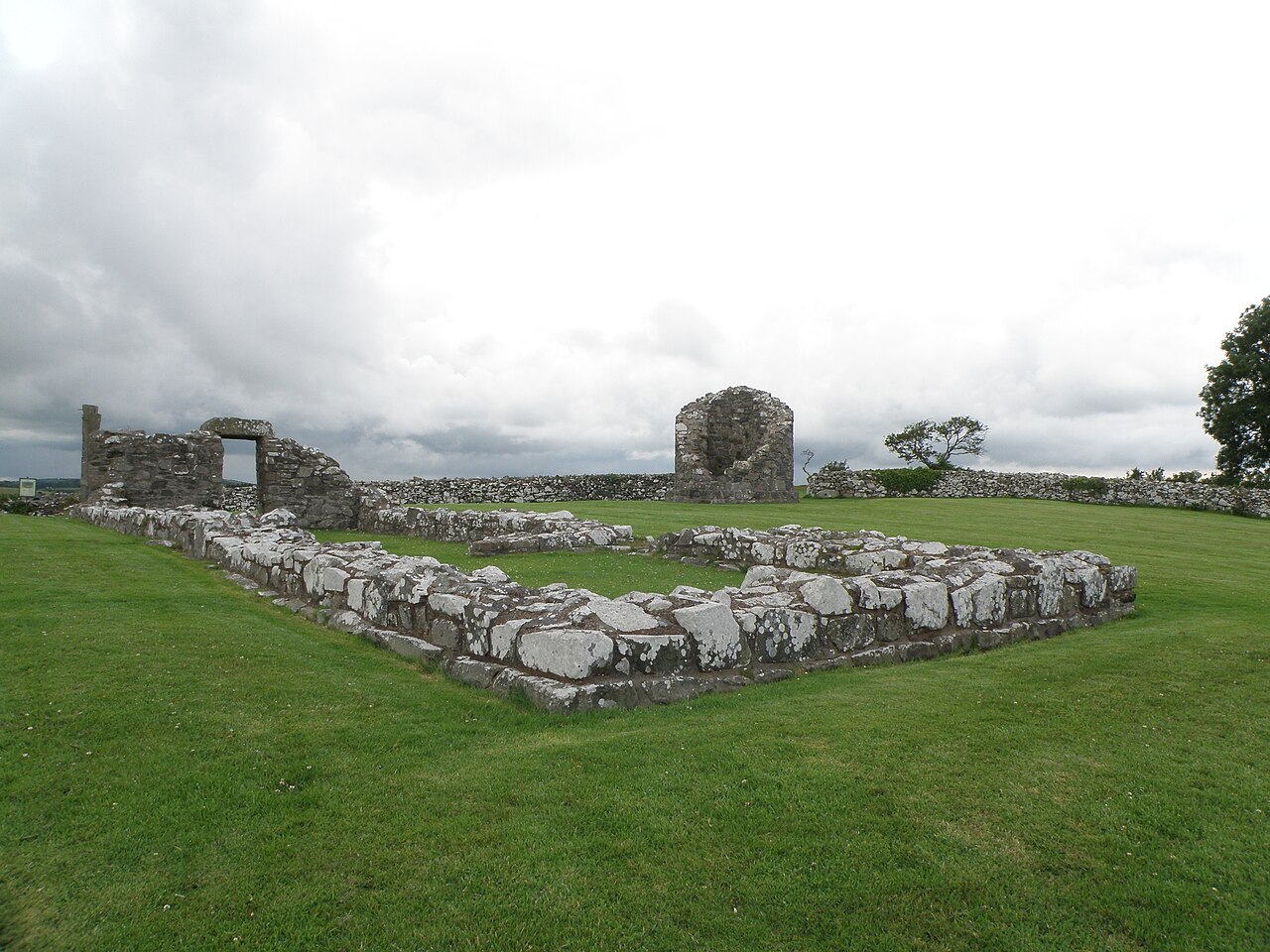
The early evidence makes the idea of a technologically backward Middle Ages hard to sustain. At Nendrum, a monastery on Mahee Island in Strangford Lough, archaeologists identified the remains of a tidal mill. Water entered a pond as the tide rose. Retained behind a barrier, it could subsequently be released to drive a horizontal wheel when the water outside had fallen.
The excavators’ report for 1999 described multiple construction phases and timbers from the earliest phase dated by tree rings to AD 619. Stonework, planks, upright timbers and traces of wattle helped reveal an engineered installation where an apparently ambiguous shoreline feature had first demanded investigation. The discovery depended on reading damaged remains together, not finding an intact machine.
The tide set the working hours. Stored water made energy available at suitable stages of the tide, rather than whenever someone wanted to grind. That constraint was different from a river mill’s dependence on rainfall and stream flow. Nendrum demonstrates a community’s capacity to build around a particular environment; it does not establish that every contemporary monastery possessed comparable equipment.
Timbers beneath the later landscape
In England, excavation at Wellington Quarry in Herefordshire in 2000 exposed a rectangular assembly of substantial oak beams and fragments of large millstones. The upper structure had been removed long before. Enough remained, however, to identify the base of a wheel pit for a vertical wheel. Preliminary tree-ring analysis placed construction in the first half of the eighth century.
Herefordshire Archaeology’s account of Wellington explains why this mattered: together with earlier remains at Old Windsor, it challenged an easy assumption that early medieval mills necessarily began with horizontal wheels and only later acquired more complex gearing. Different forms could coexist. The evidence is too patchy to turn their surviving dates into a complete sequence of invention.
What survives makes a difference too. Waterlogged timber can reveal construction that vanished above ground, while a later mill may have moved its wheel pit or replaced earlier foundations. An attractive surviving building and an archaeologically early site are therefore different kinds of evidence. The oldest-looking wall need not belong to the first mill that used the stream.
Counting mills in Domesday England
The documentary scale changes dramatically with Domesday Book in 1086. The Hull Domesday Project identifies more than six thousand mills in the survey, enough to make water power an ordinary component of the economy rather than an occasional monastic curiosity. Its comparison is roughly one mill for every two vills, allowing for omissions. This was an extensive network, although not an evenly distributed one.
Those numbers need a little unpacking. A fiscal survey concerned with rights and income is not a modern engineering census. Recent research on lordly power centres between about 800 and 1200 notes the difficulty of deciding whether references count separate buildings, sets of stones or divided interests. The safest conclusion is the broad one: thousands of milling installations and claims over their earnings already existed by the late eleventh century.
For the people involved, these distinctions had everyday consequences. Recording a fraction of a mill might describe a share in revenue rather than a physically incomplete wheel. For a landholder, the mill was an asset; for the person taking grain there, it was a service and possibly an obligation. Both perspectives could attach to the same building. Consequently, an entry showing a valuable mill cannot tell us, without other evidence, how smoothly it worked, how many hours it operated, or how its customers regarded the service.
Paying for the grind
A mill needed customers. Customers didn’t always get to choose their mill. The obligation known as suit of mill could require tenants to use a particular lord’s mill. The miller took a toll, often called multure. The Mills Archive’s account of medieval water power stresses an important qualification: this was a privilege rather than a single statutory rule binding every tenant everywhere. Its profitability nevertheless gave owners a strong reason to enforce it.
There wasn’t one standard milling charge across the Middle Ages. Customs, tenures and local arrangements differed. Equally, a toll was not simply a payment for the moment when grain passed between stones. It supported an installation requiring capital and repair while also providing income to those entitled to collect it. Whether that income seemed a reasonable exchange or an imposed burden depended on one’s position.
And the person running the mill wasn’t necessarily its owner. A tenant miller could owe rent to a lord while collecting payments from customers. The working person encountered at the mill was not necessarily the person who controlled its legal privileges. Medieval food production contained several such layers, as Histovia’s account of English alewives and brewing explores in another essential trade.
The hands that machines did not replace
Handmills didn’t disappear when water-powered mills arrived. Archaeological finds and household records show continued use of querns in later medieval Kent. The study Becoming Through Milling brings those sources together to challenge a simple narrative in which machinery steadily displaced domestic work. Querns appear in places where access to larger mills was possible, not only beyond the reach of technology.
A household’s choice could reflect the quantity being processed, local rules and the balance between paying a fee and supplying its own labour. A small batch and a large commercial demand posed different problems. Hand grinding therefore cannot automatically be classified as evidence of backwardness, nor can every surviving quern be called an act of resistance. Its meaning depends on the context in which people owned and used it.
The larger mill still needed human work. Grain had to reach it; machinery required attention; worn grinding surfaces needed renewal. Water replaced a source of motive power, not the entire chain of skills and decisions that turned a harvest into food.
Who paid when something broke?
An account from Sutton lets us see who actually had to pay for what. In 1433 Robert Milward and his son Richard held the manorial mill for their lives, paying an annual rent of £4 6s. 8d. Their arrangement required them to keep it working and perform customary work on the mill, ponds and dams. The lord supplied structural timber and undertook to maintain the millstream beneath the great dam.
The arrangement, recorded by the Sutton Coldfield Local History Research Group, reveals a negotiated division of costs. It is one local example, not a national contract form. Yet its detail explains why ownership alone says too little: timber, watercourses, routine repairs and rent could fall to different parties. A broken component or obstructed channel could interrupt the income expected by both.
Grinding stones themselves were working surfaces, not permanent equipment that could be left untouched. A Kent Archaeological Society discussion of mill accounts and stones notes that dressing could be the miller’s work, involving a pick to restore the required surface. The skill lay partly in knowing the stone, not just in controlling the water. Successful mechanization depended on such repeated manual interventions.
A monastery’s working building
Fountains Abbey provides an unusually substantial architectural counterpart to the scattered timbers and terse accounts. The National Trust’s heritage record for Fountains Mill describes a stone building probably first constructed in the late twelfth century, with machinery below and granary space above. In its medieval form it had two wheels and two sets of milling equipment. Water arrived through a leat and pond before leaving through culverts.
This was an organized complex joining storage, processing and engineered water supply. Its later uses changed, including timber sawing and electricity generation. Those alterations are part of the building’s history, but they must not be projected back into its monastic operation. A place can preserve medieval walls while containing equipment and arrangements introduced centuries later.
Reading what survives
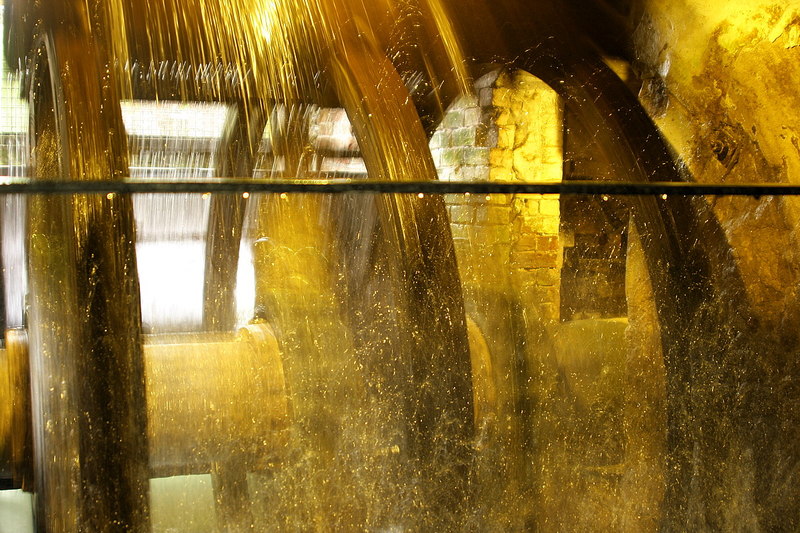
The same caution applies to Winchester City Mill. The National Trust’s history traces the site’s long past while identifying rebuilding begun in 1743. The photographed wheel is useful for understanding an urban mill’s physical setting, but it is not evidence that this exact machinery served medieval Winchester. Continuity of location and survival of original equipment are separate claims.
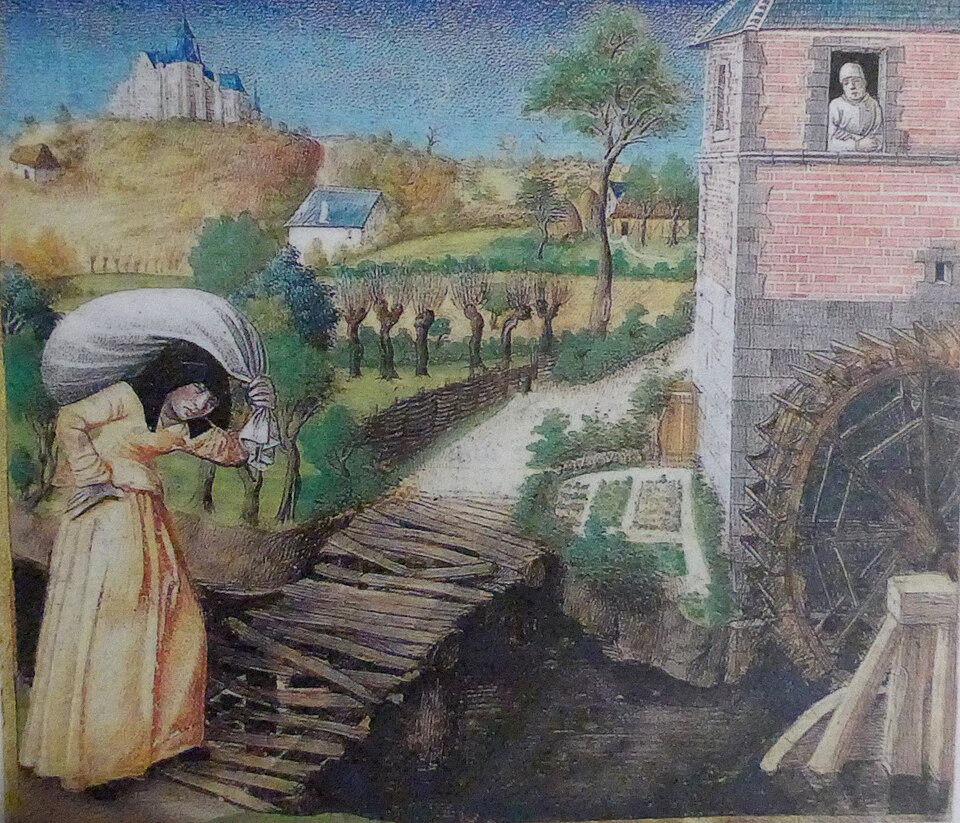
Manuscript pictures have their own limits. The Luttrell Psalter’s riverside mill is contemporary evidence, yet it belongs to a richly decorated devotional book associated with a landholding household. It does not supply a measured engineering drawing or a transparent record of every worker. The French miniature reproduced here is likewise a fifteenth-century representation, not a photograph of an English village.
To find out how a mill really worked, we need to put these sources together: the beam that fixes a construction phase, the record that assigns a repair, the account that values income, and the channel that explains where the water went. Each answers a different question. Together they recover something more precise than a picturesque wheel: a food-processing workplace whose operation depended on a river, a set of rights and continuing skilled labour.