
Histovia · World War II & its aftermath
Why Britain Rationed Bread After World War II
Bread remained outside Britain’s coupon system throughout the war. In July 1946, it went on the ration. Understanding that reversal means looking beyond the date of victory.
By Histovia Team
On 21 July 1946, more than a year after victory in Europe, British shoppers began surrendering coupons for bread. It was a striking addition to a familiar routine. Families had spent years accounting for rationed food, yet bread had remained a dependable way to fill a meal when other ingredients were scarce. Peace now brought a restriction that the war itself had avoided.
The apparent contradiction disappears only when we separate military victory from economic recovery. Ending the fighting did not immediately restore harvests, rebuild overseas trade or give Britain the foreign currency to buy whatever it needed. Nor did a ration book solve every problem of getting dinner on the table. Bread’s journey into and out of the system shows how food policy combined material scarcity, administrative choices and arguments about fairness.

01 · More than coupons
The ration book was one part of a much larger food system
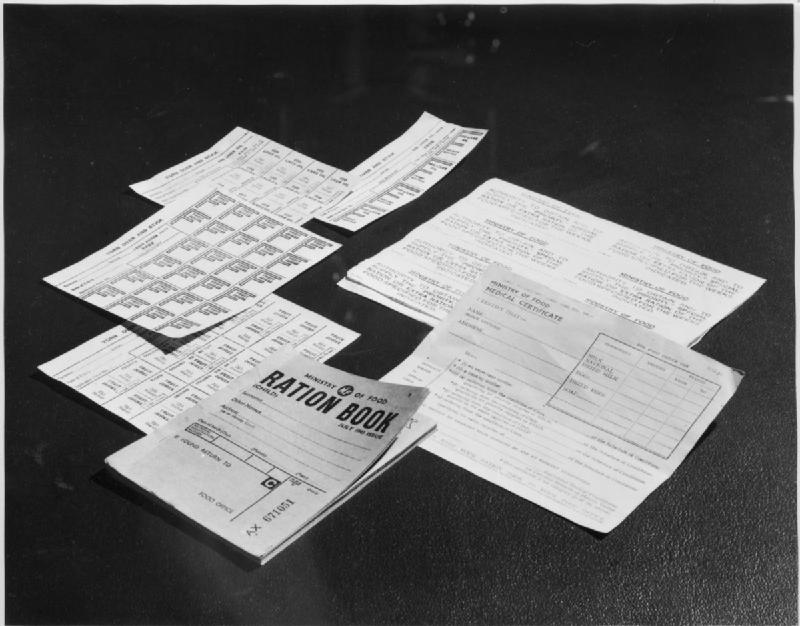
Food rationing began on 8 January 1940 with bacon, butter and sugar, as the National Army Museum’s ration-book record explains. Meat followed in March. The Ministry of Food organized imports and distribution as well as household allowances. Its 1951 account of food policy and household diets describes bulk purchasing, registration with retailers and controls over domestic supplies.
These arrangements answered different questions. Buying food overseas secured supplies. Directing it through wholesalers and retailers helped distribute it. Ration coupons limited how much an individual could purchase. Price ceilings and subsidies addressed affordability. None of those functions should be collapsed into the idea that the state simply handed everyone an identical weekly parcel.
Coupons were entitlements to buy, rather than money or a complete meal plan. A points system introduced in December 1941 allowed choices among designated foods. School meals, industrial canteens and British Restaurants supplemented food eaten at home. Special provisions recognized some differences in need: children and expectant mothers received priority foods, while certain workers without canteens received additional cheese.
There was no single, unchanging “wartime ration.” Allowances, eligible products and access to supplementary meals changed. A photograph of one week’s ration can illustrate a particular moment; it cannot describe every person’s whole diet throughout the war.
Bread occupied a special place. The Ministry’s retrospective report explains that keeping it plentiful and, if possible, unrationed helped meet energy needs and sustain morale. When rationed ingredients ran short, an available staple gave households room to improvise. Bread’s freedom from coupons was therefore part of the system’s design, not evidence that officials had ignored it.
02 · Victory did not refill the granaries
The food crisis changed after 1945
During the war, shipping capacity was a central constraint. Food cargoes competed with military requirements, and enemy action threatened deliveries. Afterward, the problem acquired a different geography. The Ministry’s 1951 report describes poor harvests in 1945, damage to European agriculture and shortages of fertilizer. Drought in parts of Africa and India, alongside disrupted rice production in Asia, increased pressure on the world’s wheat supply.
Britain also faced a purchasing problem. Lend-Lease ended in 1945. As physical shortages gradually eased, the ability to pay for imports, particularly from dollar-earning countries, became increasingly important. A ship being able to cross the Atlantic did not mean Britain could readily finance everything it might carry.
Officials tried other measures before introducing bread coupons. They raised the flour extraction rate, retaining more of the grain in flour, reduced the standard loaf’s weight, limited biscuit production and restricted restaurant bread service. The eventual decision was thus an escalation within an existing conservation effort.
The sequence matters. The severe British winter of 1947 later deepened food difficulties, but it could not have caused a scheme introduced in July 1946. Nor should the whole postwar story be reduced to one shipment, one foreign commitment or one bad harvest. Agricultural damage, competing demand, stocks and money interacted over several years.
03 · The decision in public
Bread rationing was presented as insurance against a breakdown
In his announcement to the Commons on 27 June 1946, Food Minister John Strachey stressed uncertain supplies and dangerously limited reserves. He expected savings of roughly five to ten per cent. The argument was preventive: restrictions would create a margin of safety before a more disruptive failure occurred.
The scheme covered bread, flour and flour confectionery. Bread units could be used across products, while food offices could exchange them for ordinary points. Arrangements recognized adolescents, manual workers and people needing packed meals. On paper, officials were trying to combine an overall limit with some flexibility in how families ate.
Winston Churchill challenged the necessity of the measure, the information supplied about stocks and the administrative burden. The debate is valuable precisely because it preserves disagreement. Strachey’s estimate tells us what the government expected, not what the scheme demonstrably achieved. Churchill’s criticism records the opposition’s case, not proof that scarcity was imaginary.
For shoppers, the new system also changed the meaning of a staple. Bread had been a fallback when other food was unavailable. Requiring a coupon made that fallback another item to plan, account for and negotiate. A restriction could be comparatively loose in aggregate while still adding work to an individual household.

04 · Fair shares, uneven work
An equal entitlement did not produce an equal shopping day
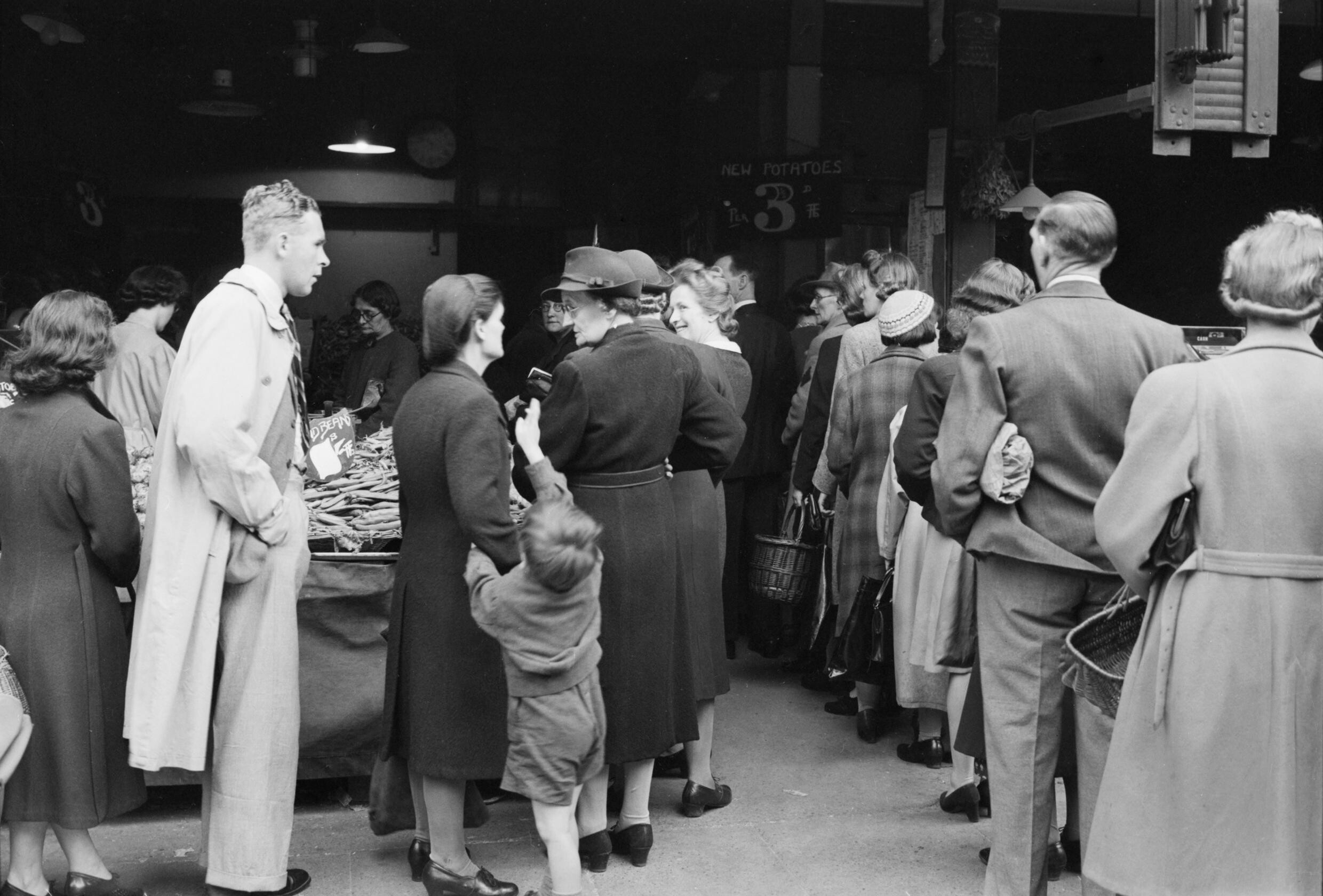
A coupon did not guarantee that a shop had the food. Imperial War Museums’ account of food and nutrition emphasizes the time spent queuing, including for unrationed products such as fish and sausages. Much of the shopping and meal planning fell to women. Supply could run out before a customer reached the counter.
That distinction explains how support for rationing could coexist with anger at its daily operation. The Historical Journal study of Labour women MPs and housewifery finds both defenses of fair distribution and criticism of exhausting shopping routines. Women in paid employment had less time to search multiple shops. Parliamentary disputes also asked whether the physical work of running a household deserved recognition in special allowances.
These debates show why fairness requires more than comparing coupon totals. Access to time, transport, a canteen or a usable kitchen affected what an entitlement became in practice. The parliamentary record does not speak for every household, but it reveals that these tensions were recognized at the time.
Likewise, rationing should not become a nostalgic claim that everyone grew healthier. A later analysis of the Oxford Nutrition Survey found that vitamin A and C deficiencies were less frequent in a 1944 group of working-class pregnant women than in a 1942 group following supplementation policy. Other measures did not improve similarly. Those limited cohorts cannot represent the whole country. They do show why targeted benefits and continuing deficiencies belong in the same history.
05 · Ending coupons was another policy choice
By 1948, officials were asking whether bread rationing still helped
A January 1948 draft letter preserved by the National Archives argued for removing the relatively loose bread scheme while retaining restrictions further up the supply chain. Written by Sir Herbert Broadley on behalf of the Food Minister to Chancellor Stafford Cripps, it proposed controlling flour distribution and preventing misuse rather than continuing household coupons.
The draft also considered American opinion and the calculation of British wheat requirements under Marshall Aid. Its author worried that keeping consumption within a rationing framework could affect the level of need recognized by the aid program. This is evidence that diplomacy and administrative measurements entered the decision. It does not establish that the 1946 scheme had been invented solely to obtain American assistance.
On 21 July 1948, Strachey announced abolition, effective Sunday 25 July. He acknowledged that the scheme had probably had little effect on human consumption during its second year, while defending its earlier role in preventing a supply breakdown. Churchill continued to dispute its justification.
Controls on mill deliveries and measures against feeding bread or flour to animals remained. The household coupon disappeared before the wider apparatus of food control. That is an important distinction: de-rationing was a change in how supplies were managed, not a declaration that wheat, foreign currency and public patience had become unlimited.
Different foods had different endings
- 8 January 1940Britain begins rationing bacon, butter and sugar; the system expands during the war.
- 21 July 1946Bread and flour enter the coupon system after wartime victory.
- 25 July 1948Bread and flour coupons end, while other controls and food rations continue.
- 4 July 1954The remaining food-rationing scheme ends, including meat and bacon provisions.
The final date is recorded in the 1954 order revoking the remaining food-rationing rules. Bread was not rationed for all nine postwar years. Confusing its two-year scheme with that longer endpoint obscures the uneven pace of recovery.
Britain’s experience reveals a state capable of coordinating supplies and protecting access, but dependent on work performed in kitchens, shops, farms and ports. Rationing distributed claims on food; people still had to turn those claims into meals. Victory removed the enemy. Restoring choices at the counter required a longer reconstruction of production, trade and ordinary life.
Sources
Contemporary statements are identified as government or opposition arguments. The Ministry’s retrospective report provides policy context; its household survey does not represent every British household.
- Ministry of Food, The Urban Working-Class Household Diet, 1940–1949 (HMSO, 1951), especially printed pp. 7–10 and 54–56.
- House of Commons, Bread and Flour Rationing, 27 June 1946; and Bread Rationing (Abolition), 21 July 1948.
- The National Archives, January 1948 draft letter, MAF 84/197.
- Imperial War Museums, Food and Nutrition teacher notes; National Army Museum, ration-book collection record.
- “Labour Women MPs and Housewifery in the House of Commons, 1945–1951,” The Historical Journal, published online 2024.
- “Nutritional research in World War 2: The Oxford Nutrition Survey and its research potential 50 years later,” British Journal of Nutrition 84 (2000), 247–251.
- Food Rationing (Amendment and Revocation) Order 1954, SI 1954/797, article 3 and explanatory note.
Historical photographs are reproduced from public-domain Commons files; provenance and rights records appear beneath each image. Sources checked October 2026.
More World War II history
D-Day’s Invisible Front
For readers exploring another side of the war, Histovia’s illustrated ebook follows the deception campaign behind the Normandy landings, from false signals to the limits of what the evidence can prove.
US$3.90 · PDF + EPUB · By Histovia Team