
Histovia · World War II & its aftermath
Liberated, but Not Home: Europe’s Displaced Persons After World War II
In 1945, returning millions of people was an extraordinary achievement. It also exposed the limits of a recovery plan built around the idea that everyone had a home to return to.
By Histovia Team
Victory could end a regime without restoring the lives it had destroyed. For people displaced by Nazi persecution, imprisonment and forced labor, liberation raised questions a military surrender could not answer: Was anyone in the family still alive? Was return safe? Who could issue the documents needed to leave? Which country would admit them?
The displaced-persons crisis is often treated as an administrative aftermath to World War II. Yet its central problem was political as well as practical. Food, transport and shelter mattered enormously; so did the power to decide where a person belonged. The disagreement over that question helps explain why some survivors remained in camps long after the fighting stopped.
A necessary distinction: “Displaced persons” was a broad category, encompassing people with very different wartime experiences and prospects. This article examines the wider repatriation problem, then concentrates on Jewish Holocaust survivors and the controversy surrounding their treatment in 1945. Their experience should not stand in for every displaced population.

01 · The first solution
Repatriation worked for millions. It could not work for everyone.
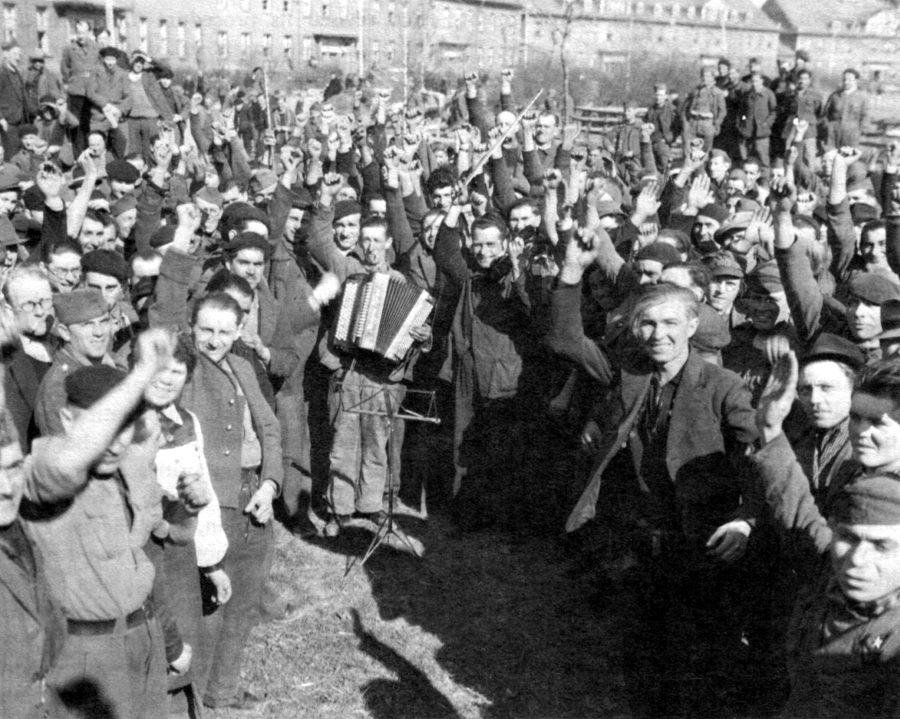
Allied authorities initially organized assistance around rapid return. Assembly centers grouped people by nationality, making it easier to provide relief and arrange transport. Some occupied former barracks, forced-labor installations or concentration camps. According to the United States Holocaust Memorial Museum’s account of the Harrison Report, more than seven million displaced people had been repatriated by the end of July 1945.
That success created a misleading expectation: the remaining population might appear to be the unfinished portion of the same transport operation. But a person who could not return did not simply need a later train. The difficulty might involve destroyed family networks, persecution, or the absence of an acceptable future in the place designated as home.
For many Jewish survivors, the destruction of their communities and continuing antisemitism made return impossible or frightening. The Museum’s overview of Jewish displaced persons describes their movement toward Allied-controlled areas in western Europe. Between 1945 and 1952, more than 250,000 Jewish DPs lived in camps and urban centers in Germany, Austria and Italy. That figure covers a period of movement and resettlement; it is not a count of people confined in camps on one day.
Repatriation and resettlement therefore answered different questions. The first asked how to restore a previous national connection. The second asked what should happen when that connection could no longer provide a viable home.
02 · Evidence from the camps
Harrison made the gap between rescue and freedom impossible to ignore
Earl G. Harrison’s 1945 investigation gave particular attention to Jewish refugees in Germany and Austria. His report, reproduced by German History in Documents and Images, described overcrowding, guards, barbed wire and difficulty communicating with the outside world. It also questioned why survivors remained in grim facilities while nearby civilian housing was available.
The report was an intervention, not a neutral census of every camp. Harrison had been asked to examine a particular problem and argued forcefully for changing policy. Reading it critically means recognizing that purpose while taking seriously the conditions he documented. It should neither be generalized to every occupation zone nor dismissed because it was written to persuade.
The crucial issue was what liberation ought to mean in daily life. Survival under a new authority was not the same as the ability to make choices. A survivor might receive food yet remain unable to find relatives, work meaningfully or establish a household. The report shifted attention from maintaining a population to restoring some control over its future.
There is no equivalence between Allied relief centers and the Nazi system of persecution and murder. The historical argument concerns failures of care and freedom after liberation, and the reforms those failures demanded.
03 · Orders and implementation
A humane policy on paper was not enough
In a letter dated 31 August 1945, publicly released on 29 September, President Harry Truman pressed General Dwight D. Eisenhower to act. Truman’s argument was specific: military instructions already allowed housing to be requisitioned, but practice in the field was falling short. He called for better accommodation and inspections that would make senior commanders confront actual conditions.
This matters because it locates responsibility inside an organization, rather than attributing everything to postwar chaos. Scarcity was real, but the allocation of housing was also a decision. Rules, inspections and the priorities of local officers shaped what assistance reached survivors. Saying that a policy existed did not establish that people benefited from it.
Eisenhower responded with changes to accommodation, nutrition, medical provision and representation. The USHMM account records the creation of separate Jewish centers and the appointment of Rabbi Judah Nadich as an adviser on Jewish affairs. These measures did not complete resettlement. They did show that a supposedly temporary system could be reorganized when its shortcomings became a command responsibility.
04 · Who decided where people belonged?
Nationality was a legal category, not a complete account of safety
British officials resisted aspects of the American approach. In an official letter of 6 October 1945, diplomat Roger Makins explained the British preference for organizing displaced people by nationality. His government opposed treating Jews as a separate national category and distinguished legal statelessness from unwillingness or inability to return.
The letter also stated an exception to its general assurance against involuntary return: Soviet nationals were subject to the repatriation agreement reached at Yalta. Thus, even the vocabulary of voluntary return concealed different rules for different groups. The document is evidence of the British position, not proof that every person experienced that policy exactly as its author described.
At issue was a difficult boundary between formal membership and practical protection. A person could retain a nationality without trusting the conditions awaiting them. Officials could regard refusal to return as an obstacle to recovery; the individual could regard it as the only way to remain safe.
The same letter supported transferring camp administration to the United Nations Relief and Rehabilitation Administration, while noting personnel constraints. Civilian relief required staff and organization as well as a new name. The debate echoed a broader wartime problem explored in Histovia’s history of the Atlantic Charter: shared principles did not settle who could claim them, or which authority would put them into practice.
.jpg)
05 · Life during the wait
Camp residents were rebuilding communities, not simply awaiting decisions
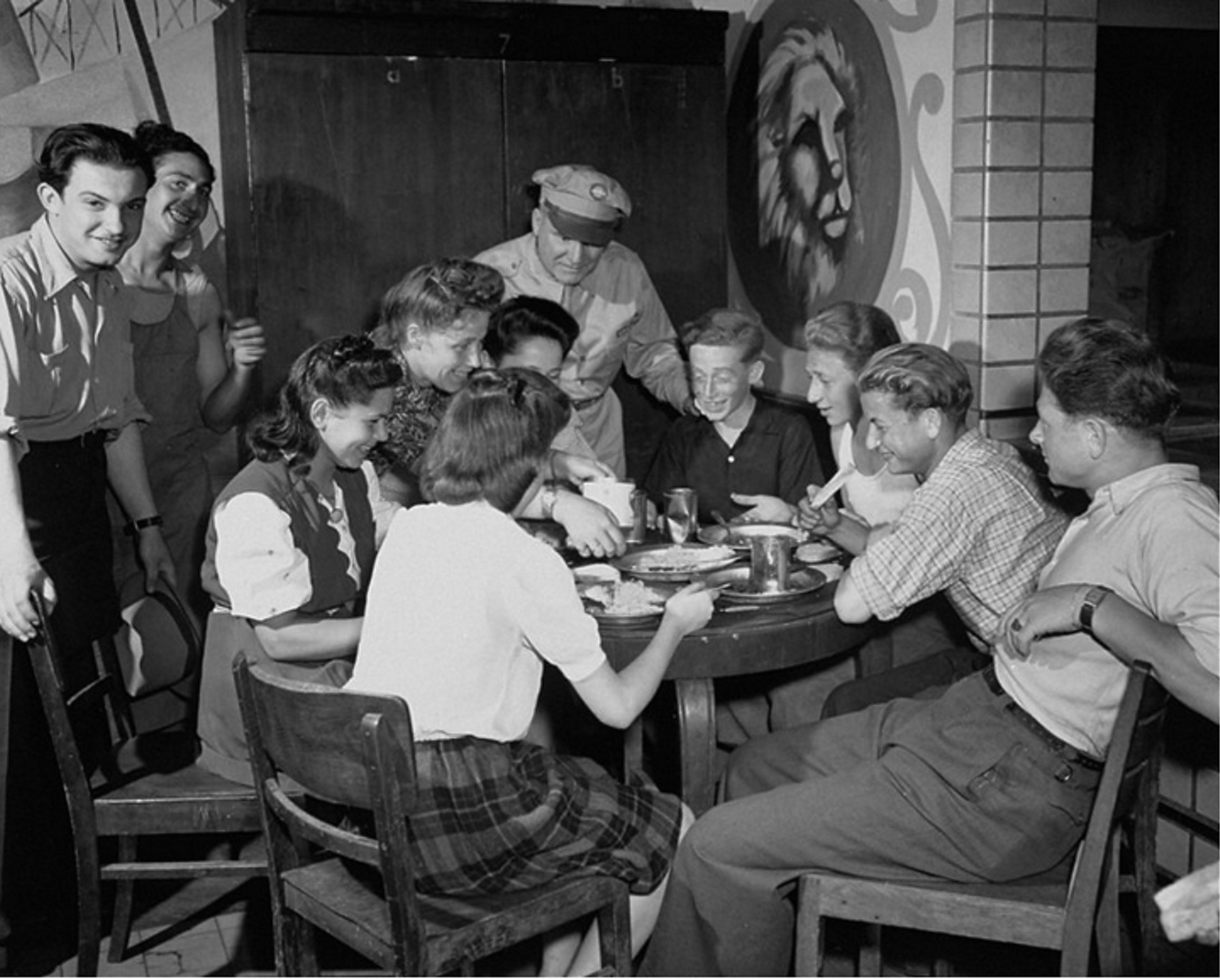
Eschwege makes that point concrete. The Museum’s history of the camp places its opening in January 1946 on a former German air force base. Residents developed schools, religious institutions, sports and theater. Their newspaper, Undzer Hofenung, meant “Our Hope.” The camp closed on 26 April 1949.
Such institutions complicate a picture of displaced people as passive recipients of aid. A newspaper allowed residents to communicate; a school organized children’s time around a future; religious and cultural life reassembled social connections that persecution had attacked. These activities were responses to loss, not evidence that the loss had been overcome.
The wider DP community also searched for missing relatives through tracing services, broadcasts and published lists. New marriages and births existed alongside uncertainty about the dead. The history of recovery has to hold those experiences together. Describing renewed communal life as a happy ending would erase the conditions in which people built it.
A camp could become a place of meaningful relationships without becoming the home its residents wanted. That tension helps explain why greater local autonomy and the demand to emigrate were compatible ambitions.
06 · The gate beyond the camp
Permission to leave was different from permission to enter
Truman’s directive of 22 December 1945 sought to facilitate immigration to the United States, but explicitly within existing quota laws. It ordered consular and immigration work near displaced-persons centers and called for coordination over transport, health examinations and financial support. It did not abolish the legal limits on admission.
That distinction reveals why sympathetic statements could coexist with prolonged waiting. To create a route out, officials had to connect several systems: documentation, eligibility decisions, sponsors, ships and the receiving country’s laws. A breakdown in any one could prevent departure even when everyone agreed that a person needed help.
The National Archives’ guide to the Displaced Persons Commission records a further institutional response in 1948, when Congress created the body to oversee selection and resettlement in the United States. Its existence three years after victory shows how far the emergency extended beyond the military timetable.
One individual chronology conveys what those years meant. The USHMM’s account accompanying Madeline Deutsch’s oral history states that she and her mother were liberated in May 1945, lived in a Munich DP camp while awaiting American visas, and reached New York in March 1949. Her later recollections describe rebuilding her education without the school records lost during the war. Arrival was another beginning, not a return to an untouched earlier life.
Three different tasks behind the word “recovery”
The crisis persisted when these tasks were treated as interchangeable. More efficient relief did not necessarily create a destination. An available train did not make return safe. A humanitarian appeal did not automatically change immigration law.
World War II’s end should therefore be measured on more than one calendar. Surrender ended military resistance. Liberation removed Nazi authority. Rebuilding a life required rights, relationships, documents and choices that could take years to recover. The history of displaced persons begins in the space between those milestones.
Sources
Contemporary official documents are read here alongside museum histories and survivor testimony. Official correspondence records policy arguments and instructions; it is not treated as a complete account of conditions in every camp.
- United States Holocaust Memorial Museum, The Harrison Report and Displaced Persons.
- German Historical Institute, German History in Documents and Images, The Harrison Report, 1945.
- Harry S. Truman Presidential Library, Truman to Eisenhower, 31 August 1945, released 29 September.
- U.S. Department of State, FRUS, 1945, volume II, Makins to Matthews, 6 October 1945.
- Harry S. Truman Presidential Library, Truman Directive, 22 December 1945.
- USHMM, Eschwege Displaced Persons Camp and Madeline Deutsch’s oral history.
- U.S. National Archives, Records of the Displaced Persons Commission (RG 278).
Photograph sources, creators where known, and public-domain records appear beneath each image.
Longer reads · Coming soon
Histovia Ebooks
Our forthcoming ebook, D-Day’s Invisible Front: The Deception Campaign Behind the Normandy Landings, explores another dimension of World War II: how intelligence, false signals and German expectations shaped the invasion’s setting. Histovia ebooks will offer a way to explore history in greater depth while supporting this blog. Purchase details will be added when the store opens.