
Wars & Conflicts
Tsushima 1905 and the Voyage That Came Before the Guns
The Russian squadron reached Tsushima after seven months at sea. Coal, exhausted crews, changing objectives and Japanese communications shaped the battle before the first salvo.
On 27 May 1905, Russian warships entered the waters between Korea and Japan after a voyage from the Baltic that had lasted more than seven months. Their destination was Vladivostok. Waiting to intercept them was Admiral Tōgō Heihachirō’s Combined Fleet. Within two days, most of the Russian force would be sunk or captured, and a naval expedition intended to reverse the course of a war would become its most decisive disaster.
The battle makes little sense if its story begins with the first salvo. Coal, repair facilities, neutral ports, exhausted crews and intelligence had been shaping the encounter long before the fleets saw each other. Tsushima was fought with guns and torpedoes, but the ability to bring usable fighting power to the battlefield had already become sharply unequal. The U.S. Naval History and Heritage Command’s published analysis places that problem of distance at the center of the campaign.
Reinforcements for a distant war
The Russo-Japanese War arose from competing imperial ambitions in Korea and Manchuria. Japan needed to move and supply armies across the sea. Russia possessed a Pacific naval force, but much of its larger navy was far away in European waters. The U.S. State Department’s historical account traces the disputes over ports, territory and influence that preceded the fighting. The contest was not an abstract duel between national fleets: command of nearby waters supported military operations on land.
Russia responded to the danger in East Asia by assembling the Second Pacific Squadron under Zinovy Rozhestvensky. It included new battleships, older vessels, cruisers and the support ships necessary for an extraordinary passage. The modern Borodino-class ships were substantial additions to Russian naval power. Their presence is a reason to resist an explanation in which obsolete machinery alone made defeat inevitable. A force can contain powerful ships and still be poorly suited to act as a coordinated fleet.
That distinction was already evident to naval observers immediately after the battle. Captain Richard Wainwright’s October 1905 examination of the encounter weighed ship characteristics against speed, training and the ability to operate together. Even contemporaries disagreed over which side was stronger “on paper.” Counting hulls or large guns did not measure the readiness of the people aboard them or the constraints imposed by the slower members of a formation.
The North Sea was dangerous before Japan was near
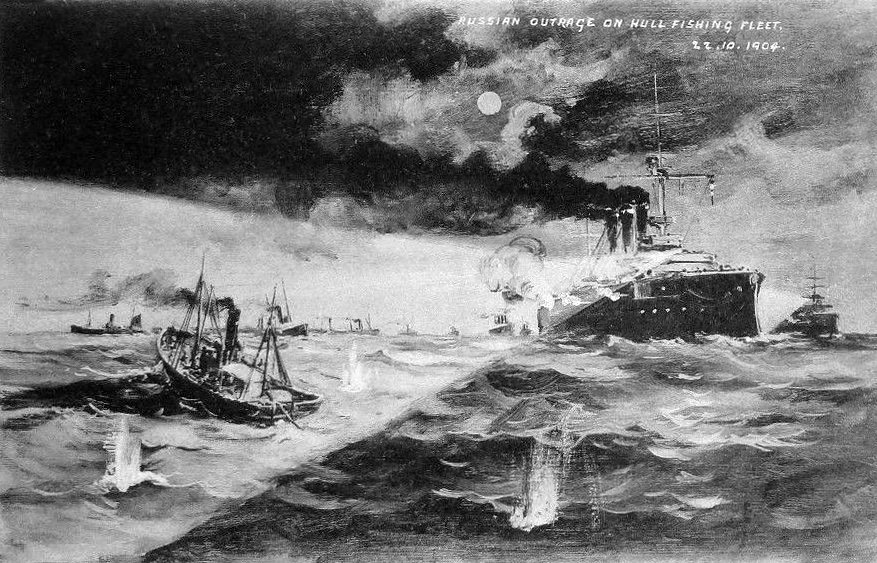
The expedition left the Baltic in October 1904 amid repeated fears of Japanese torpedo boats. On the night of 21–22 October, Russian ships fired on British fishing vessels near the Dogger Bank. Two fishermen were killed in the immediate attack, a trawler was sunk and other vessels were damaged. Here was a deadly failure of identification thousands of miles from the theater in which the fleet expected to fight.
The subsequent international inquiry preserved by the Permanent Court of Arbitration reconstructed the alarming reports that had reached the Russian admiral and assessed responsibility for the firing. Its records use the Russian calendar in some passages. The night appears as 8–9 October in Old Style dating, equivalent to 21–22 October in the Gregorian calendar used here. Keeping that difference visible prevents one incident from acquiring two contradictory dates.
The crisis threatened relations with Britain and complicated the fleet’s journey. It also demonstrated how intelligence could damage a force when warnings did not reliably distinguish real threats from imagined ones. Vigilance imposed a cost on the crews even when no enemy appeared. The Royal Museums Greenwich collection of inquiry material preserves the resulting investigation, a reminder that this episode was a civilian maritime tragedy and a diplomatic emergency before it became a notorious naval anecdote.
Coal measured the journey
A coal-burning battleship could not simply sail until the admiral chose to stop. Fuel consumption created a repeated demand for heavy physical work and access to supplies. Coal had to come aboard, be moved and stored, and then be fed into the machinery that kept the fleet going. In the early twentieth century, carrying fuel across an ocean did not solve the additional problem of transferring it to the warships that needed it.
A study by Japan’s National Institute for Defense Studies explains the logistical character of warships in this period. Coaling required ships to stop, suitable conditions and extensive manual labor. Heat, restricted living space and limited means of keeping food fresh added to the burden of tropical service. The technologies that gave battleships impressive firepower also tied them to an elaborate supporting system of workshops, stores, transport vessels and shore installations.
Rozhestvensky had no chain of Russian overseas bases along his route. The main battleship force went around Africa, while another detachment traveled through the Mediterranean and Suez Canal. The expedition depended on commercial arrangements and the uncertain hospitality of neutral powers. Arriving at an anchorage did not guarantee a proper rest or an opportunity for sustained training. The ship’s routine continued, and the labor of keeping the expedition moving competed with preparation for battle.
Shannon R. Butler’s study of the voyage, drawing on Russian participants, emphasizes accumulated fatigue and restrictive shore leave as well as Rozhestvensky’s leadership. Such testimony should not turn all Russian sailors into a single demoralized character. Experiences varied by rank and ship. It does establish that the voyage consumed human capacity, and that the admiral’s achievement in getting his force across the world was different from bringing it there ready to fight effectively.
A destination vanished along the way
Port Arthur fell on 2 January 1905, while the expedition was still far from East Asia. The Pacific force that the Russians had hoped to reinforce could no longer be rescued there. The strategic problem changed during the voyage, but the expedition continued. Vladivostok became the remaining destination around which the passage was organized.
The fleet lingered near Madagascar and later off French Indochina. Additional vessels under Rear Admiral Nikolai Nebogatov eventually joined it. Reinforcement increased the number of ships without making the formation uniform. Rozhestvensky now had to lead a mixed force through waters where Japanese scouts could locate it and where the enemy could concentrate. A modern Naval Institute reassessment of the campaign describes the earlier loss of Russia’s Pacific position and the problems of preparing the distant reinforcement.
There were other possible approaches to Vladivostok around the Japanese islands. The Tsushima passage was the direct route, but it also brought the fleet into the waters Tōgō was guarding. Choosing a longer course would have created new demands for fuel and time. The Russian commander did not possess an option that removed risk altogether. His practical task was now to bring as much of the squadron through as he could, under conditions increasingly favorable to interception.
A fleet connected to the shore
Japan’s advantage included a developed system of observation and communication. The Japan Center for Asian Historical Records’ study of Tsushima and Okinoshima draws on ship logs, communications records and shrine diaries to show information moving between vessels and land. Wireless sets worked alongside cables and observation stations. The battle’s intelligence system was a network, not a single inspired sighting.
Early on 27 May, the auxiliary cruiser Shinano Maru reported the approaching Russian ships. Further messages helped confirm their route. Tōgō’s force left its anchorage at Jinhae Bay to intercept them. Fog and rain restricted visibility, which makes the successful transmission and comparison of reports especially important. There was uncertainty on the Japanese side too; scouting reduced it enough to permit concentration at the crucial place.
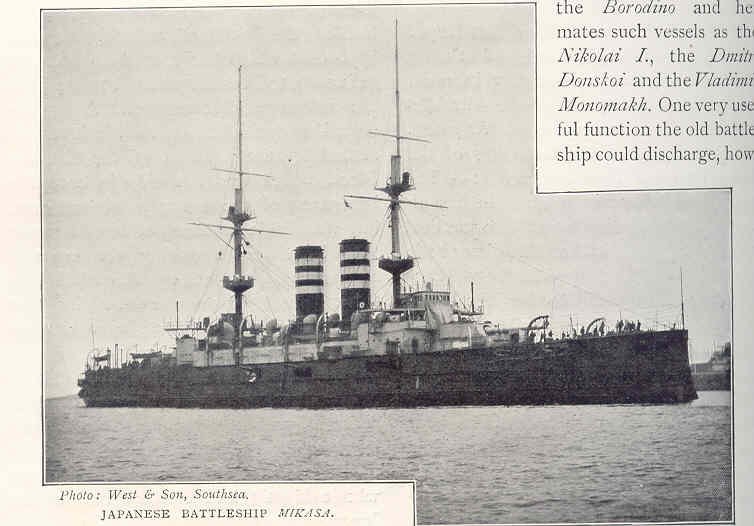
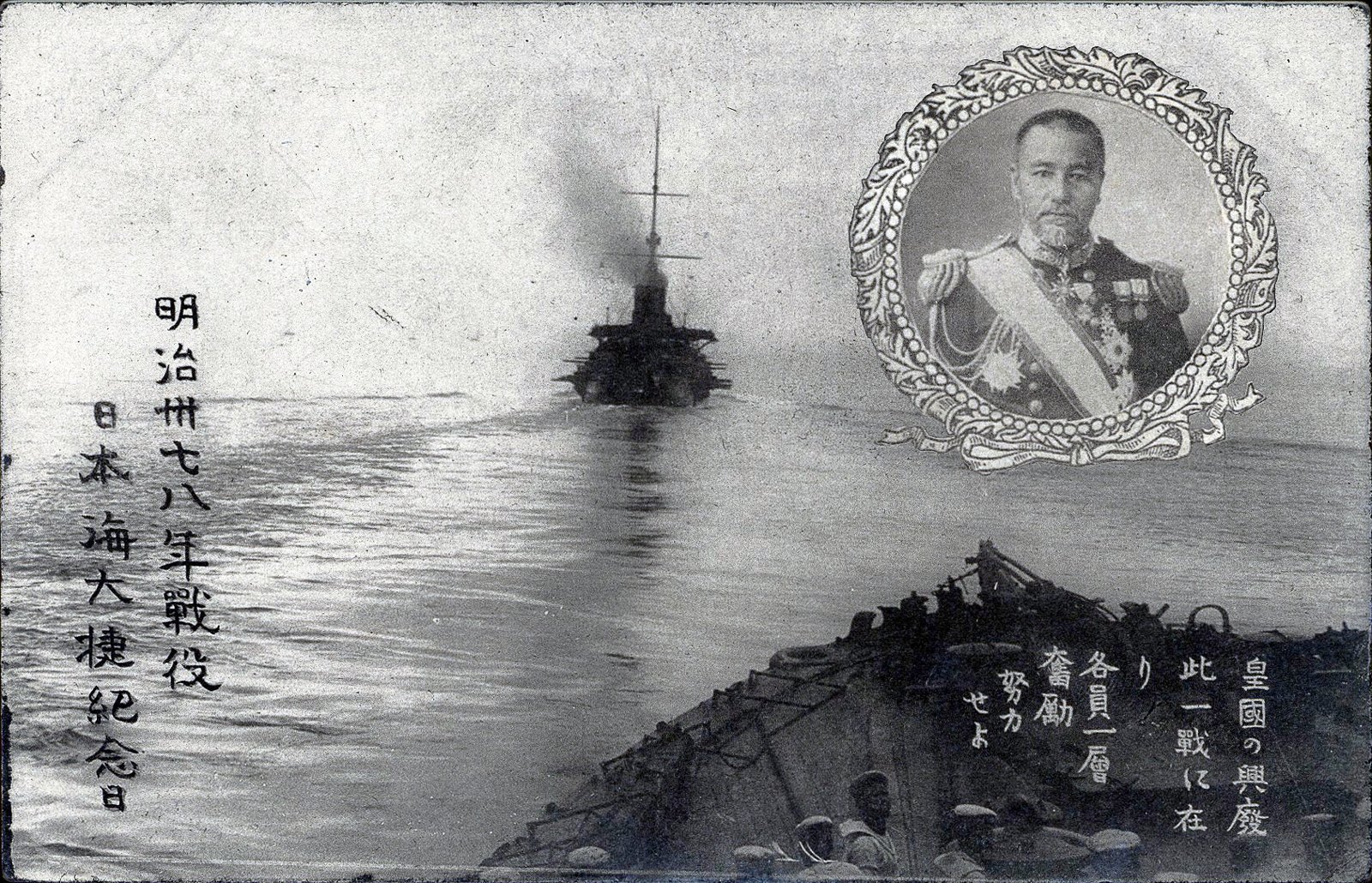
Tōgō’s professional formation also complicates any simple story of an isolated Japan defeating European technology. Royal Museums Greenwich’s account of his career notes his training in Britain and the Japanese navy’s close connections with the Royal Navy. His flagship Mikasa had been built in Britain. Japan’s achievement drew on imported ships and knowledge transformed through its own institutions, preparation and wartime experience.
The afternoon when formation broke
The main fleets engaged in the early afternoon. Tōgō maneuvered his line to bring concentrated fire against the leading Russian ships. The famous turn at the opening of the battle was important, but its consequences depended on the handling and gunnery that followed it. Russian ships fired back and struck Japanese vessels. A catastrophic result for one side does not mean the fighting was effortless for the other.
Captain Vladimir Semenoff, aboard the Russian flagship Knyaz Suvorov, left a survivor’s account describing the succession of hits, fires, casualties and disruption. It is powerful testimony precisely because it comes from a limited place inside the battle. It cannot supply an omniscient view of every ship. Smoke and damage increasingly separated the view from the flagship from the overall movement of the formation.
Oslyabya was sunk, and Suvorov was battered out of the line. Rozhestvensky was wounded and eventually removed from his disabled flagship. Other ships attempted to continue the northward movement, but a coherent fleet was becoming a collection of damaged groups. In a 1906 account based on an unnamed participant’s observations, Lieutenant R. D. White presented the difficulties of Russian awareness and tactical control. The unnamed source warrants caution, even where the detail is persuasive.
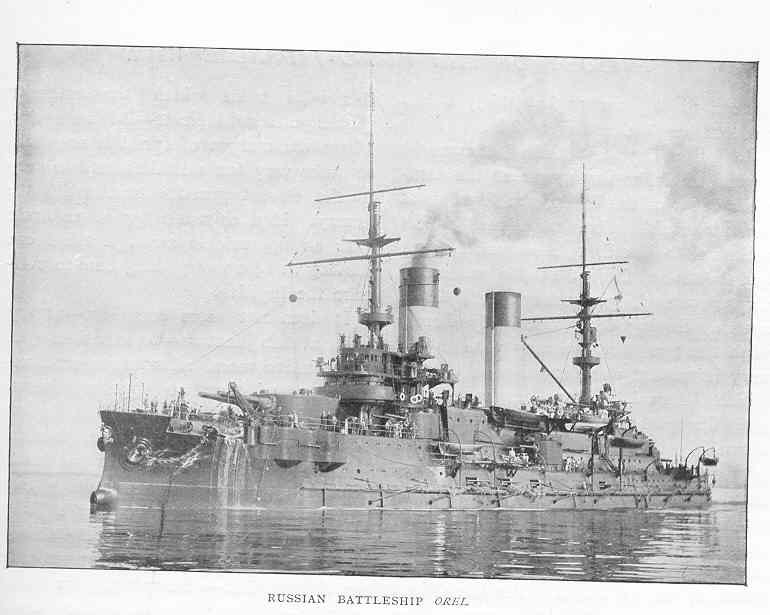
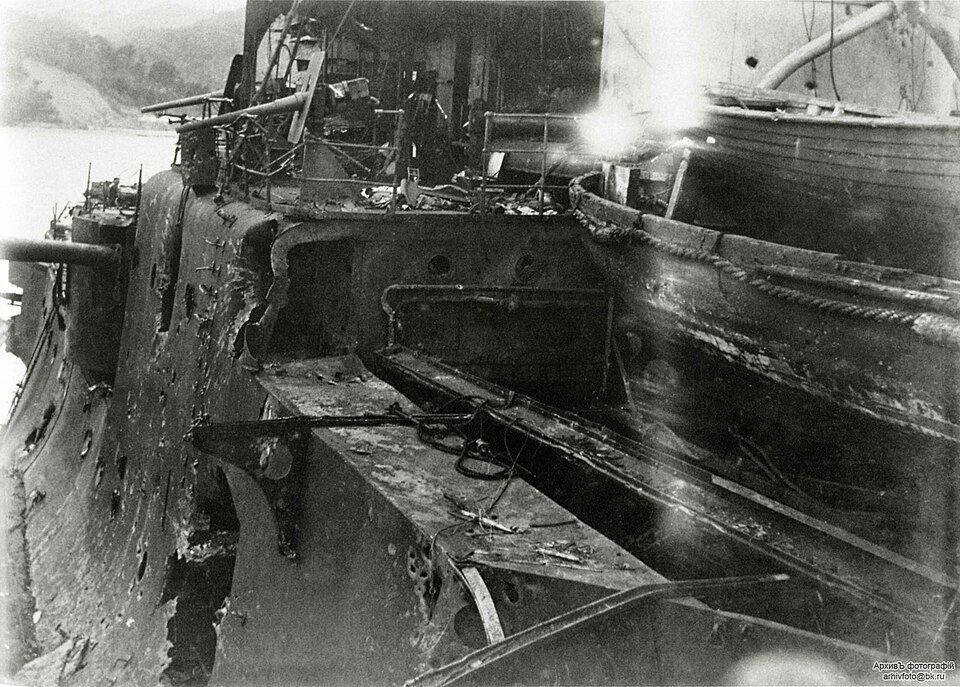
The damage affected far more than armored belts and gun barrels. Fires, broken communications, casualties among trained personnel and disrupted steering could undermine a ship’s ability to fight without immediately sinking it. Photographs of the captured Orel make this physical destruction visible. They are also a warning against reading a fleet’s theoretical capabilities as a reliable guide to what it could still do several hours into combat.
Night attacks and the morning surrender
The fighting did not end with daylight. Japanese destroyers and torpedo boats attacked the scattered Russians during the night of 27–28 May. Darkness and rough water made these attacks dangerous and confused. Contemporary reports do not always agree on individual torpedo hits or the precise sequence in which damaged ships were lost. The broad result is clearer: the surviving Russian formation fragmented further.
On 28 May, Nebogatov surrendered the ships gathered around him. Other vessels fought on, sank, were abandoned or reached neutral ports. Rozhestvensky was captured aboard a destroyer. The cruiser Almaz and two destroyers reached Vladivostok; the expedition had failed to deliver the battle fleet for which the long journey had been undertaken. Contemporary naval literature, including the 1908 discussion in Proceedings, wrestled with the interaction of formations, speed, gunnery and command rather than finding one mechanical explanation.
A decisive battle with an unsettled meaning
The Treaty of Portsmouth was signed on 5 September 1905. Its text in the U.S. diplomatic record recognized Japanese predominance in Korea, transferred Russian leasehold and railway interests in southern Manchuria under specified conditions, and ceded southern Sakhalin. Japan did not obtain the war indemnity many of its citizens expected. Naval victory strengthened its bargaining position without giving it unlimited power to dictate the peace.
The negotiations themselves took place at the Portsmouth Navy Yard, in what is now Kittery, Maine, across the river from Portsmouth. The shipyard’s history of the treaty identifies Building 86 as the site of signing. The geographical precision matters: even a universally recognized treaty name can conceal the actual location of an event.
Naval officers immediately argued over what Tsushima proved. In October 1906, William S. Sims’s essay on all-big-gun battleships challenged Alfred Thayer Mahan’s conclusions about speed, size and armament. The battle was being recruited into debates whose participants already had strong views. It influenced naval thought without furnishing a single uncontested blueprint for the future.
Tsushima’s enduring historical lesson is more demanding than a diagram of one fleet crossing another’s course. A navy’s strength rested on the condition in which its ships and crews arrived, the support they could draw upon, the information their commanders received and their ability to act together under damage. The Russian voyage brought impressive machinery across an extraordinary distance. The Japanese victory showed how much more was required to turn that machinery into effective power at sea.
Sources and further reading
- The U.S. Naval History and Heritage Command’s published analysis
- U.S. State Department’s historical account
- October 1905 examination of the encounter
- international inquiry preserved by the Permanent Court of Arbitration
- Royal Museums Greenwich collection of inquiry material
- study by Japan’s National Institute for Defense Studies
- study of the voyage
- Naval Institute reassessment of the campaign
- Japan Center for Asian Historical Records’ study of Tsushima and Okinoshima
- Royal Museums Greenwich’s account of his career
- survivor’s account
- 1906 account based on an unnamed participant’s observations
- the 1908 discussion in Proceedings
- text in the U.S. diplomatic record
- shipyard’s history of the treaty
- essay on all-big-gun battleships