
Histovia · World War II · Science & production
Making Penicillin at Scale: The Wartime Work Behind the Miracle Drug
A promising treatment could still fail if the supply ran out. Penicillin’s wartime transformation depended on laboratory teams, agricultural research, factory engineering and decisions about who received it.
By Histovia Team
On 12 February 1941, Oxford researchers began treating police officer Albert Alexander with penicillin for a severe infection. His condition improved, but the small supply available could not sustain the treatment. He died. The episode, described in Oxford University’s account of Norman Heatley, exposed a problem that a story centered only on discovery cannot explain.
Knowing that a substance might save a patient was different from having enough of it, in a reliable form, when needed. The Oxford team’s early clinical work made production a medical question. Scarcity could determine the outcome just as decisively as the substance’s antibacterial activity.
Within a few years, penicillin was being produced on an extraordinary scale. That change was not one invention enlarged. It required several problems to be solved together: cultivating productive mold, recovering a fragile drug, measuring potency, organizing factories and distributing supplies under wartime pressure.

Discovery was a beginning
Fleming found an effect; a team had to develop a medicine
Alexander Fleming observed mold inhibiting bacterial growth in 1928 and published his findings in 1929. The American Chemical Society and Royal Society of Chemistry’s landmark history traces that discovery alongside the later work needed to turn it into treatment.
The observation was foundational. It did not immediately provide a stable, purified product that could be manufactured consistently and tested in patients. The familiar image of an accidental culture dish can make those later tasks seem like routine finishing work. In practice, they were major scientific and technical obstacles.
At Oxford’s Sir William Dunn School of Pathology, Howard Florey directed a multidisciplinary effort involving Ernst Chain, Norman Heatley, Edward Abraham and colleagues. Animal experiments in 1940 preceded the clinical work of 1941. Alexander was an early Oxford patient; describing him as the first person anywhere ever to receive penicillin would make a broader claim than this history requires.
It is equally misleading to describe the period before penicillin as one in which no useful antibacterial treatment existed. Sulfonamide drugs already mattered. Penicillin’s significance lay in its own therapeutic capabilities and eventual availability, not in the erasure of everything that came before it.
The laboratory as a workplace
Apparatus, measurement and repetitive care made clinical research possible
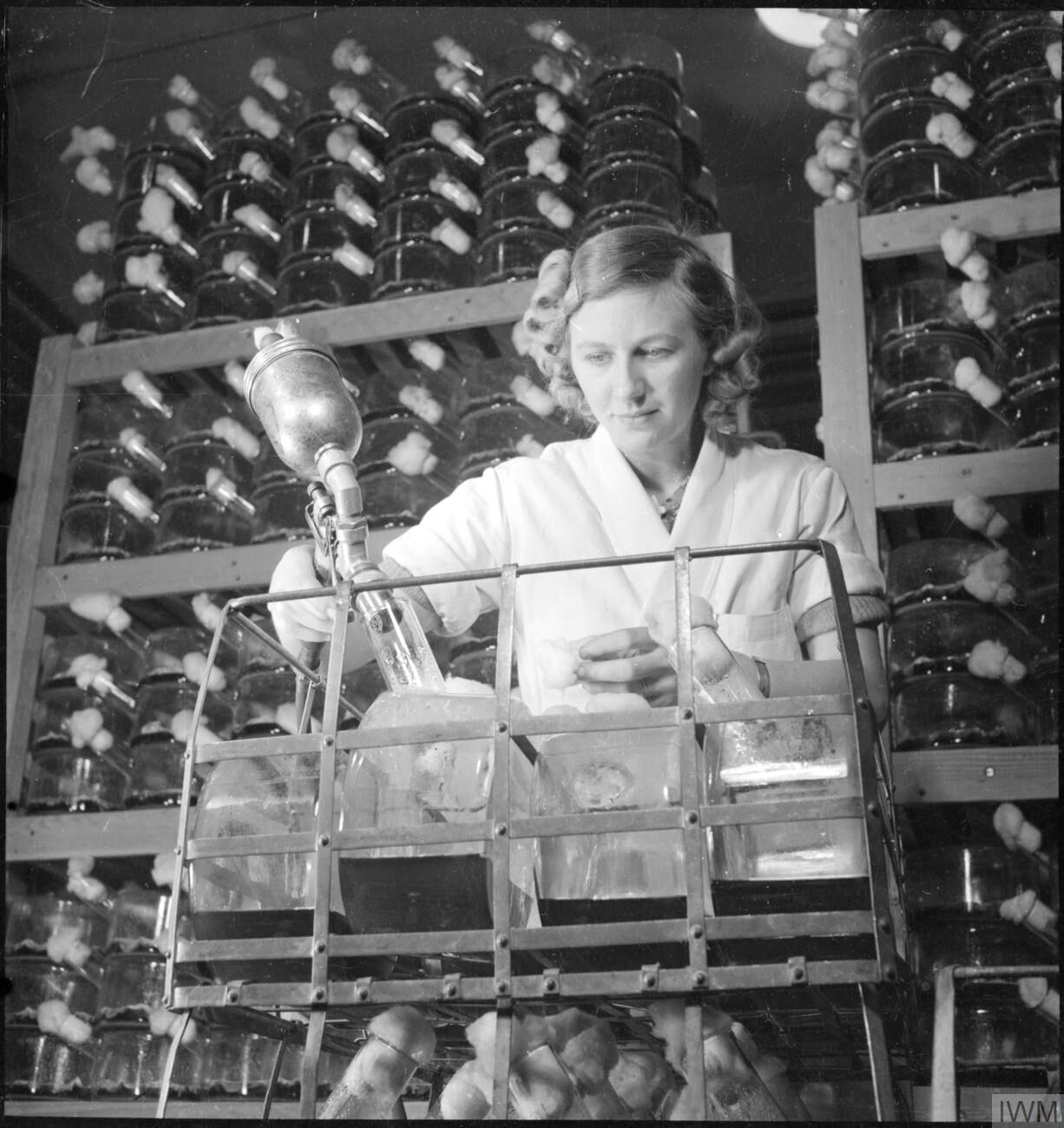
Heatley helped develop methods for measuring activity, preserving the material during processing and extracting it from large quantities of culture liquid. Purpose-designed ceramic vessels improved the practical work of cultivation. Oxford’s History of Science Museum account of production shows how much the early effort depended on apparatus and working routines.
The Museum’s “Team Penicillin” exhibition also restores people easily omitted from the three-name version of the discovery. Margaret Jennings investigated toxicity; Ethel Florey supervised clinical trials; Arthur Gordon Sanders operated extraction equipment. Six women cultivated the mold, including Ruth Callow, Claire Inayat and Betty Cooke. Their historical nickname, the “penicillin girls,” should not obscure skilled and demanding labor.
Keeping cultures productive involved repeated handling and close attention. If production failed, researchers could lose more than a batch: they could lose the material needed for the next experiment or patient. Clinical development and supply were interdependent from the start.
Credit therefore needs to follow the work. Chemical analysis, microbiology, patient observation, equipment design and routine cultivation contributed different kinds of knowledge. None alone was the finished medicine. A laboratory became capable of treating patients only when those activities could support one another.
An unexpected partner
Agricultural research in Illinois helped unlock the supply problem
In 1941, Florey and Heatley traveled to the United States seeking help with production. The partnership began before the United States entered the war. In Peoria, Illinois, the Department of Agriculture’s Northern Regional Research Laboratory brought expertise in molds and fermentation developed for agricultural and industrial purposes.
The USDA’s history of its penicillin work describes improvements in yields and the search for productive strains. Andrew Moyer and colleagues investigated nutrient media, including corn-steep liquor, a by-product of corn processing, and lactose. Heatley shared techniques with the American researchers.
The collaboration linked medical urgency to knowledge that had developed in another field. What appeared in a hospital as a shortage of drug could appear in a fermentation laboratory as a problem of organism, medium, process and recovery. That change of perspective widened the range of possible solutions.
A productive mold found on a cantaloupe from a Peoria market became part of the strain-development story. It makes a memorable episode, but it should not become another miracle replacing the Fleming anecdote. Better strains still needed suitable conditions and reliable production methods. Nor does the story establish that every wartime batch came from that one find.

From vessels to factories
A larger tank created new engineering problems
Early surface-culture production required large numbers of vessels and extensive handling. Submerged, or deep-tank, fermentation offered a way to expand output while reducing that labor. But a tank was not simply a bottle made larger.
The mold needed oxygen throughout the liquid. Agitation and aeration had to be managed alongside cooling, foaming and the risk of contamination. A failure could affect a much larger volume than in a small culture vessel. The ACS history of deep-tank fermentation explains how manufacturers adapted experience with industrial fermentation to these demands.
Pfizer’s Brooklyn plant, opened in March 1944, provides one striking example of the scale transition. It was part of a broader production effort involving firms such as Merck, Squibb, Lederle and Abbott, as well as government laboratories and British work. A company-centered account can illuminate engineering decisions without establishing that one company alone created the wartime supply.
Recovery remained a separate difficulty. A great volume of broth could contain a comparatively small amount of useful penicillin, and losses during processing mattered. Increasing cultivation output was valuable only if the active substance could then be recovered and prepared consistently.
Coghill’s April 1944 account captures the choices hidden behind the phrase “mass production.” Officials had to weigh familiar 1,000-gallon equipment against proposed 10,000-gallon tanks. Smaller tanks required many more motors, valves and agitators; larger ones put more material at risk in a process still being mastered. Continuing with surface cultures offered a different trade-off: numerous small vessels limited the damage from an individual failure but demanded substantial labor.
These were decisions made before the eventual success was secure. An engineer could not solve the whole problem by specifying the largest available vessel, and a planner could not guarantee supply by announcing an ambitious target. The production program had to balance scarce equipment, workers’ experience, acceptable losses and the time needed to learn. Reading the contemporary report makes the achievement more intelligible because it restores the alternatives and uncertainties that later celebration can hide.
Three different questions: How much culture liquid was produced? How much active penicillin could be recovered? How much usable medicine reached patients? A gain at one stage did not automatically answer the others.
The problem of making batches comparable
Potency was as important as volume
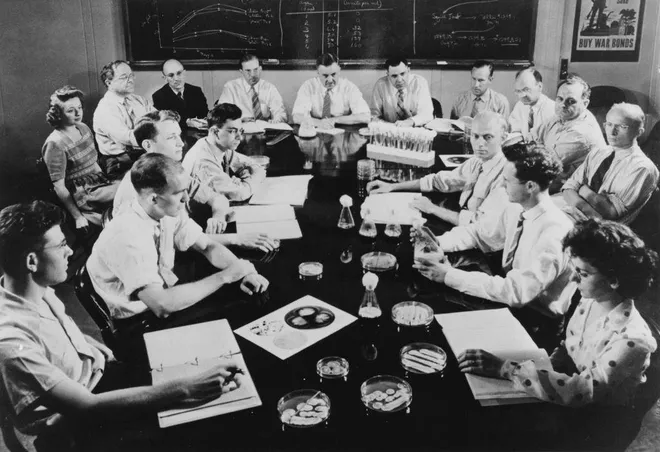
Robert D. Coghill, head of the Peoria laboratory’s fermentation division, described the developing system in an address delivered in April 1944. His account is especially useful because it was written while production was still being expanded. It discusses assays, standards, contamination, scale and allocation as linked problems.
An assay measured biological activity, allowing preparations from different sources to be compared. Without a shared way to assess potency, reporting a quantity of liquid or material would tell clinicians too little. Reference standards made the language of production more meaningful.
That is why wartime output figures are expressed in units of activity. A unit is not a vial, a patient or a complete course of treatment. The ACS landmark history reports U.S. output of about 21 billion units in 1943 and 1,663 billion in 1944. The comparison conveys the expansion, but those numbers cannot simply be relabeled as doses or lives saved.
Coghill’s report is also a participant’s source. It records how a government scientist explained a collective effort in progress. Its technical and institutional detail is valuable, while its broad contemporary medical claims should not be treated as present-day clinical guidance.
Coordination under pressure
Government support did not remove competition
Alfred N. Richards and the Committee on Medical Research within the U.S. Office of Scientific Research and Development helped organize clinical investigation and cooperation. By 1943, the War Production Board was coordinating expansion and access to scarce construction materials. Factories needed steel, equipment and labor in an economy already committed to war.
A WIPO economic-history working paper on wartime medical innovation examines how public agencies and private firms interacted. Cooperation existed alongside concern about patents, antitrust rules, sharing information and the return on investment. Companies committed substantial resources of their own.
The resulting system was neither a lone entrepreneur’s achievement nor a frictionless government project. Public coordination could set priorities and connect organizations; firms and laboratories still had to decide what to disclose, develop and build. Wartime urgency did not erase the incentives or uncertainty involved.
Scarcity also made distribution a difficult administrative matter. Chester Keefer coordinated civilian clinical access while military demand absorbed much of the supply. Coghill’s contemporary account makes clear that expanding production and deciding who could receive it were simultaneous tasks.
The breakthrough was reliable supply
By the Normandy campaign in 1944, Allied medical services could use penicillin on a scale that had been impossible during the early Oxford trials. It did not treat every infection or eliminate the need for surgery, nursing and other care. Its contribution depended on identifying suitable cases and having medicine available when treatment required it.
Wider civilian access followed at different times. The ACS history dates the lifting of U.S. civilian distribution restrictions to 15 March 1945 and general prescription availability in Britain to 1 June 1946. The transition from scarce experimental material to ordinary medical supply continued beyond the battlefield timetable.
The 1945 Nobel Prize was shared by Fleming, Florey and Chain. That recognition captured important contributions without naming everyone responsible for the transformation. Heatley, the culture workers, other researchers, engineers and factory staff belonged to the same history even though they did not appear in the three-person award.
Penicillin’s wartime story is therefore about how knowledge becomes dependable. Discovery made a possibility visible. Clinical work tested it. Fermentation and recovery made material available; assays made batches comparable; organization connected production to use. The medicine’s promise became more widely realizable when those systems could keep working, rather than when one celebrated moment occurred.
Sources
This is a history of research and production, not a treatment guide. Contemporary accounts are read alongside institutional histories; company-specific accounts are balanced with public-laboratory and economic-history sources.
- American Chemical Society / Royal Society of Chemistry, Discovery and Development of Penicillin.
- American Chemical Society, Deep-Tank Fermentation and Penicillin.
- University of Oxford, Norman Heatley: the unassuming penicillin pioneer.
- Oxford History of Science Museum, Team Penicillin and Production.
- USDA Agricultural Research Service, Penicillin: Opening the Era of Antibiotics.
- Robert D. Coghill, The Background of Penicillin Production, address to the American Chemical Society, 5 April 1944.
- WIPO, Second World War and the Direction of Medical Innovation, Economic Research Working Paper 70, especially section 4.1.
Photograph creators, dates and public-domain rights records appear beneath the images. Sources checked October 2026.
Further reading from Histovia
D-Day’s Invisible Front
For readers interested in another part of the wartime Allied effort, this illustrated ebook follows the deception campaign behind the Normandy landings and the evidence for its effects.
US$3.90 · PDF + EPUB · By Histovia Team