
Ancient History · Rome
The Birth of the
Roman Republic
How the overthrow of a tyrant king gave rise to a governing experiment that would shape the entire Western world — and endure for five centuries.
Chapter I
A City Born of Myth and Blood
Long before Rome became the master of the Mediterranean, it was a muddy cluster of hilltop villages overlooking a ford on the Tiber River. Roman tradition dated the city’s founding to 753 BC, crediting a pair of wolf-suckled twins — Romulus and Remus — with laying its sacred boundaries. Romulus, having killed his brother in a dispute over those very boundaries, ruled as Rome’s first king. He was followed by six more monarchs in succession, each shaping the nascent city’s character: from the devout Numa Pompilius, who organized Roman religion, to the ambitious Servius Tullius, who restructured Roman society into its first census-based classes.
For nearly two and a half centuries, Rome was a monarchy. Kings led armies, administered justice, and presided over religious rites. The Senate — a council of elders drawn from the city’s leading families — advised them, but ultimate authority rested with the crown. This arrangement was not, by ancient standards, remarkable. Kingdoms were the normal form of government throughout the ancient world, from Egypt’s pharaohs to the city-states of Greece. What made Rome exceptional was not that it had kings, but what it chose to do when kingship proved intolerable.

The Capitoline She-Wolf nursing Romulus and Remus — Rome’s most enduring founding symbol. Capitoline Museums, Rome.
The city grew steadily under its kings, absorbing neighboring Latin communities and establishing dominance over much of central Italy. By the sixth century BC, Rome had become a significant regional power, boasting a proper Forum, temples of impressive scale, and a population that may have reached 35,000 souls. The Etruscans, a sophisticated civilization to the north, exerted strong cultural influence on Rome during this period, leaving lasting marks on art, architecture, religious practice, and the institution of kingship itself.

Chapter II
Tarquinius Superbus — The Proud King
The seventh and final king of Rome was Lucius Tarquinius Superbus — “Tarquin the Proud.” His very epithet tells us what the Romans thought of him: a man consumed by arrogance, contemptuous of tradition, and deaf to the counsel of his Senate. According to ancient sources, he seized power through treachery and violence, murdering his father-in-law, the popular King Servius Tullius, and claiming the throne without the customary ratification of Senate and people. This violation of constitutional norms, even in an age of monarchy, was taken as a serious transgression.
Tarquin ruled through fear. He executed senators he suspected of disloyalty, abolished the right of citizens to appeal to the king, and made himself the sole judge of capital cases — removing traditional checks that had moderated Roman royal power. The historian Livy, writing centuries later, describes him as a tyrant in the Greek sense: a ruler who placed himself above law, tradition, and the welfare of the community. Unlike his predecessors, Tarquin never consulted the Senate on matters of war, peace, or treaty. He treated Rome’s allies with contempt and enriched himself through forced labor, compelling Roman citizens to work on his building projects as if they were slaves.
He maintained his power not by the affection of his subjects but by terror; he ruled surrounded by armed guards, for he knew that he could not be safe unless he was feared.
— Livy, Ab Urbe Condita, Book IYet even tyrants can be effective rulers in some respects. Tarquin was a capable military commander who expanded Roman territory significantly. He oversaw the completion of the great Temple of Jupiter Optimus Maximus on the Capitoline Hill — a monument that would remain Rome’s most sacred religious site for centuries. His Etruscan connections brought wealth and artistic sophistication to Rome. But the manner in which he exercised power — the suspicion, the violence, the contempt for peers — planted the seeds of his destruction.
The Crime of Sextus Tarquinius
The immediate trigger for the revolution was not a political act but a personal outrage. Around 509 BC, Sextus Tarquinius, the king’s son, assaulted Lucretia — the wife of a kinsman, a woman celebrated throughout Rome for her virtue and honor. The assault struck at the heart of Roman aristocratic values, which placed enormous emphasis on feminine chastity as a measure of family honor and social standing.
Lucretia summoned her father and husband, described what had happened with unflinching clarity, demanded that they avenge the wrong done to her, and then took her own life with a dagger — an act that Romans would remember for centuries as the ultimate affirmation of Roman virtue over dishonor. Her death transformed a private crime into a public outrage. Lucretia became a martyr; her story became a catalyst.

Tarquinius Superbus — painted by Lawrence Alma-Tadema. Rome’s last king is remembered as a byword for tyranny and contempt for law.
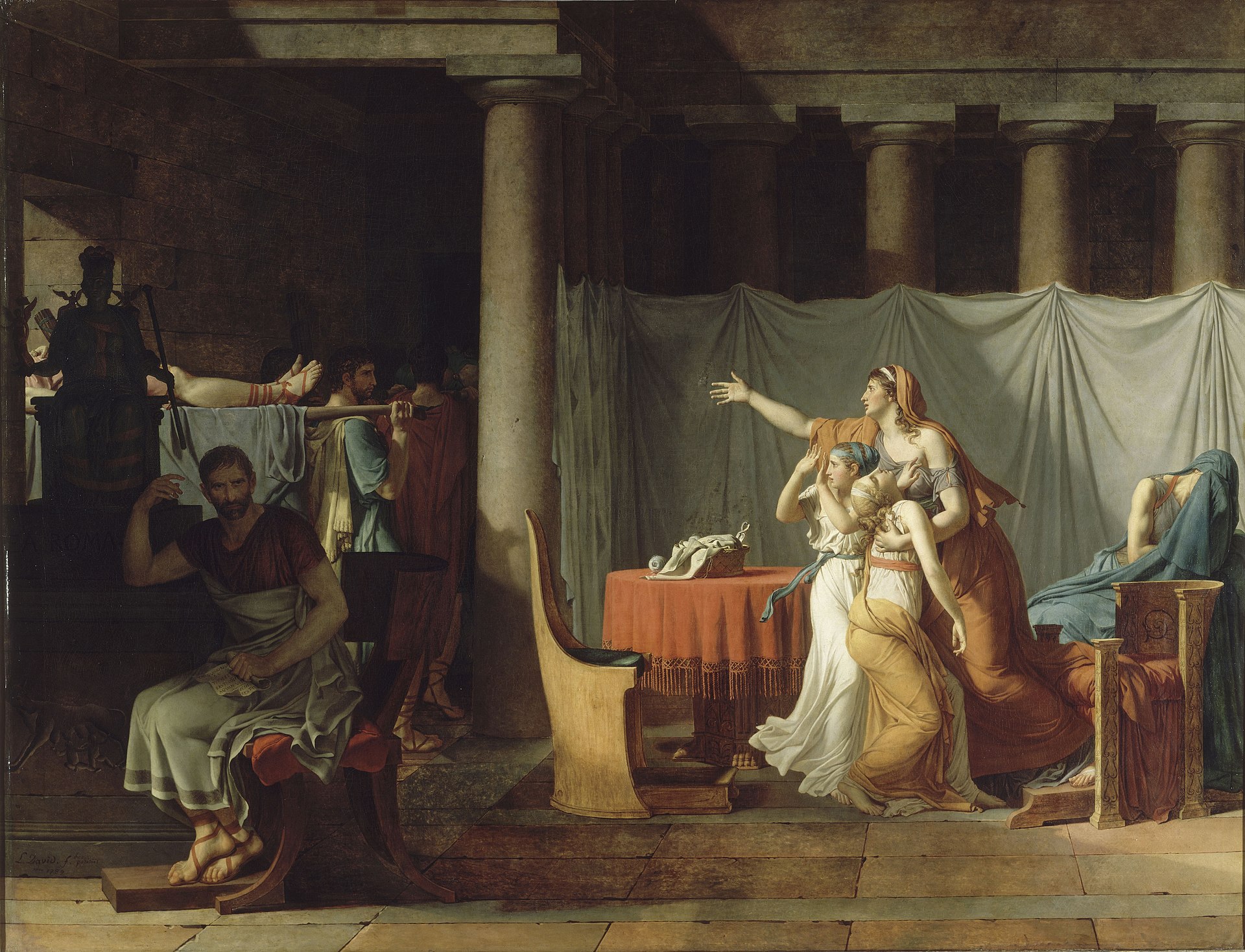
Jacques-Louis David, Lictors Bring to Brutus the Bodies of His Sons (1789) — a meditation on republican virtue and its terrible cost.
Chapter III
The Revolution of 509 BC
Lucius Junius Brutus carried Lucretia’s body into the Roman Forum and displayed it before an assembled crowd. Brutus had spent years concealing his intelligence behind a mask of foolishness — his name, “Brutus,” itself means “dull-witted” — precisely because survival under Tarquin demanded such camouflage. Now he cast the mask aside. Standing before the assembled Romans, he delivered an oration cataloguing the tyranny of Tarquin’s reign: the murder of Servius Tullius, the contempt for the Senate, the burden of forced labor, and finally the violation of Lucretia. He appealed to Roman pride, to their sense of dignity, to the memory of a freer past.
The response was electric. Rome’s citizens voted to expel Tarquin and his family, abolish the monarchy, and never again allow a single man to hold the title of king. Rex — “king” — became one of the most despised words in the Latin language. Even centuries later, when Julius Caesar was assassinated in 44 BC, one of the charges whispered against him was that he intended to make himself king. The stigma planted in 509 BC never fully faded.
Tarquin, absent from the city on campaign, found the gates of Rome barred against him when he returned. He appealed to Rome’s Latin allies, raised an army, and fought a series of engagements against the new republic, but he could not retake the city. He eventually died in exile at Cumae in southern Italy — a broken old man, stripped of everything — while Rome went on to build an empire.
From this year Rome began to have annually elected magistrates and annually limited powers, for it was above all the love of freedom that prevented them from ever enduring a king again.
— Livy, Ab Urbe Condita, Book IIThe Principal Actors
Architects of the Republic
History turns on individuals. These are the men and women whose actions — noble, desperate, or treacherous — brought the Roman Republic into being.
Lucius Junius Brutus
First Consul of Rome · Liberator
The architect of the revolution. After years feigning idiocy to survive under Tarquin, Brutus used Lucretia’s death as the catalyst to rouse Rome. He became one of the first two consuls and personally presided over the execution of his own sons when they were found conspiring to restore the king.
Lucretia
Noblewoman · Catalyst of the Revolution
A victim who became Rome’s most powerful political symbol. By choosing death over dishonor, Lucretia transformed a personal crime into a moral indictment of Tarquin’s entire regime. She was commemorated in Roman art and literature for centuries as the embodiment of republican virtue.
L. Tarquinius Collatinus
First Consul of Rome
Husband of Lucretia and co-founder of the Republic. His very name — Tarquinius — later became a political liability: suspicious Romans pressured him to resign and go into exile, preferring that no member of the hated dynasty hold office, however innocent.
Publius Valerius Publicola
Consul · Constitutional Architect
After Collatinus’s resignation, Publicola became the constitutional architect of the early Republic, codifying the right of citizens to appeal capital sentences to the popular assembly (provocatio ad populum) — a bedrock protection against tyranny that would endure for centuries.
Chapter IV
Building a Republic: The Architecture of Shared Power
The Romans did not simply abolish the monarchy and improvise from there. They had thought deeply about what had gone wrong, and they constructed their new system with specific safeguards against the tyranny they had experienced. The most fundamental principle was the division of power. Rather than concentrating authority in one man, supreme executive power — the imperium — would be shared between two officials of equal rank, elected annually by the citizen assembly. These were the consuls, and their annual election, their equality of power, and their brief tenure formed the triple bulwark against the return of one-man rule.
The Genius of Collegiality and Annual Terms
Each consul held a veto over the actions of the other — a principle the Romans called intercessio. If one consul wished to do something the other opposed, the second could simply say “veto” (Latin: “I forbid”) and block the action entirely. This meant that ambition, to be successful, had to be tempered by negotiation and consensus. No consul could bulldoze his will through without at least the acquiescence of his equal. Combined with the strictly enforced annual term — after twelve months, both consuls became private citizens again, subject to prosecution for any abuses — this created powerful incentives against overreach.
The Romans also retained and elevated the Senate, transforming it from a purely advisory body into the dominant institution of Republican governance. The Senate controlled Rome’s finances, directed foreign policy, assigned military commands, and provided the continuity that the annually rotating consuls could not. While senators did not technically have the power to make law — that belonged to the popular assemblies — their authority in practice was immense. Senatus consultum, a “recommendation” of the Senate, carried the weight of law through almost all of the Republican period.

Cesare Maccari’s fresco Cicero Denounces Catiline (1888) captures the Senate in session — the supreme deliberative body of the Roman Republic, whose authority held Rome together for five centuries.
The Fasces: Symbol of Republican Power
Roman magistrates were accompanied by attendants called lictors, each carrying a bundle of elm or birch rods bound together around an axe: the fasces. The symbolism was precise and deliberate. The rods represented the magistrate’s power to inflict corporal punishment; the axe represented the power of capital punishment. But their binding together into a bundle expressed the idea that Roman power was collective, disciplined, and institutional rather than personal. Outside Rome’s sacred boundary (the pomerium), the axes were included; within it, they were removed — a reminder that even supreme magistrates were constrained by law within the city itself.
The Roman Republic at a Glance
- Founded509 BC, following the expulsion of Tarquinius Superbus
- Duration482 years, until the principate of Augustus (27 BC)
- ExecutiveTwo annually elected consuls with equal power and mutual veto
- LegislatureMultiple popular assemblies (Comitia Centuriata, Comitia Tributa)
- Senate300 lifetime members from patrician — later also plebeian — aristocracy
- CurrencyAes grave bronze coins; later the silver denarius (from c. 211 BC)
- MottoSenatus Populusque Romanus (SPQR) — “The Senate and People of Rome”
- TerritoryInitially c. 900 km²; grew to encompass the entire Mediterranean world
Chapter V
A Republic for Whom? The Struggle of the Orders
The Republic of 509 BC was, in modern terms, an oligarchy of the wellborn. Rome’s society was divided into two hereditary classes: the patricians (from patres, “fathers”) — a small number of ancient, wealthy clans who monopolized political, religious, and social power — and the plebeians, everyone else, who comprised the vast majority of Rome’s free citizens. When the kings were expelled, the patricians moved swiftly to consolidate their grip on the new system. The consuls were invariably patrician. The great priestly colleges were patrician. The legal knowledge that governed Roman courts was a patrician monopoly, jealously guarded.
The plebeians were not without resources, however. They served in Rome’s armies, paid its taxes, and labored on its public works. Without them, Rome could not function. Beginning in the early fifth century BC, the plebeians began to organize, pressing their demands through increasingly dramatic means. The most radical was the secessio plebis — the “secession of the plebs” — in which Rome’s common citizens physically withdrew from the city and threatened to found a city of their own. Deprived of workers, soldiers, and tax-payers, the patricians were forced to negotiate.
The Twelve Tables: Law Written in Stone
One of the most consequential plebeian demands was the codification and publication of Rome’s laws. Until around 451 BC, Roman law existed as an oral tradition known only to patrician priests and magistrates — an arrangement that gave patricians enormous advantages in legal disputes. After sustained plebeian agitation, a commission of ten men (decemviri) was appointed to write down Rome’s laws in a fixed, public form. The result was the Twelve Tables, engraved on bronze tablets and displayed in the Roman Forum for all to read.
The Twelve Tables were not a liberal document by modern standards — they codified the death penalty for writing seditious songs, and treated debt in ways that could reduce a man to something approaching slavery. But their very existence was revolutionary: law was now a public text, binding on all, including magistrates. No patrician could invent legal principles on the spot to disadvantage a plebeian opponent. Roman jurists of the classical period referred back to them as the origin of all subsequent legal development.

The Twelve Tables — Rome’s first written legal code (c. 451–450 BC). Their public display in the Forum was a landmark victory for plebeian rights and the rule of law over aristocratic discretion.
Key Milestones
The Early Republic: A Century of Transformation
509 BC
The Republic is Founded
Tarquinius Superbus is expelled. Brutus and Collatinus are elected as the first two consuls. The Senate is expanded to 300 members. The monarchy is abolished, never to return.
508 BC
The Battle of the Janiculum
Tarquin, aided by the Etruscan king Lars Porsenna, marches on Rome. The legendary Horatius Cocles holds the Sublician Bridge alone while it is destroyed behind him, saving Rome from capture.
494 BC
The First Secession of the Plebs
Rome’s common citizens withdraw to the Sacred Mount, refusing to serve in the army. In response, the patricians agree to create the tribuni plebis — tribunes of the plebs — who hold the power to veto actions harmful to plebeian citizens.
451–450 BC
The Twelve Tables Published
Rome’s first written legal code is codified and displayed in the Forum. For the first time, Roman law is a public text accessible to all citizens regardless of birth — a foundational moment in Western legal history.
445 BC
The Canuleian Law
Tribune Gaius Canuleius succeeds in legalizing marriage between patricians and plebeians — a privilege previously forbidden. The social wall between the orders begins, slowly, to crack.
367 BC
The Licinian-Sextian Laws
Plebeians finally win the right to hold the consulship. One consul must henceforth be plebeian — a transformation of the Republic’s fundamental character from aristocratic oligarchy toward broader civic participation.
Chapter VI
Legacy: The Idea That Changed the World
The Roman Republic endured, in recognizable form, for nearly five centuries — from 509 BC until the reforms of Augustus transformed it into the Principate after 27 BC. During that time it survived Gallic invasion, Carthaginian devastation, devastating civil wars, and the strains of governing an empire that stretched from Britain to Mesopotamia. Its institutions bent, flexed, and sometimes broke under these pressures, but the core idea — that government derives its authority from the community it serves, that power must be divided and checked, and that law applies to rulers as well as ruled — proved remarkably durable.

Bust of Cicero (106–43 BC), Capitoline Museums, Rome. Rome’s greatest orator and the Republic’s most eloquent defender, whose writings on republican theory the American Founders studied carefully.
The Roman Republic’s influence on subsequent political thought is almost impossible to overstate. When Cicero wrote his great treatises on the ideal state, he took Rome’s republican institutions as both model and starting point. When Renaissance humanists rediscovered classical antiquity, the Roman Republic became their template for civic virtue and good government. When the American Founders sat down in Philadelphia in 1787 to design a new government, they were explicitly and self-consciously looking at Rome: the Senate, the separation of powers, the concept of res publica — public affairs belonging to the public — all flowed directly from the republican tradition born in 509 BC.
Even the word “republic” is Latin: res publica, “the public thing.” It encodes an idea — that the state is not the private property of a king or dynasty, but a shared enterprise belonging to its citizens — that the Romans were perhaps the first people in history to institutionalize at scale. Across twenty-six centuries, through monarchies and tyrannies and totalitarian states, that idea has survived as a persistent, subversive challenge to those who would claim power as their personal birthright.
The Roman Republic gave the world not merely a form of government but a language for talking about government — a vocabulary of citizenship, law, representation, and accountability that we are still using today.
— Modern Scholarship on Republican RomeRome’s republican experiment ultimately failed, consumed by the contradictions of governing a world empire through institutions designed for a city-state. The civil wars of the first century BC — Sulla, Marius, Caesar, Antony, Octavian — were symptoms of a system strained beyond its design limits. But even in failure, the Republic left a template that later ages would return to again and again, trying to recapture the balance, the accountability, and the civic spirit that Romans had briefly achieved on the banks of the Tiber.
The expulsion of Tarquin was an act of revolutionary courage by a community that decided it was worth risking war and chaos rather than accepting despotism. In that moment — a woman’s death, a body carried into a forum, a speech delivered in anger and grief — the Romans planted a seed whose roots would reach across millennia to touch every modern democracy on earth. That is no small thing for a single morning in 509 BC.
Senatus Populusque Romanus
The Senate and People of Rome — four words that encapsulated a revolutionary idea: that sovereignty belongs not to a monarch but to a community. This motto, stamped on Roman standards and carved into Roman monuments, was the Republic’s declaration of identity, its founding creed, its daily reminder of why Tarquin had been expelled and must never return.
It is still inscribed on manhole covers, public buildings, and official documents in modern Rome — a thread connecting the eternal city to the morning, twenty-six centuries ago, when its citizens decided that they were worth more than a tyrant would admit.